
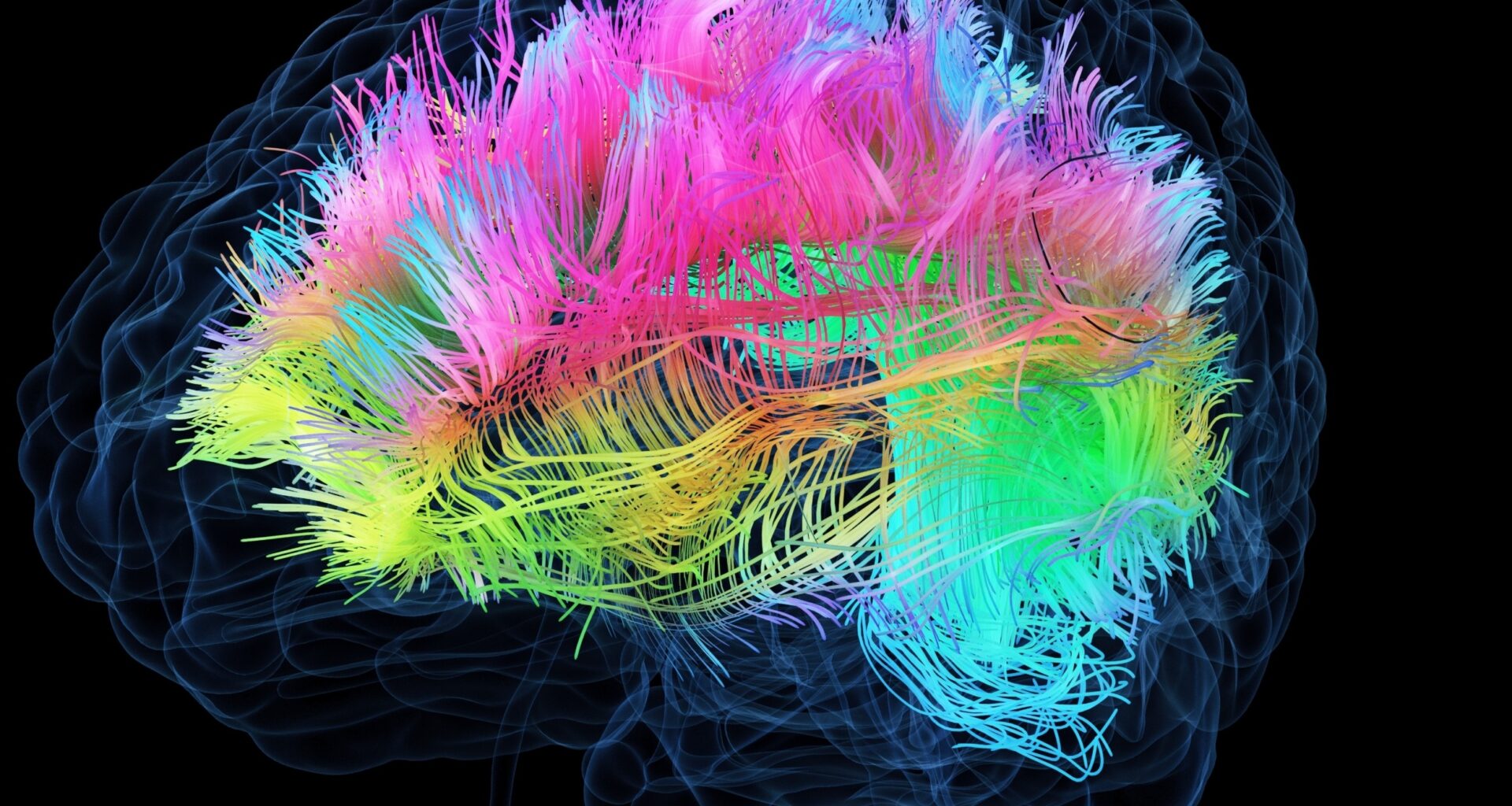
Researchers have found that imagination relies most strongly on higher-level brain systems that organize meaning – not on early sensory regions alone.
The finding reframes imagination as a process that builds complete internal experiences rather than replaying fragments of sight or sound.
Inside detailed brain scans

Across more than 60 hours of detailed brain scans, imagination consistently aligned with regions that handle scenes, language, and events as integrated wholes.
Mapping those patterns, Rodrigo Braga at Northwestern University Feinberg School of Medicine showed that imagined experiences overlapped with perception after raw sensation had already been transformed into meaning.
That overlap appeared in the same association areas regardless of whether participants imagined scenes or inner speech, indicating a shared stage of processing.
Early sensory regions still contributed, but their limited role pointed to a broader system that assembles experience before it is used for planning or understanding.
Why replay struggles
For years, many scientists treated mental imagery as sensory reinstatement, the idea that the brain reactivates sensory areas without outside input.
Earlier experiments had already shown that imagined faces and places can stir some of the same visual regions as real ones.
Natural scenes and inner speech asked more of the mind, though, because they carry context, narrative and expectation all at once.
“Our study doesn’t refute sensory reinstatement theory, but it does suggest we need to refine it,” said Braga.
Imagination and stored experiences
When volunteers imagined a castle on a hill or a birthday party, scene-building leaned on a broad internal system.
Earlier work linked the default network, a set of regions active during internally directed thought, to memories and future plans.
In Braga’s scans, that network coordinated with the hippocampus, a key memory structure, when imagined scenes pulled together place, time, and detail.
That pattern fit the idea that rich imagination draws on stored experience, then rearranges it into something useful, not mere echo.
Imagined conversations feel like events
Inner speech did not ride the same circuitry as scenes, even when both kinds of imagination felt vivid and detailed.
A recent paper showed that the language network, a distributed system for speech and reading, responds across auditory and visual input.
“When you ask someone to imagine the sound of a kid’s birthday party, they don’t just hear it – they also automatically picture the scene,” said Braga.
That blend of inner sound and scene helps explain why imagined conversations feel like events, not detached scraps of audio.
Vividness leaves marks
After leaving the scanner, participants described what they had experienced, giving the researchers a direct link between feeling and brain activity.
Higher activity in those association regions rose with reported vividness, so stronger images and clearer inner sounds left a stronger mark.
Eight people returned for eight separate sessions, a demanding design that let each person’s own patterns stand out clearly.
That mattered because imagination varies from moment to moment, and averaging everyone together can wash out what it feels like.
Beyond the sensory cortex
Traditional brain studies often blur neighboring networks together, especially when they average many people into one shared map.
Working one person at a time, the team used precision functional MRI, a scan that tracks activity through blood flow.
That approach exposed borders between nearby systems that older group-averaged maps can smear into one blurry pattern.
The cleaner view helps explain why earlier studies could point to sensory cortex and still miss where richer imagination mostly lives.
Networks that support human thought
Beyond this experiment, the same high-level regions have drawn attention because they expanded strongly over human evolution.
A 2019 analysis found higher-order cognitive networks expanded more than primary sensory networks in humans compared with chimpanzees.
“These association areas are particularly interesting because they are greatly expanded in the human brain compared to our close evolutionary ancestors,” said Braga.
That link does not prove imagination caused the expansion, but it strengthens the case that these networks support human thought.
Future research directions
Seeing imagination as a meaning-rich process changes where scientists may look when inner experience goes wrong.
That frame may matter for future work on disorders that blur inner events with outside ones.
Memory, planning and inner dialogue also sit closer together in this picture, because the same networks help build all three.
Even so, the study stopped short of disease claims, and it only mapped healthy volunteers performing carefully guided tasks.
Imagination in this account begins where the brain organizes meaning, linking sights, sounds, language and memory into a usable inner event.
Future work can test whether other forms of mental imagery, from music to fear, follow the same route or branch elsewhere.
The study is published in the journal Neuron.
—–
Like what you read? Subscribe to our newsletter for engaging articles, exclusive content, and the latest updates.
Check us out on EarthSnap, a free app brought to you by Eric Ralls and Earth.com.
—–