
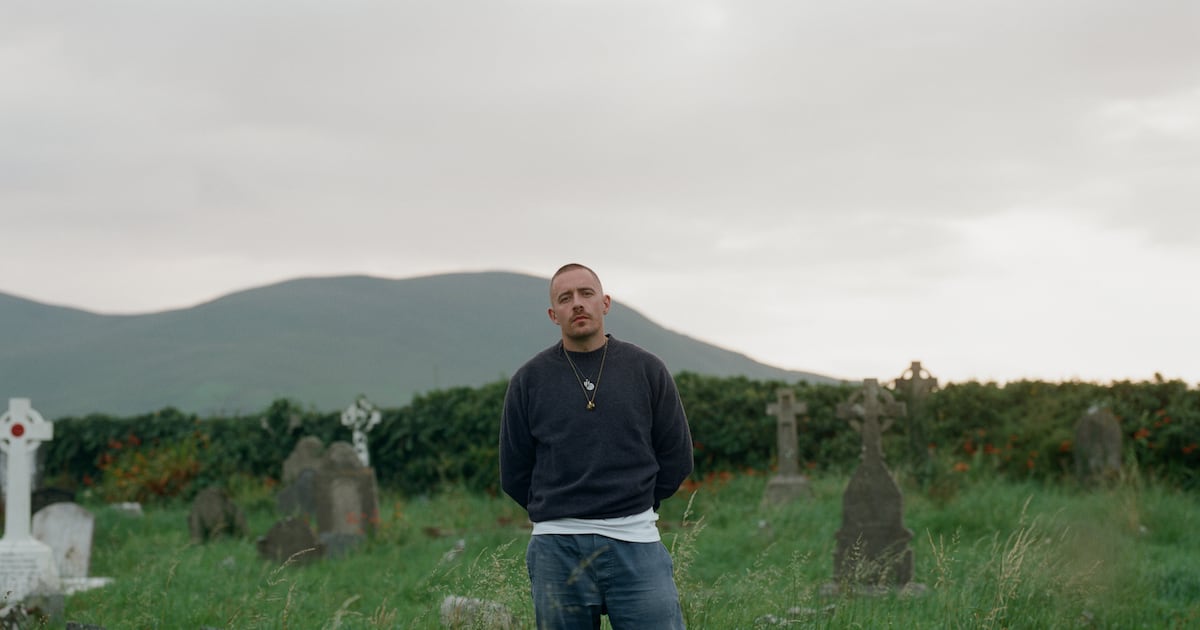
Dermot Kennedy once had a sneak peek at how awful global stardom could be. He was in Manila in the Philippines on tour. “I had to have a security guard the whole time,” he says. “He was just waiting outside the room. Even if I went down the road to get a coffee he had to come with me.”
That memory is on Kennedy’s mind when we speak, as he gears up to release his third album The Weight of the Woods, and embark on a European and UK tour that includes London’s O2 and two nights at Dublin’s Aviva Stadium.
“I like to think I can play Madison Square Garden and the O2 and still walk around and not have my life changed,” he says, a comment that in 2026 sounds closer to a dim hope than a realistic expectation for the 34-year-old singer-songwriter.
Kennedy is one of the most successful artists ever to have emerged from Ireland. His Spotify streams number in the hundreds of millions, for hits including Outnumbered, Better Days and Giants. He has duetted with Paul Mescal, been quoted by Leo Varadkar in a pandemic speech, and singled out for praise by Taylor Swift. A charismatic live performer, his 2019 set at Electric Picnic was introduced by then president Michael D Higgins in a bespoke audio recording. His Aviva dates are a record-breaker: he’s the first Irish solo artist ever to perform two dates there.
The singer from Rathcoole, on the outskirts of Dublin, is naturally shy, private and reserved. He loves home, football, and his family and friends. He wants to stay true to himself. “Being such a homebird can be difficult,” he says. “There’s varying levels of how much of yourself you’re willing to give away.”
Kennedy is calling from London, where he arrived the previous night for his promotional schedule, having just days before played an invite-only gig for fans at Beyond the Trees Avondale in Co Wicklow, on their 38-metre high viewing tower, surrounded by thickets of trees. “I think people appreciated it, it was nice.” He explains that he’s going to sign autographs while talking. “I’ve signed a billion things for this album. I’m on the last of them now.”
The autographs are a distraction technique for him, a way to take his mind off the experience of being interviewed – a bit like a patient in a doctor’s surgery turning their head to gaze at a colourful animal chart on a wall or out the window at cars, when the injection pinch comes. “I feel like I’m better at chatting if I’m doing something else. My thoughts are clearer.”
Kennedy’s new record is a declaration of his allegiance to home. He has jettisoned the phalanx of songwriters that often accompany global releases of this nature, in favour of working largely with one trusted collaborator: Gabe Simon, producer of Noah Kahan’s Stick Season. Simon brought his family from Nashville to Rathcoole for six weeks so he could understand Kennedy’s literal maps of inspiration: the forest behind his home, near his parents’ place; the paths he’d take his dog, a rescue terrier named Tom, for walks; the jotted-down lyrics in his journals.
The title track is a moving paean to where Kennedy wants to be buried: “If I should fall down … get me back to my home ground,” he sings. “Tether my bones tight, in view of this coastline. Bury this soul of mine, give it back to the weight of the woods.”
 Dermot Kennedy treats fans to a sunset performance at Beyond The Trees, Avondale,
with the Maynooth University Chamber Choir, ahead of the release of his album The Weight of the Woods. Photograph: Greg Purcell
Support on the record comes not from Ed Sheeran or Taylor Swift, but the Maynooth University Chamber Choir, along with Cormac Begley, who plays a few bars, and Muireann Ní Shé on uilleann pipes. The record harnesses gentle touches to convey humanity: the scrape of fingers across a fretboard, the joining together of disparate choral voices, the subtle pleasures of hushed vocals against plucked guitar, and drum thumps on Blue Eyes.
“It’s not this perfect, polished thing,” says Kennedy. The (relative) looseness is intentional, an antidote to the sometimes sterile studio sessions he has suffered through in the past decade, where well-meaning, top-class collaborators have asked him to spit out his emotions into a nicely packaged pop format, and he hasn’t felt comfortable.
“I’ve done so much co-writing, going around LA and London, trying stuff, and it can be demoralising and deflating,” says Kennedy, who was first inspired as a kid to pick up a guitar by artists such as Damien Rice, Ray LaMontagne and David Gray.
“So many times, you’re faced with: ‘What’s cool at the moment? Will this be well received?’ It’s important to come back to centre. What do I feel like doing? Whether it succeeds or fails? What will make me happiest as an artist?
“There’s so many ways you can go viral, and I don’t claim to be any good at that. One thing I know I’m half-decent at is playing to people, so I do that a lot,” he says. “Half-decent” is a very Kennedy term: it’s as close as the intensely self-critical singer gets to giving himself a compliment.
So often on record, Kennedy sounds daunted: like he’s trying to find the courage to speak and the confidence to make his own way.
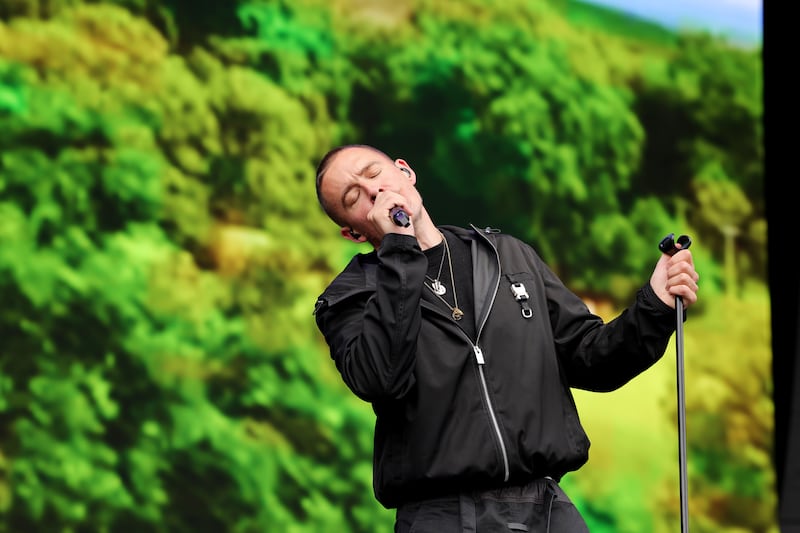 Dermot Kennedy on stage at Electric Picnic in 2025. Photograph: Alan Betson
Certain words predominate in the Kennedy lexicon – the title of his first album Without Fear reads less like self-description than personal instruction. His Irish-artists-led festival Misneach, which he created in 2025 in Sydney and Boston and plans to return to (“It’s not a one-and-done”), literally means courage. Kennedy writes about pain, vulnerability, frailty, hurt, darkness, trepidation (it’s a song title on the new record) and death. None of this seems like shamming or vamping for the sake of a song.
In school, first at Scoil Chrónáin in Rathcoole and then the Holy Family Community School, Kennedy was so shy he developed a method to duck social interactions. Instead of swapping his books in and out of his locker in secondary school, he would lift the entire stack around with him all day, so he didn’t need to talk to anyone.
[ Dermot Kennedy: Without Fear review – Deeply personal and high on emotionOpens in new window ]
He loved playing football, finding it mentally freeing, but guitar gave him a pathway to communicate and a rare sense of calm. “It was this lovely source of confidence,” he says. “For someone who is very shy, it was a way to click with people.”
When he first started as a busker on Grafton Street (“I didn’t have an amp: it was disastrous”), he could see the reaction his grainy, reverberant baritone – a supple, marvellous instrument – would get.
It was addictive. “Immediately you’re given this feeling of, ‘Oh I’m half-decent at it.’ I would sit around waiting for the phone to ring and trying to get a gig in Whelan’s or Eamonn Doran’s. The street is there all day. It’s the best way to get a musical education.”
There were early signs that Kennedy would become successful – talented, handsome, ambitious, it was no surprise that in Dublin, Simon Cowell tapped him on the shoulder in the street and suggested he audition for Britain’s Got Talent (he bailed out after a successful first audition, realising the fame show circuit wasn’t for him).
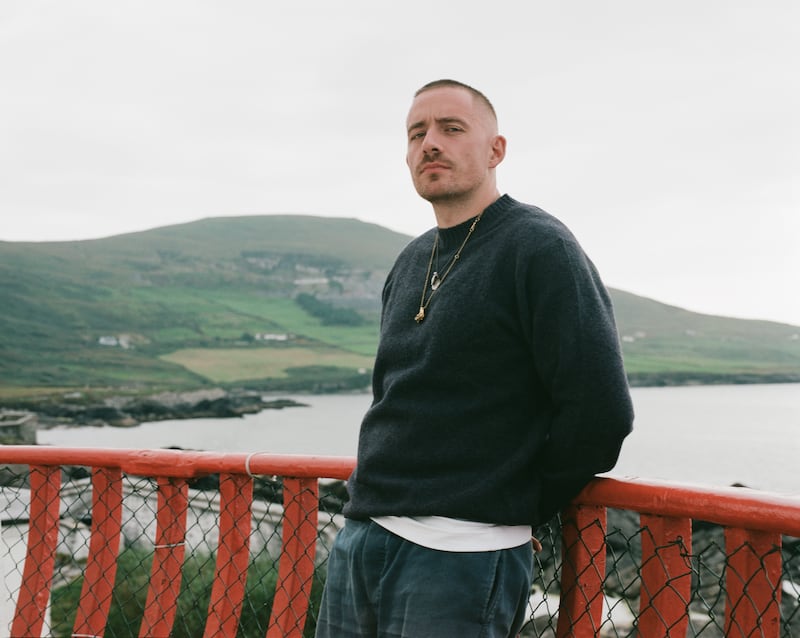 Dermot Kennedy at Valentia Lighthouse, Co Kerry. Photograph: Silken Weinberg
As an independent artist, Kennedy started releasing his music on Spotify. In 2016, Spotify’s Discover Weekly algorithm picked up An Evening I Will Not Forget, pushing it to listeners worldwide.
When Kennedy signed to Universal and released his debut album Without Fear in 2019, it was helmed by industry heavyweights confident they had a global artist on their hands. Taylor Swift called his lyrics “poetic” in an interview with Entertainment Weekly.
At home, there was some understanding of what a life in music and media might entail: Dermot’s aunt Deirdre Ni Chinnéide is a musician, his aunt Mary Kennedy is the well-known presenter, formerly of Nationwide. But Kennedy hadn’t trained for a career in singing.
A reluctant student – once christened “minimalist Kennedy” by his English teacher for doing the bare minimum – he had undertaken a classical music degree in Maynooth, but vocally he was just doing what came naturally. “I was an untrained singer and I took foolish pride in that,” he says now. “Nobody ever taught me how to sing in a way that protected my voice. I was singing incorrectly for years.”
When his career began to take off, he was suddenly faced with going from a “a couple of gigs every month to playing 200 shows a year”. The effects were cataclysmic. “We did a festival in Finland where, no matter how hard I tried, it was as if someone was pushing my head back down and pushing the note back down. I just couldn’t get it and I was so confused.”
Over the space of a few days, Kennedy’s top note “kept getting lower and lower until I couldn’t sing above a low C almost”. When Kennedy went to a vocal doctor in France, he was told he needed surgery. “He’s in my bad books forever, he was woeful.”
After cancelling a number of festivals and gigs, Kennedy took further measures. “I was freaking out. I did two weeks where I didn’t speak. As a singer, the number one thing you’re terrified of is your vocal cords being damaged.”
A light came on when he went to Dr Mark Rafferty, a specialist at Vincent’s Hospital in Dublin. Rafferty told him his vocal cords were fine. “But I’d been singing with so much tension in my chest and neck for such a long time that I was essentially strangling myself.”
Kennedy worked with the late vocal coach Judith Mok on the recommendation of Glen Hansard, to “relearn how to breathe properly” and to use his diaphragm. Other musician friends checked in, seeing his hectic touring schedule, and wondering how he was managing. “In Paris, I got a message from Hozier. Some years had passed since Take Me To Church. I was in the thick of it. He said, ‘This schedule looks quite familiar, I hope you’re doing okay.’ I really appreciated that.”
Did he do any cognitive behavioural therapy, to help deal with the stress? “No,” he says. “But I would love to. I definitely should. I think CBT would be very valuable just to retrain your brain and how you approach things.”
Before gigs, Kennedy knows he needs to “relax completely, keep my shoulders down”. It’s a battle to keep himself in the right state. “My perspective on stage is awful. When you’re on stage you’re so intensely critical of yourself. You can literally tighten the muscles just with your thoughts.” He’s much better thanks to Mok – “I generally walk out on stage feeling confident” – but it’s not a given. “It’s an ongoing thing,” he says. “I sing in such a way that it’s challenging and taxing.”
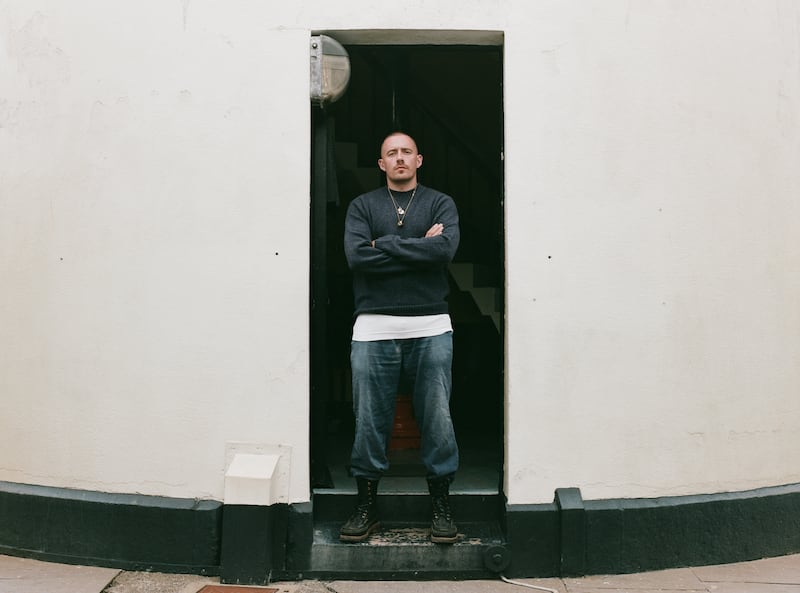 Dermot Kennedy says the guitar gave him a way to communicate, and a sense of calm. Photograph: Silken Weinberg
We talk a little about Sam Fender, the intensely shy, Mercury Prize-winning artist who has supported Kennedy in the past, and how there’s something inherently crazy about the fact that a person who writes a song can wind up a quasi-spokesman for a generation.
Kennedy feels that acutely. “We’re people who sit at home and sit with our thoughts, and then a song shows up, and then you become this public-facing person who’s on stage. I would be the exact same as Sam. You just want to be sitting somewhere, chilling out.”
I’m reminded of a line from REM’s Peter Buck, who said the group broke up in 2011, not because of any lack of joy in recording or playing music, but because of everyday big band hardships, like “having to meet new people 24 hours a day”.
Solitude is important to Kennedy. “I’m generally quite a loner,” he says. “There’s plenty of nights on tour, and travelling, when I would much rather be by myself. Music is full on because you’re all essentially living on a bus together.”
What helps him with his emotional health? Being “disciplined” for a start. Running. Staying off his phone. Playing football. Staying connected to his friends from home. “We don’t really discuss music. It’s one of the things I’m most proud of, about my normal life not changing. If those friends weren’t there for me, I think I would struggle.” He talks about making sure he doesn’t get “locked into a cycle of doubt about the album”.
“It’s about me trying to control my thoughts,” he says.
Another well known musician-turned-runner, Harry Styles, gave an interview recently to Runner’s World, where he sat down with Haruki Murakami, author of What I Talk About When I Talk About Running, for a discussion on running, art and making sense of a surreal life.
Kennedy has read Murakami’s book and admires Styles’ endeavours in relation to the 2025 Berlin marathon. “I find it very inspiring, he ran that marathon in less than three hours. That’s nuts to me.”
Musical inspiration might come from anywhere – in Styles’ case, it’s often the 1970s – but physically, pop stars are taking their lessons from athletes. “You have to take your health seriously,” Kennedy says. “If you’re playing four nights in a row, it’s different nowadays. There will be videos everywhere of every single show. And so, if you’re hanging and don’t do a good job, that will exist forever.”
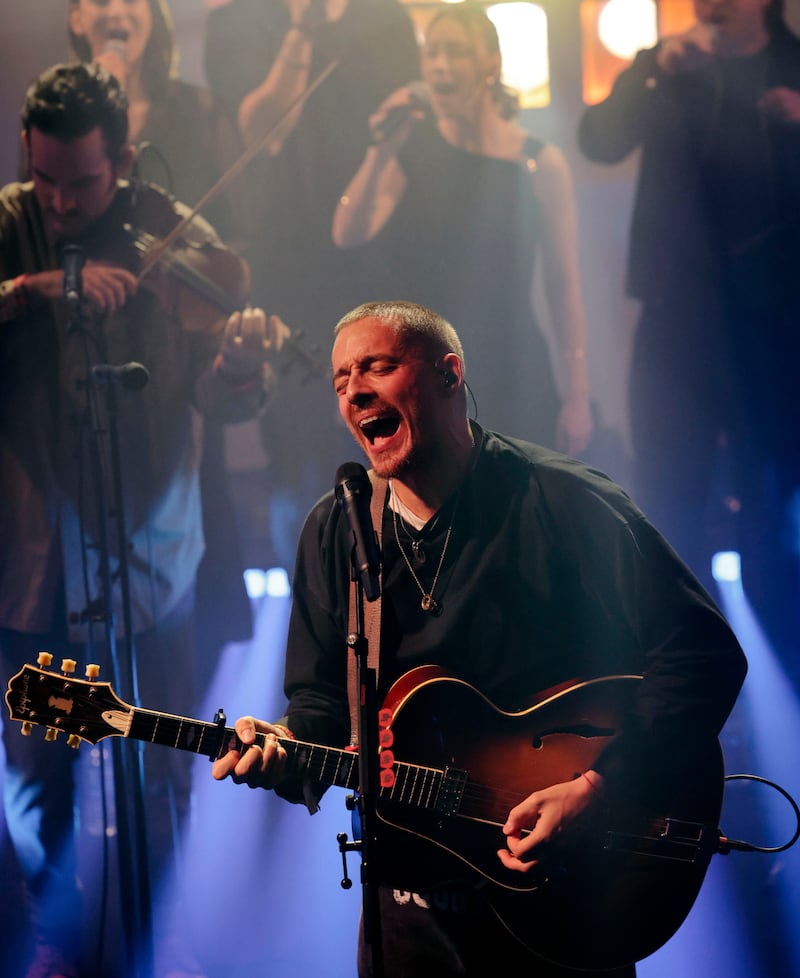 Dermot Kennedy performs on RTÉ’s Other Voices
At 34, Kennedy tries to find balance in all things. He still drinks, for example. “If you are on tour for two months, you do come away from it being like, Jesus, I did actually drink whiskey every day for the last two months. But I don’t find it too hard to find balance. You might drink a little bit on stage, but then I make sure I go for a run the following day. And then don’t drink on a day off. I’m not trying to take all the joy out of my life.”
Speaking of small moments of joy, before this interview I had a look at his social media, and noticed that he follows Paddington Bear, Eminem and Damien Rice. Would he consider this a fair representation of his social media interests? He laughs. “They’re my heroes. That’s the trifecta. Paddington and Eminem, there is crossover there.”
Who’s most likely to come up on his Instagram feed? “What I do lately is save cooking videos. Tyler Butt: I’m a fan of his. His stuff is simple and achievable and you don’t have to spend three grand in Avoca to do it.” Kennedy doesn’t have a favourite dish to prepare. It’s more about the act of watching the cooking, allowing it to help bring him back to ordinary life. “Certain things ground you when you do this for a job. I’m very determined to live in the real world.”
For Kennedy, the real world is always about being home, even if, he says, “being so tied to home can put strain on certain relationships”. (He doesn’t elaborate further, and Kennedy’s publicist has requested that The Irish Times not ask him questions about his significant others: he is married with a young daughter.)
Notably, his favourite book is The Hobbit, the story of Bilbo Baggins, the respectable hobbit who must leave the Shire and his comfortable hobbit hole to go on exciting adventures.
“It’s harder and harder as you’re older to feel like you’re living in The Hobbit. When I was a kid I found that quite easy, but that sense of wonder is something I’m trying to hold on to all the time.” Out in the world, then, on his important quest, but longing to head back to the woods? “The woods represent home.”
The Weight of the Woods is out now. Dermot Kennedy plays The Aviva Stadium on July 11th and 12th; for tickets, see ticketmaster.ie.