
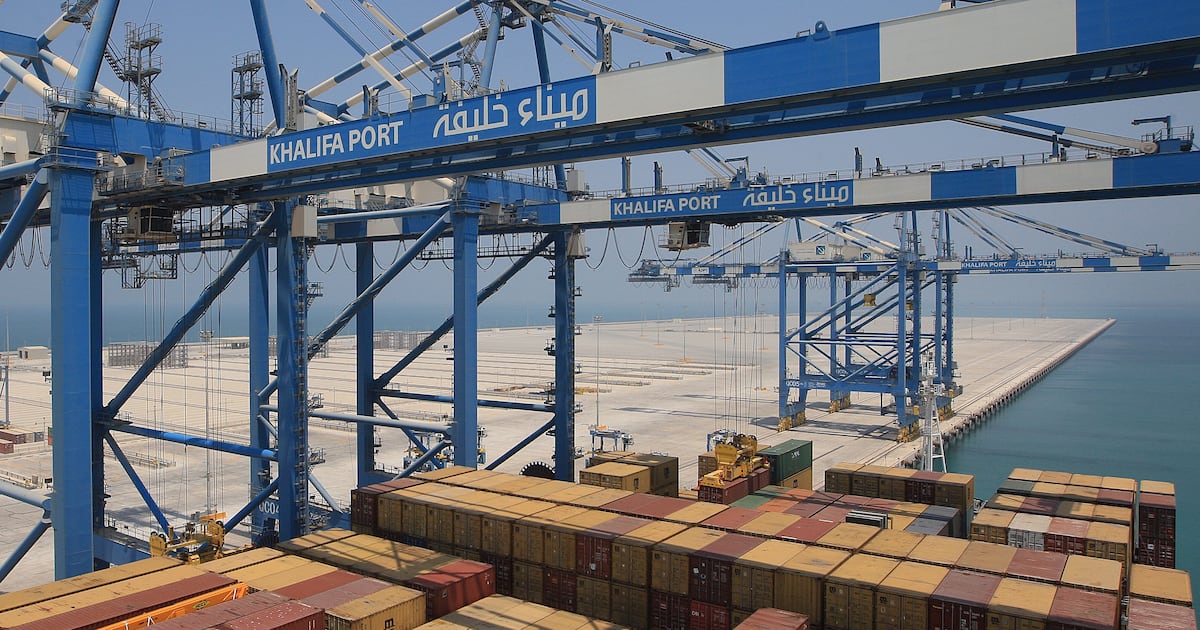
The UAE has been ranked among the world’s top 10 exporters for the first time, highlighting its growing role as a global trade hub despite mounting geopolitical headwinds.
New figures from the World Trade Organisation (WTO) showed that the UAE climbed to 9th place in global goods exports in 2025, up sharply from 17th just five years ago.
Total goods and services trade reached $1.637 trillion (Dh6.014 trillion) in 2025, compared with $949 billion in 2021, the WTO said.
Goods trade accounted for trade worth Dh4.9 trillion, while services surpassed the Dh1 trillion mark in trade for the first time, highlighting the UAE’s diversification beyond traditional sectors.
Exports accounted for 53 per cent of the total goods trade and 61.4 per cent of services trade.
The growth in exports helped drive a record trade surplus of Dh584.1 billion in 2025, up 19 per cent year-on-year.
Dr Thani Al Zeyoudi, Minister of Foreign Trade, said the achievement reflected international confidence in the UAE economy.
“The UAE’s top 10 ranking in goods exports for the first time in history is a testament to our nation’s competitiveness,” he said, adding that the country aims to further strengthen its position on the global trade map.
Overall, the UAE contributed 3.3 per cent of global goods exports and 2 per cent of services exports. Digital services, a fast-growing segment, reached exports of $33 billion, accounting for 17 per cent of the UAE’s total services exports.
The UAE’s non-oil foreign trade surged 26 per cent annually last year to exceed $1 trillion for the first time, Sheikh Mohammed bin Rashid, Vice President and Ruler of Dubai, said on X in January.
Non-oil exports during the year rose 45 per cent to Dh813 billion. “These figures were targets we announced three years ago that we would reach by 2031 … 95 per cent of them have been achieved ahead of schedule by five years,” Sheikh Mohammed said at the time.
Non-oil trade has received a big boost from initiatives such as the Comprehensive Economic Partnership Agreement (Cepa) programme, which aims to expand market access for businesses and reduce trade barriers.
The UAE has concluded Cepa agreements with 35 countries, with the latest being Gabon and Congo in February, and Angola in November.
The UAE has also maintained its status as the leading trading nation across the Middle East and Africa since 2014, according to the WTO.
However, the organisation cautioned that global trade growth is expected to slow in 2026, with goods trade forecast to expand by 1.9 per cent, down from 4.6 per cent in 2025.
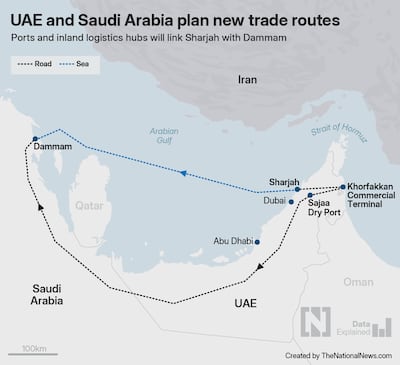
Rising energy prices and continuing geopolitical tensions in the Middle East that have disrupted supply chains, are likely to weigh on trade flows, with services growth also projected to moderate before recovering in 2027.
Despite these challenges, UAE officials said continued investment in infrastructure, regulatory reforms and advanced technologies will enhance supply chain efficiency.
Dr Al Zeyoudi said the country would continue to pursue open economic policies focused on sustainability and innovation. “The UAE is accustomed to turning challenges into opportunities,” he said, and that the nation’s trade trajectory will remain on an upwards path.