
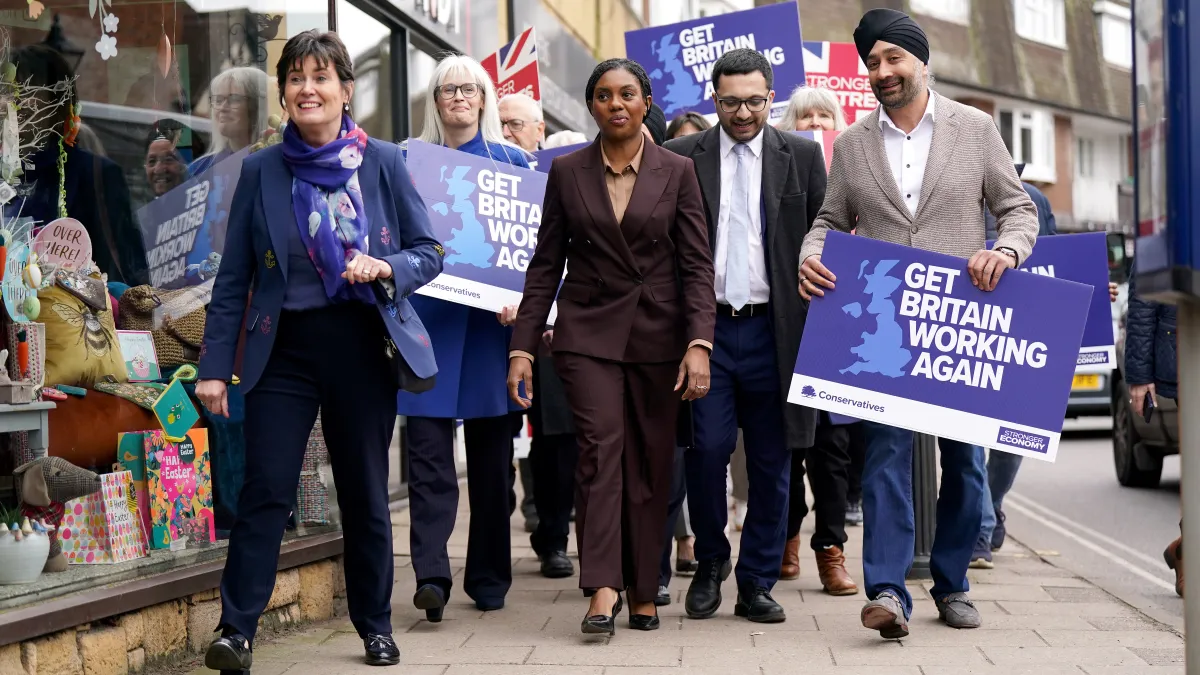
 Kemi Badenoch campaigning in the West Midlands last weekJacob King/PA
When, a few days ago, Reform UK announced that, if elected to national government, it would honour the state pension triple lock, it confirmed that, on this issue at least, the party is not living up to its name. Nigel Farage, its leader, had suggested last year that he was concerned about the affordability of pensions, suggesting that reform of the triple lock might be in the offing. The arrival of Robert Jenrick as the party’s Treasury spokesman has killed off such talk. The triple lock would be safe in Reform ’s hands.
You can see why. Reform expects to do well in next month’s local, Scottish and Welsh elections, and does not want to risk losing pensioner support, including former Labour supporters in the red wall and older former Tory voters in the shires. At a time when support for Reform in opinion polls appears to have peaked and is in modest decline, supporting the triple lock is Reform’s realpolitik.
So it is for the Labour government, which needs every vote it can get, and which upset pensioners with its on-off attempt to limit winter fuel payments to the poorest pensioners. That modest reform made a lot of sense but it was ineptly introduced and has probably ruled out any action from Labour on the triple lock for the foreseeable future.
That the triple lock needs to be reformed should not be in doubt. Its history dates back to the late 1990s, under the previous Labour government, when the state pension rose by a mere 75p a week, provoking an outcry. Gordon Brown, as chancellor, responded by pledging that the state pension would rise by 2.5 per cent, the then inflation target, or inflation itself, whichever was higher.
This “double lock” became the triple lock under the 2010 David Cameron coalition government, with the pledge to raise the state pension by earnings growth, inflation or 2.5 per cent, whichever is higher. The triple lock was introduced although the public finances were under pressure.
They remain under pressure now, and the triple lock is a significant factor in that. For a start, the 2.5 per cent backstop, a legacy of a former inflation target — on a different inflation measure — should have no place in it. The Office for Budget Responsibility estimates that the lock’s additional cost by 2030, £15.5 billion, is three times as much as was initially estimated.
Longer term, it will be the key factor in pushing up the cost of the state pension from 5 per cent of GDP now to 8 per cent over the next 50 years; more if longevity increases. Most benefit expenditure, nearly 60 per cent, is on pensioner households.
Reform UK says it will fund the triple lock by cutting other welfare benefits. The public will be sceptical. And this should not be an either/or. If there is scope for reducing working-age benefits, it should be alongside reforms to the triple lock, not instead of them. Pensioners do not need to be made poorer, but neither do they need a guarantee to do at least as well, and often better, than working people.
Reform’s decision not to go for reform, and Labour’s pensioner problem, provide an opportunity for the Conservatives under Kemi Badenoch. The Tory leader, now polling better than her party after a shaky start in the role, needs policies that will distinguish her from Reform. She writes today that she is optimistic about the future of Britain. Pledging triple lock reform would demonstrate that she has the interests of the whole electorate at heart, not just the older voters who were traditionally the Tory bedrock. The financial markets would love it, as would the young. Is Badenoch bold enough?