

Food inflation dropped significantly to 8.24% in March
TBS Report
05 April, 2026, 04:15 pm
Last modified: 05 April, 2026, 05:46 pm
Illustration: Ashrafun Naher Ananna/TBS Creative
“>
Illustration: Ashrafun Naher Ananna/TBS Creative
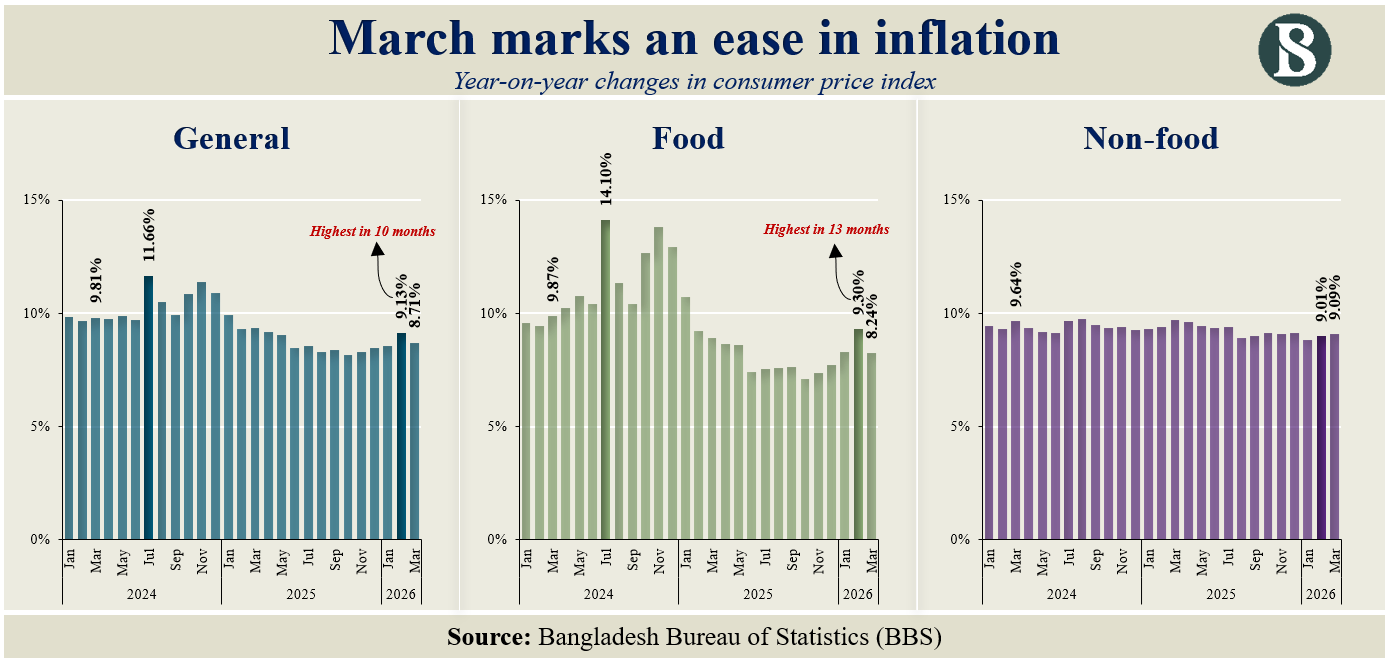
Inflation in the country decreased to 8.71% in the month of March, on a general point-to-point basis, according to the latest data from the Bangladesh Bureau of Statistics (BBS).
In February, this rate was 9.13%, and one year ago, in March 2025, it was 9.35%.
The BBS released the data today (5 April) as the Food and Agriculture Organization of the United Nations (FAO) flagged on 3 April that world food prices climbed in March to their highest level since September last year and for the second month in a row.

Keep updated, follow The Business Standard’s Google news channel
The FAO cautioned that prices could climb further if the Middle East conflict, which has already pushed up energy costs, continues.
Infographics: TBS
“>
Infographics: TBS
The BBS data also showed that the overall inflation decline in Bangladesh was driven by a sharp drop in food prices, which fell over 100 basis points to 8.24%, from 9.30% in February.
However, in March of last year, food inflation was 8.93%.
On the other hand, non-food inflation rose slightly to 9.09% last month, compared to 9.01% in February.
Nevertheless, in this sector, inflation was relatively higher a year ago in March 2025, at 9.70%.
Both rural and urban areas experienced a modest decline in overall inflation.
In rural areas, the general point-to-point inflation stood at 8.72% in March down from 9.21% in February 2026 though it was higher at 9.41% in March 2025.
Rural food inflation declined to 8.02% from 9.07% while non-food inflation increased to 9.38% from 9.34%.
In March, 2025, rural food and non-food inflation were 8.81% and 9.97% respectively.
In urban areas, general inflation declined to 8.68% in March from 9.07% in February.
Urban food inflation decreased to 8.78% from 9.87% whereas non-food inflation increased to 8.62% from 8.57%.
In January 2025, urban food and non-food inflation were 9.18% and 9.95% respectively.
Meanwhile, in March, average wages for low-paid skilled and unskilled labourers rose slightly to 8.09%, up from 8.06% in February, according to data released by the Bangladesh Bureau of Statistics on 5 April.
Although inflation eased to 8.71% in March from 9.13% in February, workers are still falling behind, extending a streak of declining real incomes to 50 consecutive months since February 2022.
In July 2024, inflation had surged to 11.66% while wage growth remained stuck at 7.93%, creating a painful gap of 3.73 percentage points. That gap has now narrowed to 0.62 percentage points.