
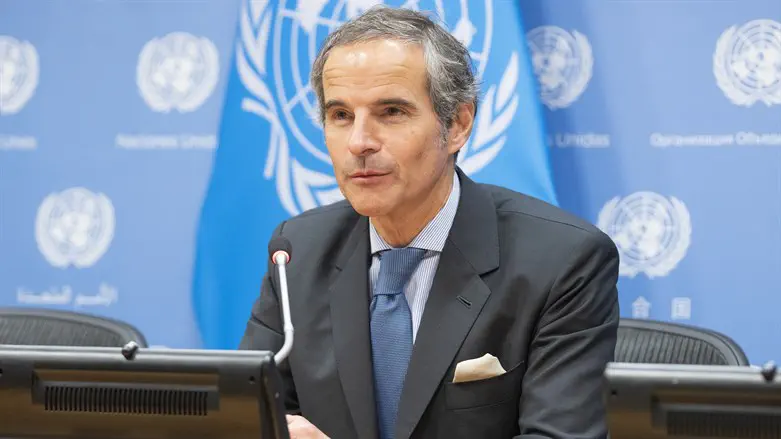
International Atomic Energy Agency (IAEA) Director General Rafael Grossi detailed in an interview with PBS Frontline the agency’s limited visibility into Iran’s nuclear activities in the wake of recent military strikes by Israel and the US, with particular focus on a newly declared underground enrichment facility in Isfahan that inspectors have yet to examine.
When asked about his reaction to the latest attacks, Grossi said, “Well, obviously, as director-general of the IAEA, I’m not informed in advance of military operations. So, of course, from that moment on, we have been following this – intensively.”
He noted that the IAEA had been participating in a negotiating process in Geneva, mediated by the foreign minister of Oman and involving Jared Kushner, special envoy Steve Witkoff, and Iranian Foreign Minister Abbas Araghchi. “That was a pretty intense exercise, which obviously did not come to fruition.”
Grossi declined to directly address President Donald Trump’s assertion that Iran was on the verge of a bomb before the most recent strikes. “Well, I would generally abstain from commenting on comments, especially from presidents. And what I can say is that the situation in Iran was concerning. Iran had not been giving – for quite some time – the IAEA access to places, clarifying activities, and a number of things that led us to a place or a position where we lost the necessary continuity of knowledge to be able to confirm that everything in Iran was in peaceful use.”
He added that there were “some elements of concern” including “the accumulation of a very big stockpile of highly enriched uranium – very close to military-grade degree – without any justifiable reason.”
On whether the IAEA had seen evidence of Iran being close to manufacturing a weapon, Grossi stated, “We cannot have evidence when we are not being given the access to places and answers to questions that we were having on a number of things.”
Regarding rebuilding after previous strikes, Grossi said the IAEA had been unable to access Isfahan, Fordow, or Natanz. Inspectors were permitted only at non-attacked sites such as laboratories, the Tehran Research Reactor, and the Bushehr nuclear power plant. An agreement signed in Cairo to restore access was later frustrated.
Grossi confirmed that Iran itself declared the new underground enrichment facility at Isfahan last year.
“Iran itself declared it. Last year, they declared that there was a new facility, and we immediately requested access to it. Access was granted, but we never made it to that place because the 12-day war started. And so, we were not able to see what kind of facility this was, whether it was an empty hole, or a place already fitted with centrifuges and cascades. So, we will still need to see.”
When pressed for evidence that an enrichment facility exists at the site, he replied, “None. I mean, the declaration by Iran that there is a facility and our request. So, it is already an object of interest.”
He addressed President Trump’s reference to Iran reconstituting its weapons program at a new site under granite. Grossi said the IAEA had not been given access to relevant areas since last year. “We are aware of some information. We have seen some things, but without inspecting – I mean, from the perspective of the IAEA, you may understand that I cannot speculate. It would be incorrect.”
In late February, the IAEA released a report which revealed that Iran has not allowed the agency access to its nuclear facilities that were bombed by Israel and the United States during the 12-day war last June.
The IAEA report stressed that due to the lack of access to the affected facilities, the agency cannot verify whether Iran has suspended all uranium enrichment activities or assess the size of Iran’s uranium stockpile.
Following the US strikes on its nuclear sites last June, Tehran suspended cooperation with the IAEA and barred inspectors from visiting the damaged sites, accusing the agency of bias and failing to condemn the attacks.
An agreement announced in September between Iran and the IAEA, intended to resume inspections and uranium accounting, has since been declared void by Tehran after Britain, France, and Germany triggered the return of UN sanctions previously lifted under the 2015 nuclear deal.