
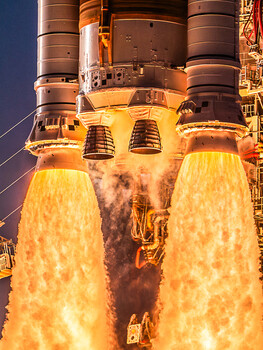
On Wednesday, April 1, NASA’s SLS rocket hurled four astronauts toward the Moon for the first time in over 50 years, and Orlando-based photographer Steven Madow was standing at the Kennedy Space Center press site with a plan years in the making. Armed with 14 Panasonic Lumix cameras spread across seven remote launchpad positions and the press site, Madow pulled off one of the most ambitious single-photographer launch coverage operations in recent memory, producing a close-up engine shot that has since gone viral around the world.
We sat down with Madow to talk about the decade-long journey that led to this moment, the painstaking technical work behind his remote camera setups, and what it feels like to watch humanity head back to the Moon.
A Decade of Chasing Rockets
Fstoppers: You’ve been shooting rocket launches for over a decade now, and your photography journey reportedly started around 2014 with rockets and drones. What was the specific moment or launch that hooked you, and what were you shooting with back then?
Steven Madow: Like many people, I’ve loved rockets since I was a child, growing up in Maryland where a TV would be rolled into our classroom whenever the Space Shuttle went up. After moving to Florida in 2007, I kept accidentally seeing minor (read: less publicized) launches going off. At the time, there weren’t close to the current two to four per week. I decided to start tracking them and trying to see every single one. When I got into photography, I was super into landscape and cityscape initially, and I still love those genres. Huge shoutout to Fstoppers, Elia, and the Photographing the World series that helped jumpstart my skills.
For launch photography, I was initially enthralled by long-exposure shots of nighttime launches. Early on, I was able to get some advice from Ben Cooper, who shoots many official NASA launch images, and after I shot my first one (it was terrible), I was totally hooked.
I still view myself as a landscape photographer alongside launches and love to combine the two disciplines.
Your primary commercial work is with brands like Visit Orlando, JetBlue, and Visit Florida. How does your rocket launch photography fit into your broader career? Is it a passion project, a revenue stream, or has it evolved into something else entirely?
Amazingly, photography for me has been an out-of-control side quest. In my primary career, I am a product executive in the FinTech space. My passion for technology definitely plays into my approach to photography. As for my photography career, I’ve been able to be a bit picky and take on work for some of the incredible clients that you listed, and also able to pour my passion into rocket launches. As for monetization, I tend to license and sell prints of my rocket portfolio and do several fine art festivals annually. These festivals are so fun and a great time to meet space fans and talk about my work.
You’re an all-Panasonic Lumix shooter, which is pretty uncommon in this space. What drew you to the system, and what specific advantages does it give you for launch photography that you wouldn’t get elsewhere?
Amusingly, when I started my photography journey, I was much more interested in video. At the time, the Panasonic Lumix G7 was a great entry-level 4K camera. As I started to build up my camera and lens collection, my drone work actually helped me first transition to photography. I found that Lumix cameras, while known for video, have actually been incredible stills cameras. Until recently, I shot only in Micro Four Thirds, which has two huge advantages for this sort of work: first, much smaller lenses with extreme reach, like the Panasonic Leica DG Vario-Elmar 100-400mm f/4-6.3 II; and second, a natively wider depth of field for a given aperture value. This allows me to collect light but still maintain focus in incredibly challenging situations. The PanaLeica lenses are also super sharp.
A general critique of Micro Four Thirds is “if you want to print big, it won’t be possible.” Well, I have printed at 40 x 60 inches from a crisp 20-megapixel image many times and have been psyched about the quality.
When I first got approval to set up cameras on the launchpad, I reached out to Lumix to see if they would loan me some cameras for the unique opportunity. They said yes, and this has led to a great partnership over the years.
The Credentialing Journey
You’ve described NASA credentialing as really tough and mentioned it took years of working your way through SpaceX and Space Force credentials before finally getting NASA access through Space Explored. Can you walk us through that progression?
It isn’t necessarily a hierarchy, but it is a bit challenging to discover; there’s no 101 guide on how to become a NASA-credentialed photographer. A lot of it was networking with people and learning from friends that had gone through the journey. Also, a lot has changed over the past few years with approvals. When I started, I was able to get credentials for the Space Force based on online performance and a portfolio of work, but now working with a media organization is required, which makes sense. NASA has a great avenue for content creators called NASA Social, but is more rigorous about their formal credentialing.
Planning 14 Cameras for a Moon Mission
Fourteen cameras is an enormous operation for one photographer. Walk us through the strategic thinking: how did you decide on seven remote and seven press site cameras, what was each one tasked with capturing, and how did you map out focal lengths and compositions across the full set?
Yeah, it was pretty wild. For this launch, I really prioritized launchpad cameras. We were brought out to five different spots and allowed one tripod per spot. I chose to place multiple cameras on some of those tripods. I was looking for compelling compositions and generally prioritized wide and medium shots. The main shot that has gone viral is a telephoto shot of the engines, which is something that I have captured of previous rockets and definitely wanted to include for this one. Since this launch was so important, I built a lot of redundancy into my plans and shot engine shots from two of the locations. For the straight-on shots, I did a riskier shot super low down to the rocks on the crawlerway and a conservative alternative. I made sure to keep my favorite camera to handhold, the Panasonic Lumix G9 II, with me for the press site, but generally used lower-priority cameras at the press site.
When you were bused out to the launchpad on Sunday to set up your remote cameras, the Orion spacecraft was already on the pad but you didn’t know the launch day or time. How do you compose a shot when you’re planning for conditions that could range from midday sun to nighttime darkness?
It’s definitely a fun mental puzzle. I need to figure out the lighting, the rocket trajectory, and where the plume will be, all in combination with any foreground elements. The compositions were relatively similar for day versus night, although I have more latitude for interest in wider shots during daytime. Exposure settings spanning day to night are the biggest challenge.
You mentioned developing a five-shot bracket technique at negative one EV center with the MIOPS sound triggers over the course of many launches. Can you get into the technical weeds on this?
On the MIOPS, when in sound mode there are two settings to configure. First is sensitivity. This one is always amusing to me and hotly debated by launch photographers. Ultimately, even at the lowest sensitivity level, I am fairly sure that the powerful rocket is going to trigger the sensor from 1,000 feet away.
Second is delay. The default is zero milliseconds, but I originally found (from a real-world test with other launches) that this would just send a singular pulse, similar to pressing and holding a cable remote when a camera is on bulb mode, as long as it was still loud. What this meant is that my camera only captured a single set of brackets. When setting the delay to a higher number, 125 milliseconds, a gap was introduced and now the camera is able to shoot consecutive brackets throughout the duration of the launch. Painstaking trial and error.
Some launch setups give photographers as little as 10 to 15 minutes to get everything dialed in. What does your actual setup checklist look like when you’re standing at a pad with a remote camera?
I try to prep as much as possible at home to set myself up for success: checking the clock, sleep modes, memory cards, batteries, trigger connections, and so on.
The checklist is all mental, but I have worked with intent to create a habit-forming process. First, despite the lack of time, I try to walk around the site and visualize my composition. This is like high-speed landscape photography scouting. Then I place the tripod down, lock down the composition, and install support stakes into the ground connected to each tripod leg. The stakes help the camera stay in position and not get knocked over by Florida thunderstorms or the force of the rocket.
Next, I lock down focus. Typically, this means switching into autofocus with a point on the rocket and then switching back to manual focus. I love the focus peaking on Lumix (I imagine that other brands of mirrorless have this as well) that allows me to get a second look at focus.
Then I turn on my sound trigger and sing to it. Okay, maybe just a guttural “ahhhhhhh” to make sure that everything is working and the camera triggers.
Finally, I double-check my camera settings, take a final look, close up my box, and then move on to the next camera or take embarrassing selfies with the rocket if I have time.
Launch Day
You’ve said you were worried the launch might get scrubbed because you had work commitments that would have prevented you from being there on a backup day. How did that anxiety play out on launch morning?
When I woke up on the day of the launch, I loved the positive weather forecast, but had memories of the Artemis I launch (which got scrubbed several times over the course of multiple months) going through my head. I knew that a scrub was a very realistic possibility for the day. As the day progressed, fueling, which was the biggest concern from a previous wet dress rehearsal of the rocket, went great. Confidence was rising. As we got closer, I started to hear that the team was working issues, which obviously brought up some fear that one of the issues would lead to a scrub. Ultimately, they fixed the issues and wound up launching just a few minutes into the two-hour launch window, and it was stunning.
The SLS is a very different rocket from the Falcon 9s and Falcon Heavy you’ve shot many times. What surprised you about this launch from a sensory or photographic standpoint?
To be honest, it’s just a really cool rocket. It’s loud, it’s big, and photographically, it has an incredible plume of smoke. The Falcon rockets don’t have solid rocket boosters, which cause the plume on SLS, Atlas V, and the historic Space Shuttle. This launch was also just more emotional due to the incredible significance of the trip around the Moon leading to an eventual base on the surface.
Describe the minutes right after liftoff. Your seven remote cameras are sitting out there unattended, and you have no idea if they worked.
I certainly had immediate joy, and then a bit of relief that it launched while I was in town to be at the press site. My confidence in the remotes was much higher since it launched on Wednesday and not several days later. That said, I knew that I was managing a very high number of cameras and had the potential for huge mistakes from the complexity. During the very end of prep, I realized that I had left a small component out of the mix on one camera that would have rendered it useless, so that was weighing on my mind a bit. But I felt really good about them overall, and was psyched about the results when I saw the back of the camera screens.
The Viral Close-Up
Your close-up engine shot from the Panasonic Lumix GH5 and the Panasonic Leica DG Vario-Elmarit 50-200mm f/2.8-4 has gone massively viral. At ISO 100, f/16, and 1/8,000 s, you were at the absolute exposure floor of that camera. Were those settings a calculated decision from previous launches, or were you hedging against something specific? And how close was this camera to the pad?
The settings were based on my general understanding from prior launches and knowledge that this rocket is particularly bright. I also consulted a friend who had shot remotes for Artemis I and he graciously shared his EXIF data and screenshots of raw images (thanks, Michael!). Since I knew daytime was possible, I knew that if I underexposed way too much, I wouldn’t be able to pull the blue sky back in the raw, so f/16 was better than f/22. Also, since the camera was sitting out for a few days, f/22 was a bit risky in terms of having too many dust spots show up on the sensor.
This camera was approximately 1,500 feet from the rocket.
When you saw that image on the back of the camera for the first time, did you know immediately that it was the one?
I definitely did not pick out the frame during the quick back-of-camera review. I just wanted to see if it worked or not. I immediately placed my camera under the media bus, ran aboard to my laptop, and imported into Lightroom. It didn’t take long to pick the right one from the set of 14 frames in the viable segment of the series.
Post-Shoot Workflow
Fourteen cameras presumably means thousands and thousands of frames. What does the cull and edit workflow look like after a launch like this?
I’ve gotten pretty quick about this. Each camera was realistically only 25 to 100 images, although that certainly adds up. I tend to pull them in, categorize into a folder per camera, and then do some basic raw adjustments. It’s a big balance between urgency to post versus desire for perfection in the edit. There have definitely been times where I have done a field edit in uncontrolled lighting and gotten home and been annoyed about missing something glaringly obvious.
Right after launch, I went into the press center so that I could view my laptop in a controlled setting and posted the first batch of photos. I then waited until the next morning to post the remotes, which gave me some time to more calmly and cleanly edit. Since I left town immediately after the launch, this happened on my laptop as well.
Prior to printing for those that have ordered, I will do even more detailed editing so that it looks perfect in large format. This will happen on my BenQ color-calibrated 32-inch monitor in my very controlled home studio in Orlando.
You’ve only collected four of the seven remote cameras so far. Is there any anxiety in leaving cameras out there for days?
The remaining cameras were picked up by some friends and are sitting in their houses. That said, I wouldn’t have any qualms about leaving them on the secure NASA launchpad for extra days. NASA had full control of the site, so they rightfully select when we go out to pick them up based on a huge number of conditions.
The remaining cameras were set up on Sunday, whereas the ones that I previously collected were set up on Tuesday. I’m excited to see if they worked as well, but I am pretty relaxed since I already have photos that I love.
What Comes Next
You described every launch you’ve ever shot as practice for this one. Now that Artemis II is done, do you feel like you’ve reached the summit, or has it shifted your ambitions?
There are always fun projects and launches ahead. The Space Coast is constantly evolving. Recently the New Glenn and Vulcan rockets started flying and I am very excited for Starship to begin launching in Florida. There are also several more Artemis missions planned, including one that will land astronauts on the Moon. Much excitement ahead.
Rocket launch photography is a pretty tight community. How do other photographers at the press site interact during a launch like this?
There’s generally a ton of camaraderie and shared excitement. People loaning batteries, sound triggers, cables, and even lenses. Some people are keen to share camera settings and past experiences and others are a bit more guarded; I tend to be very open. We are all cheering each other on as long as we don’t block someone else’s camera. It takes a lot of passion to do this, and I am always delighted and grateful for the opportunity.
As someone who photographs this stuff regularly, do you feel a sense of responsibility in how you represent these missions to the public?
I hope that my love for space exploration comes through the lens. I truly hope that my photography inspires: inspires careers and interest in STEM, love for photography, and joy about the positive side of humanity.
For a photographer reading this who has never shot a launch but wants to start, what’s the single most important piece of advice you’d give them?
Certainly don’t expect to be able to get the same shots from 10 miles away as photographers are able to capture close up. Haze from 10 miles in Florida is a killer.
Embrace the distance and play into other fun elements: show the crowds or interesting foregrounds. Practice, practice, practice. Relax in the moment, and never forget to pause for 10 seconds to watch with your eyes.
You can see more of Steven Madow’s work on his website and follow him on Instagram. All images used with permission.