
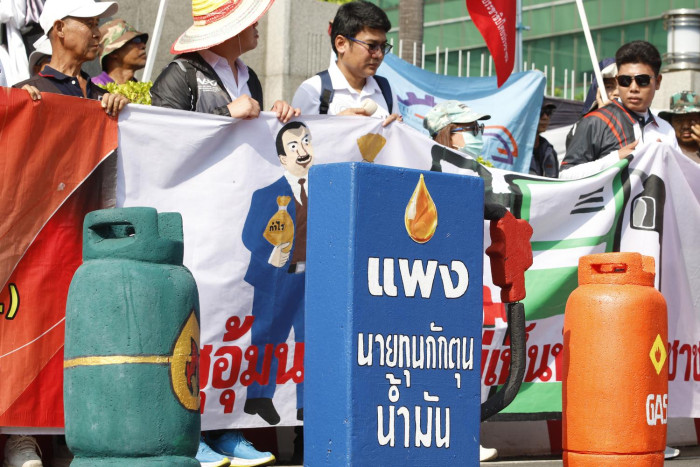
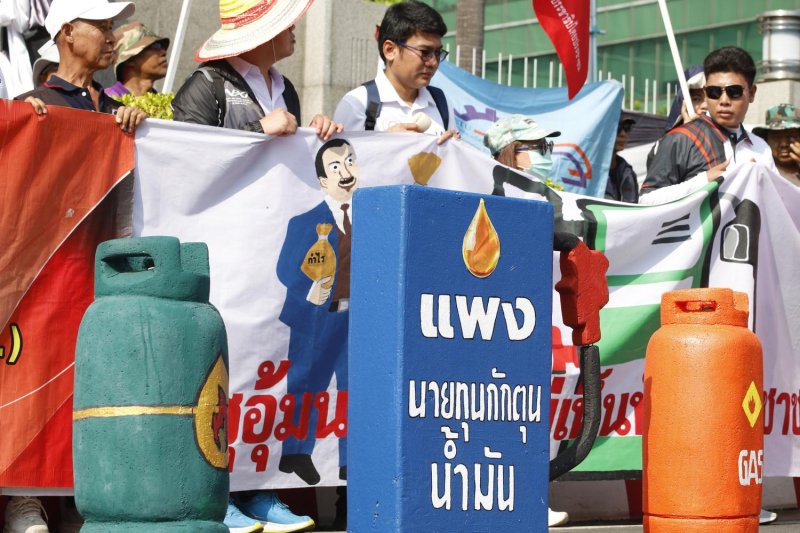
As labour unions protest against soaring energy prices, analysts warn the Thai economy faces higher stagflation risk as the new government has financial constraints. PATTARAPONG CHAPATTARASILL
Thailand faces a heightened risk of stagflation as elevated oil prices nudge up inflation, with the new government unlikely to launch large stimulus measures to prop up the subdued economy given high public debt levels, warn analysts.
Kasem Prunratanamala, head of research at CGS International Securities, anticipates a new government taking office before mid-April, rolling out targeted stimulus measures aimed at supporting consumption, such as a potential revival of the “Half-Half Plus” co-payment scheme.
“However, we do not expect any large-scale fiscal stimulus to meaningfully boost the economy, given limited policy space,” he said, citing a high public debt-to-GDP ratio.
At the end of January, public debt tallied 66% of GDP, approaching the statutory ceiling of 70%, constraining the government’s ability to implement broad-based expansionary measures.
Recent initiatives introduced by the caretaker government have been focused on vulnerable groups rather than the general population, suggesting a continued emphasis on targeted rather than universal support.
“While incremental measures may provide some short-term relief for consumption, we believe the macro impact is likely to be modest,” said Mr Kasem.
A lack of broad-based stimulus implies limited upside for mid- to high-end consumption segments, including malls and tourism-related plays, where spending is more closely tied to economic confidence and income growth, he said.
CGS favours a selective, bottom-up approach, focusing on value-driven consumption beneficiaries and defensive growth sectors such as healthcare.
“In contrast, we remain cautious on sectors reliant on a broad-based demand recovery, given constrained fiscal support and an uncertain macro backdrop,” said Mr Kasem.
With inflation risks tilted to the upside due to higher oil prices, the Bank of Thailand faces a policy dilemma. With the policy rate already low at 1.0%, the scope for further easing appears limited, even as growth risks begin to rise, he noted.
KGI Securities (Thailand) expects domestic fuel prices to rise further in April, driving higher inflation, which could erode consumer purchasing power and weigh on industries with high logistics and energy costs.
Soaring global crude oil prices prompted the government to ease pressure on the Oil Fuel Fund and begin raising domestic fuel prices from mid-March. As a result, investors became more concerned about the economic impact, particularly on inflation, said Rakpong Chaisuparakul, senior vice-president of KGI.
“These negative factors more than offset the positive impact from domestic politics, including the formation of the new government, market expectations for consumption stimulus, and policies to increase public investment and foreign direct investment,” he said.
STAGFLATION RISKS
Asia Plus Securities (ASPS) said Thailand’s economy is “feeling the crunch” from Brent crude’s 41% price jump in March, largely due to its high reliance on energy imports, half of which are from the Middle East. The country already carries a hefty energy trade deficit at 7.8% of GDP, exceeding many Asian peers.
“Compounding the issue, Thailand’s fiscal flexibility is shrinking,” ASPS said in a research note, adding public debt soared from 60% of GDP in 2022 during the onset of the Russia-Ukraine war to 66% in January.
“This reduced fiscal space means the government has less capacity for fuel price subsidies than in previous periods.”
The result is a sharp increase in domestic fuel prices, which directly lifts inflation, hiking transport, logistics and production costs across sectors, leading to higher consumer goods prices and immediate pressure on public purchasing power, noted the brokerage.