
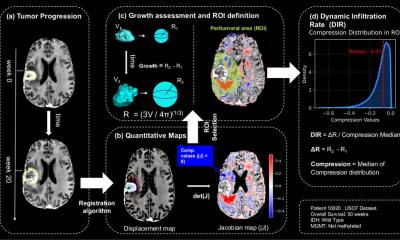
Until now, assessment methods have mainly been based on measuring the increase in tumour size or the displacement of brain structures, without adequately capturing how the tumour grows or its biomechanical impact on the surrounding brain
Carles López Mateu
In their work, the UPV’s BDSLab team presents a new biomarker, the Dynamic Infiltration Rate (DIR), capable of identifying different patterns of tumour growth and independently predicting patient survival. “Until now, assessment methods have mainly been based on measuring the increase in tumour size or the displacement of brain structures, without adequately capturing how the tumour grows or its biomechanical impact on the surrounding brain,” explains Carles López Mateu, lead author of the study.
The research was carried out by Carles López Mateu, María Gómez Mahiques, F. Javier Gil Terrón, Víctor Montosa i Micó, Juan M. García-Gómez and Elies Fuster García, in collaboration with researchers from Oslo University Hospital.
The biomarker developed by the BDSLab-ITACA team combines the tumour’s volumetric growth over time with the mechanical effects this growth exerts on adjacent brain tissue. From a longitudinal analysis of magnetic resonance imaging, the researchers have generated tissue compression maps that allow them to assess how the tumour compresses or infiltrates healthy tissue.
The DIR biomarker integrates both phenomena and allows differentiation between more proliferative tumours that compress the brain and more infiltrative tumours that expand without significant compression. “This index allows us to characterise the biological behaviour of the tumour beyond its size and provides key information on its aggressiveness,” notes Carles López.