
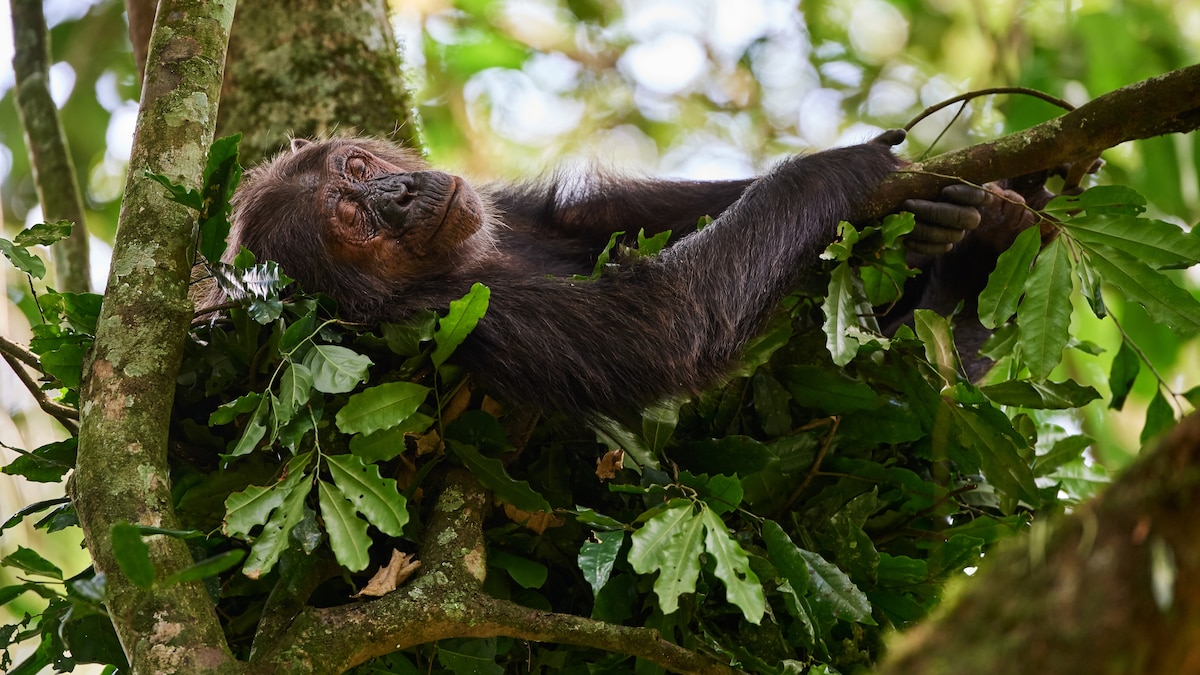
(Meet Tatu and Loulis—the last of the ‘talking’ chimpanzees)
The anthropologist David Samson has dedicated much of his life to solving this riddle. He began his career by studying the sleeping habits of chimpanzees; his fieldwork included climbing into 72 nests in order to study their construction. He then moved onto orangutans, and then human hunter gatherers, namely the Hadza people of Tanzania. In his papers, he highlights the fact that building nests was a major step in the evolution of apes (compared to, say, monkeys, who sleep on bare branches, and who, perhaps not coincidentally, exhibit the skittery irritability of the perpetually sleep-deprived). But early humans, by abandoning nests and learning to sleep on solid ground, made an even greater breakthrough.
The most common explanation for the origins of human ground-sleeping is that by that point in our evolutionary history we had already mastered fire, which would have provided heat and deterred predators. But this theory faces a major challenge: wielding fire undoubtedly allowed us to become a smarter species, but how did humans become smart enough to master fire? Anthropologists sometimes refer to this Catch-22 as the “gray ceiling,” a reference to the brain’s gray matter. Samson suggests an elegant solution: it could be that mastering the art of sleeping on the ground, over the course of many generations, gave us the increased cognition necessary to master fire—among a thousand other innovations unique to our species of ape.
Still, the central question remains: without fire, how did the earliest humans manage to leave the nest?
Samson has a theory about that, too.
A fitful night in the branches
The following evening, I packed my gear and hiked with my husband, Remi, down to a nearby river, about 30 minutes outside of camp, where there was a Brachystegia tree with a big, fresh, comfortable-looking nest that an adult male chimp had built the night before. With relatively little effort, I managed to anchor a climbing rope to a branch just above the nest, which meant that all I needed to do was to climb up the rope, using mechanical ascenders, and then lower myself into it. In theory at least, it was dead easy.
With us that day was Pascal Gagneux, a lean, leathery, alert-eyed, voluminously talkative evolutionary biologist. During one phase of his research he had climbed into more than 300 chimp nests to collect samples of their DNA. Pascal gave me three warnings: First, he warned that, as I ascended, I should take care not to jostle the nest too hard, or else it could “explode” in my face. Second, he pointed out that chimpanzees frequently soil their nests in the morning, so I should be sure to check it for droppings. Third, he said that while I was up there, I should be ready to come down at a moment’s notice. It was not likely, but it was possible that a chimp might not be happy to see me up in their domain. He said that one time while he was climbing into a nest, he had encountered a female chimpanzee carrying the corpse of her recently deceased baby. The mother, in a fit of grief and rage, screamed, threw the baby at him, and then fled.