
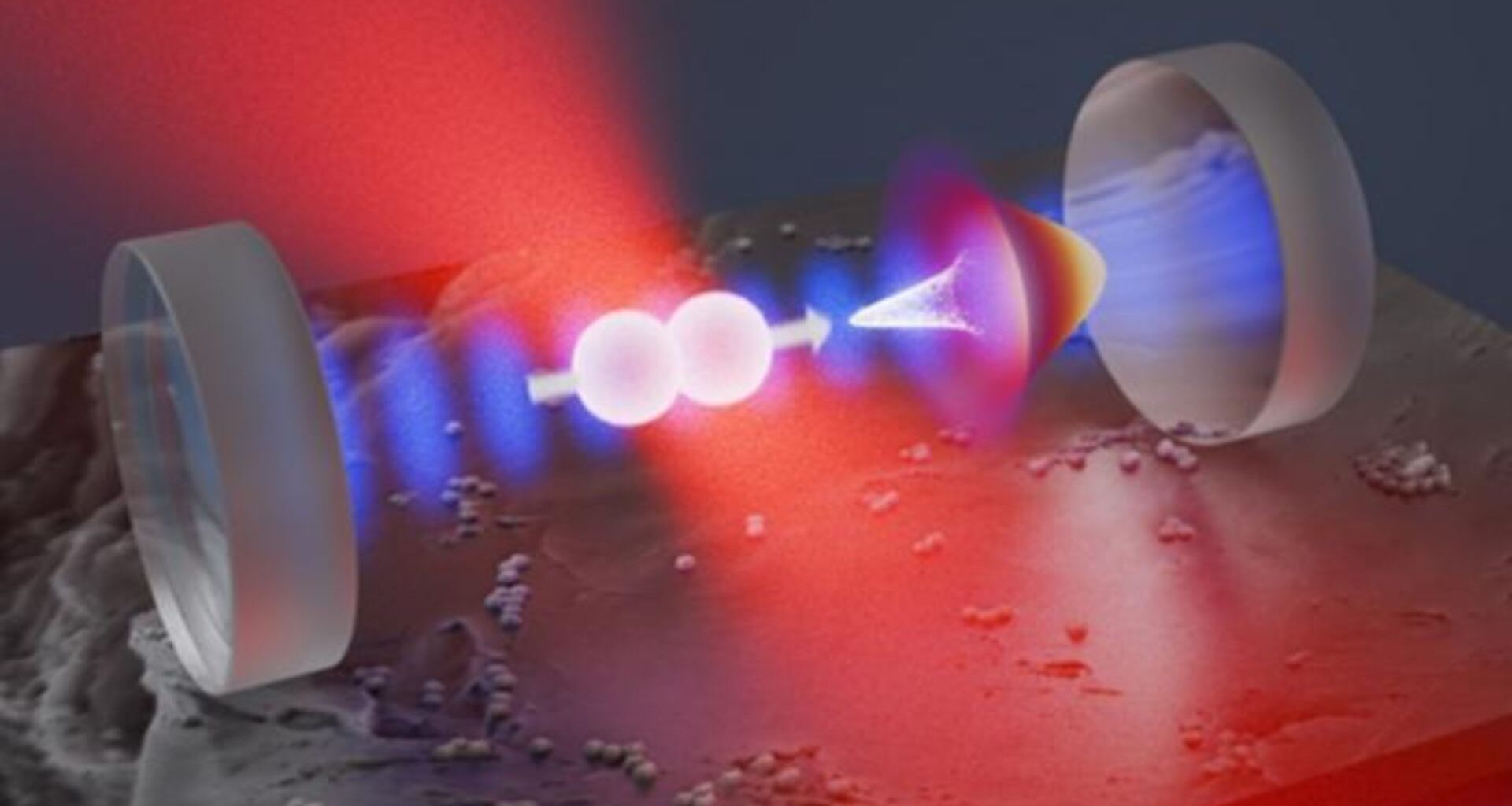
A collaborative effort between researchers at multiple institutes in Europe achieved a global first by trapping a silica nanorotor in its quantum ground state. The team used intense light to confine the nanoparticle’s orientation within bounds of quantum zero-point fluctuations, marking a major milestone towards rotational matter interferometry and quantum torque sensing.
In our everyday world, particles are always jiggling and rotating due to their thermal energy. As the temperature rises, this jiggling and rotating motion increases; as the matter cools, it decreases. According to classical physics, the motion of these particles can be brought to an absolute standstill by cooling them, but quantum mechanics tells us otherwise.
According to quantum mechanics, even at absolute zero, particles retain some energy and remain disoriented – their quantum ground state. When particles are cooled to temperatures near absolute zero, their energy does not change continuously but rather in quantized energy steps, linked to their quantum ground state.
Researchers at the University of Vienna have previously cooled levitated nanoparticles to their quantum ground state. But cooling rotational motion has proven challenging and has only been achieved in one dimension by researchers at ETH Zurich.
Cooling in two dimensions
In a new set of experiments conducted by researchers at the University of Vienna, TU Wien, and Ulm University, the team trapped a nano-dumbbell rotor using a laser’s electric field. Initially, the trapped rotor displayed thermal angular oscillations or libration so the researchers turned to optical cooling to take temperatures near absolute zero.
To achieve this, the researchers used coherent scattering where nanoparticles were trapped in light intensity of 100 MW/cm2 and scattered it into an optical resonator. During this process, a single photon carries away a single quantum of mechanical energy from the particle’s rotation into an optical resonator, thereby cooling the nanorotor particle.
Doing this in two axes, the study is the first to achieve quantum-limited alignment of the rotor’s orientation, where its direction is uncertain within only 20 microrad.
“The tip of the rotor then moves less than one hundredth of the diameter of a single atom,” explained Stephan Troyer, a researcher involved in the “This is like a compass needle oriented to better than the width of a bacterium”.
New generation of quantum technologies
The set of experiments isn’t just an achievement for the laboratory; it also opens the door to a new generation of quantum technologies. After each turn, a rotor ends up in the same orientation. These quantum effects have no analog in linear motion.
For instance, when the trapping light is switched off, the nanorotor can rotate in all directions at once, much like a superposition of orientations. These rotating particles therefore offer new insights and capabilities for future experiments that could lead to a new generation of quantum technologies.
“The beauty of our 2D cooling method is that it works across scales,” added Troyer in the press release. “Cooling is easier for larger bodies, but applying our techniques to smaller structures, we hope to be able to observe this rotational quantum interference. This is an interesting system for probing the interface between quantum physics and phenomena of our daily lives.”
A cold nanorotor is also sensitive to small torques, making it ideal for quantum torque sensing, another emerging area of quantum technologies.