
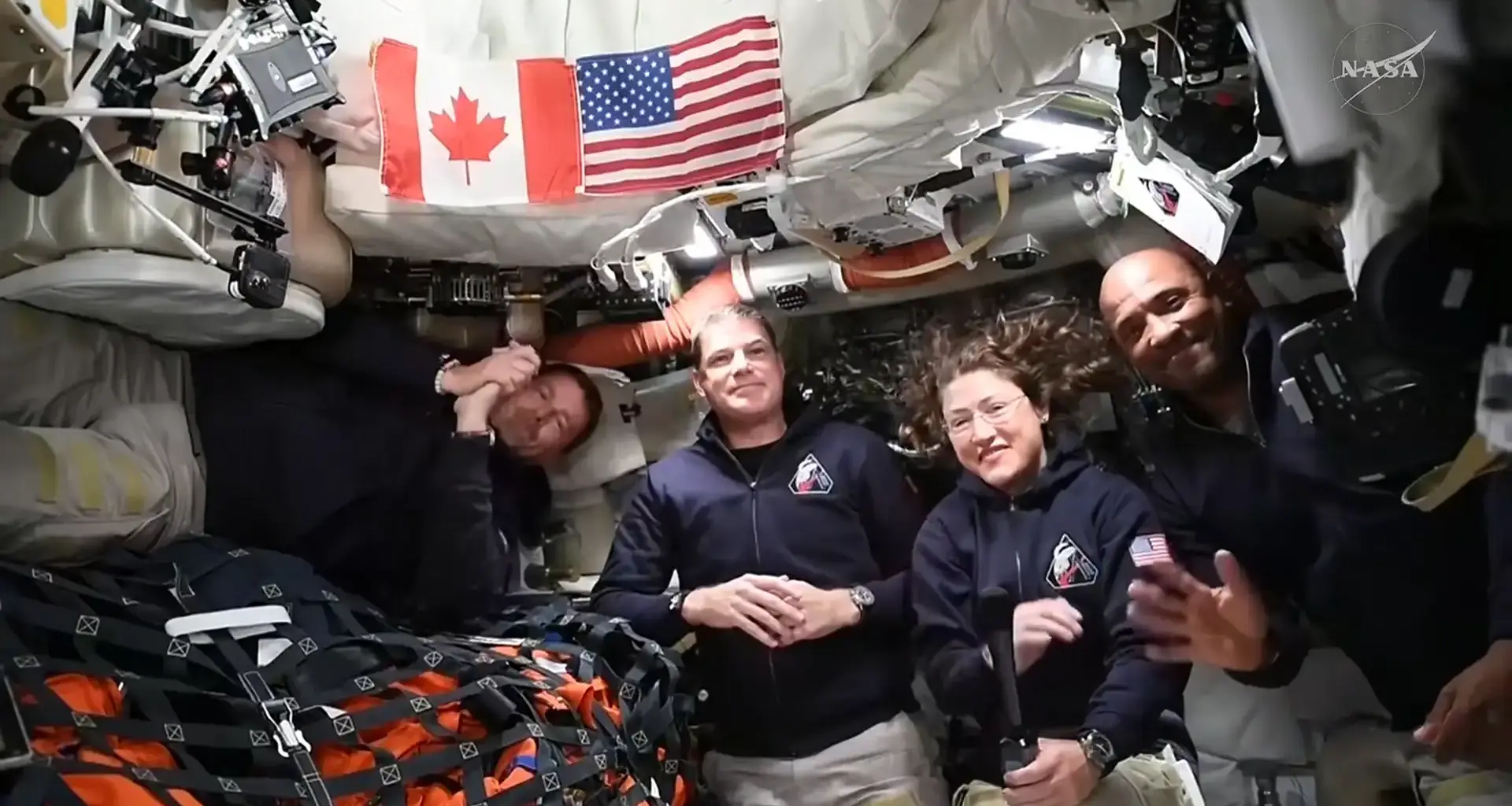

The Artemis II mission is on its way to the moon, and so far, the historic journey has been a display of brilliant engineering. The rocket launched without a hitch, the experiments are going as planned, and we’re getting some marvelous photos as a bonus.
But while the Artemis II crew prepares to shatter more records, one of their most important pieces of hardware (a 3D-printed titanium toilet) is being defeated by a simple block of ice. The world’s elite astronauts are forced to resort to “contingency bags.”
Nasty Smell
For the four astronauts aboard Artemis II, most of their historic journey to the moon has been a masterclass in the cosmic sublime and the deeply mundane. For the first time in over half a century, human beings are closer to the lunar surface than to the ground they walked on last Tuesday. Commander Reid Wiseman described the moon as a “beautiful sight” through the docking hatch. But while the view is five-star, the one thing that’s not shining is the plumbing.
The toilet, which has a door and curtain for privacy, is partly out of service. Astronaut Christina Koch reported a “burning heater smell” coming from it.
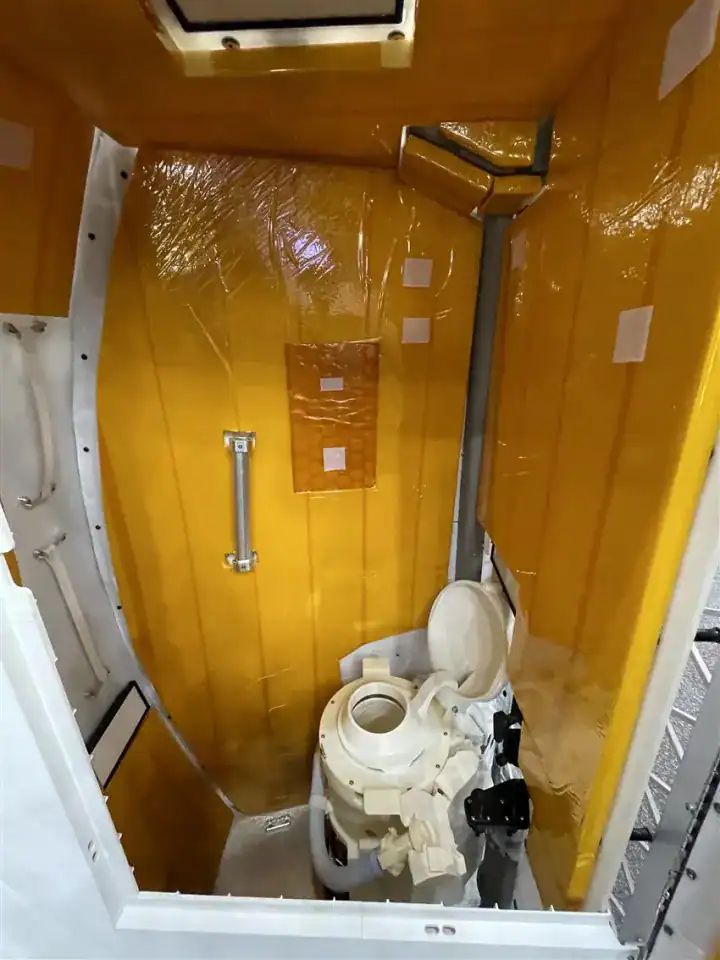 A mockup of the toilet aboard Orion spacecraft. Image credits: Canadian Space Agency.
It started soon after launch. The Orion capsule’s waste system began malfunctioning, forcing the crew to fall back on backup urine collection bags. Ever since, the toilet has been hit or miss. It’s working fine for number two, but peeing is tricky. Until the Orion capsule’s bathroom is fixed, Mission Control has instructed the astronauts to break out more of the backup urine collection bags.
Engineers suspect ice may be blocking a vent line and preventing urine from flushing overboard properly. Basically, some ice has clogged the system, preventing urine from being flushed into the vacuum of space.
The issue has been intermittent rather than catastrophic, but that distinction only goes so far when four astronauts are sharing a small spacecraft on a 10-day mission around the Moon.
In a desperate bid to fix the glitch, Mission Control on Saturday morning even performed a “sun-bathing” maneuver, reorienting the Orion capsule to point the vent toward the sun. The hope was that a little solar radiation can do what $30 million of engineering couldn’t: melt the clog.
×
Thank you! One more thing…
Please check your inbox and confirm your subscription.
It Sounds Like a Small Detail. It’s Not

Space toilets are easy to joke about because everyone instantly understands them. Rockets, life-support systems, orbital mechanics — those can feel abstract. A clogged bathroom does not.
Plus, toilets have been a notorious problem for space exploration since the 1960s.
For the moon missions, astronauts used a “roll-on cuff” (essentially a medical condom attached to a tube) for liquid waste. For solid waste, they used a plastic bag with an adhesive rim that they literally taped to their butts. The Universal Waste Management System (UWMS), the $30 million model currently on Orion, also has a track record that would make a suburban plumber retire.
A version of the Artemis II toilet was tested on the International Space Station several years ago. It was aborted after just three days because the pretreat dose pump (the part that injects chemicals to keep the urine from clogging the pipes) simply died. A second attempt in early 2024 also hit technical snags involving the dosing assembly and the controller.
The Final Boss of Space Exploration
 Image credits: NASA.
Koch, a veteran of the International Space Station, has embraced the role of space plumber” She successfully primed the system once before it clogged again. “I like to say that it is probably the most important piece of equipment on board,” Koch told reporters during a downlink. She isn’t wrong. If a toilet fails on a 10-day mission, the cabin environment quickly becomes a health hazard.
While realistically, the astronauts onboard aren’t threatened by this, it can be a significant inconvenient. It’s also an important red flag for our broader space ambitions.
NASA can build a giant moon rocket. It can fire Orion toward deep space on a free-return trajectory around the Moon. It can produce images that make Earth look like a pale blue dot. And still, one frozen waste line can become one of the mission’s defining storylines.
This mission is a systems rehearsal. It is supposed to expose weaknesses now, before astronauts attempt more ambitious lunar operations later. A toilet problem on a flyby mission is inconvenient. A toilet problem during a more complex mission (say, one involving docking, landing, surface stays, or longer-duration habitation) becomes much more serious.
Still, none of this means the mission is failing. Quite the opposite.
Artemis II remains historic and on track to be a landmark mission. The four-person crew, featuring Reid Wiseman, Victor Glover, Christina Koch, and Jeremy Hansen, carries the first woman, the first Black astronaut, and the first non-American toward the Moon. Orion has already delivered stunning views of Earth and the growing lunar disk. The spacecraft is on a free-return path that will swing the crew around the Moon and send them home.