
 Jon Froehlich
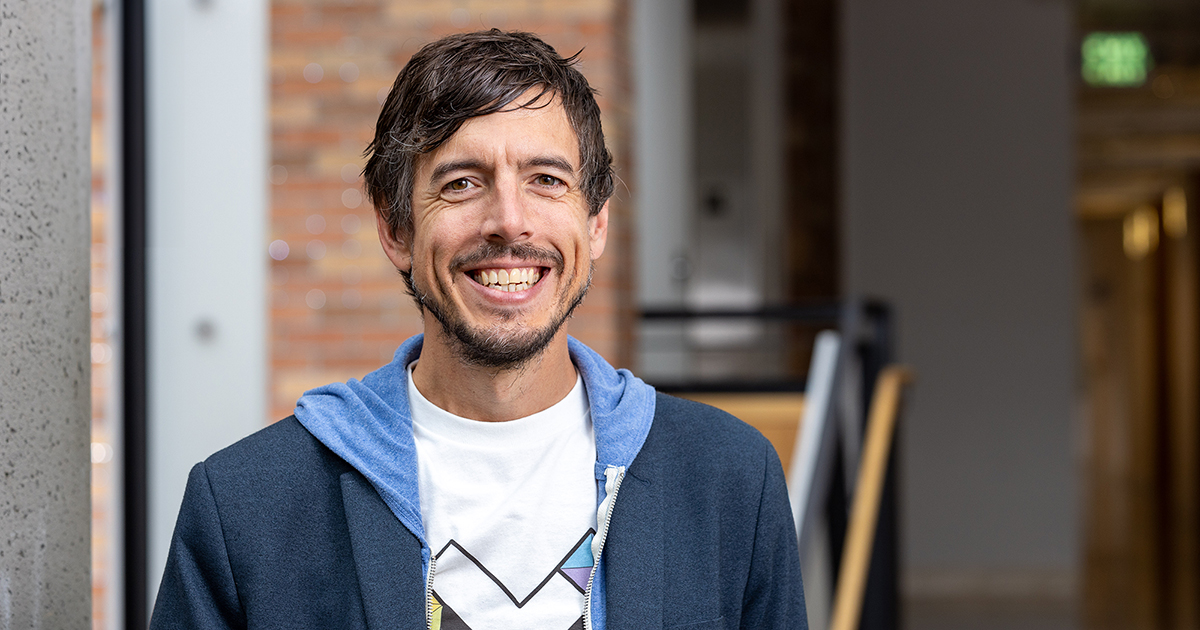
As the director of the University of Washington’s Makeability Lab, Allen School professor and alum Jon Froehlich (Ph.D., ‘11) utilizes human-computer interaction (HCI) and machine learning to tackle high-impact socially relevant problems. Already, his work has led to improved city planning and sidewalk infrastructure across the globe, and he has developed technologies that have enabled blind and low-vision users to prepare meals, participate in sports and even engage with children’s artwork.
“Our work aims to transform how humans interact in the real world via advanced techniques in HCI and AI, such as assessing the bikeability of a city at scale using vision language models and providing personalized bike routes, determining whether a building is accessible and to whom via capability-conditioned AI agents, and allowing people who are deaf or hard of hearing customize their own sound feedback visualizations with Generative AI,” Froehlich said. “This is an incredible time to work in HCI because sensing hardware, computation, and processing have transformed how we can augment human capabilities in the world.”
The ACM Special Interest Group on Computer-Human Interaction (SIGCHI) recently honored Froehlich with the 2026 SIGCHI Societal Impact Award, which recognizes mid-career to senior researchers whose HCI work “demonstrates social benefit.”
“This recognition belongs to my incredible students and collaborators in the Makeability Lab who work tirelessly to design more accessible, equitable futures and pursue research in accessibility, education, and environmental sustainability,” said Froehlich, who is also an associate director of CREATE (Center for Research and Education on Accessible Technology and Experiences).
At the heart of Froehlich’s societal impact is his work developing Project Sidewalk, a web-based platform that uses crowdsourcing and AI to transform how sidewalks are visualized, mapped and analyzed. Users can explore cities through immersive imagery, similar to a first-person video game, and label sidewalks as well as accessibility issues such as uneven surfaces, missing curb ramps or obstructions like poles or fire hydrants. Project Sidewalk has assembled the largest ever sidewalk accessibility dataset — it includes more than 3 million data points across 27,000 kilometers of city streets in 43 cities and 10 countries. Froehlich and his collaborators presented a paper on the project’s pilot deployment in Washington D.C. at CHI 2019, where they received a Best Paper Award.
Across the country, cities have used Project Sidewalk to help fund initiatives to improve the safety and accessibility of their pedestrian infrastructure. For example, in Newberg, Oregon, Project Sidewalk collected more than 17,000 labels and showed that sidewalks were inaccessible especially around voting centers and bus stops, prompting the city council to authorize $50,000 for immediate sidewalk repairs and establish a grant program to help homeowners fix their own sidewalks. After Mendota, Illinois, experienced devastating fires in 2022, community partners used Project Sidewalk data to secure a $3.6 million Illinois Transportation Enhancement Program grant to rebuild their sidewalks.
Project Sidewalk has also helped spur systemic changes in how governments make decisions about accessibility in their communities. In Chicago, the Project Sidewalk team provided expert testimony that helped shift the city’s infrastructure allocation from a complaint-based system to a more data-driven prioritization. The Mexico-based NGO Liga Peatonal partnered with Project Sidewalk to connect municipal accessibility data to international development frameworks. Froehlich also leveraged Project Sidewalk data in his collaboration with the University of Zurich in Switzerland on the ZüriACT project, which aimed to make Zurich more accessible and walkable.
Outside of Project Sidewalk, Froehlich has worked on a variety of other accessibility projects. He led the development of StreetReaderAI, the first screen reader for Google Street View which can describe the physical environment such as sidewalks, crosswalks and ramps to blind and low-vision users. Froehlich and his collaborators also introduced CookAR, a headmounted augmented reality system that provides low-vision users real-time support during meal preparation, and earned the Belonging and Inclusion Best Paper Award at the ACM Symposium on User Interface Software and Technology (UIST 2024). More recently, he and his team developed GeoVisA11y, an AI-based geovisualization question-answering system for screenreader users, which received a CHI 2026 Best Paper Award.
“Jon Froehlich’s research in urban accessibility has achieved what few HCI researchers ever accomplish: direct, measurable change on a global scale,” said Jacob Wobbrock, UW Information School professor and Allen School adjunct faculty. “Specifically, his work has affected how cities invest in pedestrian infrastructure, how communities and governments in 40+ cities plan for accessibility, and how federal agencies define walkability and accessibility data standards.”
Froehlich joins a long line of recipients of the SIGCHI Societal Impact Award from the Allen School community. This includes faculty colleague Jennifer Mankoff, professor emeritus Richard Ladner, alum Nicki Dell (Ph.D., ‘15) and Wobbrock. He will be formally honored at the CHI 2026 conference taking place in Barcelona, Spain, later this month.
Also at the conference, fellow Allen School alum Jeffrey Bigham (Ph.D., ‘09) will be inducted into the SIGCHI Academy. Bigham, who is now faculty at Carnegie Mellon University and director of human-centered intelligence and responsible AI at Apple, is being recognized for his research that combines machine learning and crowdsourcing to enable people to interact with systems in a useful and responsible way, with a focus on accessibility.
Prior to receiving the SIGCHI Societal Impact Award, Froehlich earned a Sloan Research Fellowship, UW College of Engineering Outstanding Faculty Award, U.S. National Science Foundation CAREER Award and the PacTrans Outstanding Researcher Award.
Read more about the ACM SIGCHI Awards here.