
Photo: Warrick Page/HBO Max
Season one of The Pitt established its core cast of medical professionals as both hypercompetent and empathetic in their treatment of patients. They were human, so they made mistakes and sometimes fell victim to unconscious bias, but they always strove to learn and do better. At first, you couldn’t say the same for season two’s most off-putting new addition: fourth-year medical student James Ogilvie (Lucas Iverson), whose general know-it-all attitude and “gunner” persona already alienated his co-workers during his first few shifts at the hospital. It’s hard to root for someone who seems to view patients more as checkboxes for his procedure log than real people — all while insisting he “was born for this.”
As season two progresses, though, Ogilvie shows more of his humanity, thanks in part to lessons in sensitivity from Drs. McKay (Fiona Dourif) and Whitaker (Gerran Howell). After the death of Mr. Green, an English teacher who reminds Ogilvie of his father, he breaks down, forced to reckon with the reality of working in an ER. He may have the technical expertise, but is that enough for this line of work? “I don’t think every doctor does begin like a Whitaker or a McKay or a Robby,” Iverson says. “What do you do when somebody comes in with all of the medicine but needs to learn the humanity?”
What was your first impression of Ogilvie?
I had a breakdown from the audition, which said something along the lines of, “Can’t really read a room, really smart and likes to show it.” I showed up for my fitting, and as I was trying on 60 different T-shirts to go under the scrubs, people were saying, “So I hear you’re really an asshole.” They’re like, “You’ve got a really big rivalry with Javadi coming up.” I was like, “I do? Who is this guy?” Then John Wells got me a really instrumental note in episode one: I was concerned that I was being too much of an asshole, and he said, “I think your job is to be too much of an asshole.” He said this thing that stuck with me that I have been afraid to talk about prior to the end of the season: “If you want to crash into humanity, you have to start running from really far away.” I was like, Okay, give yourself the furthest possible distance to fall.
Did you ever go too far?
We went back and redid a setup so that I could be a bigger asshole in it. Then I was, and we didn’t use any of those takes.
Where does that behavior stem from?
It’s about leaning into that self-preservation and unbridled ambition. I need to choose the thing that I need, even at the expense of other people. Only one of us can get a residency here. If I’m going to make my life into something beautiful, something I want to inhabit, I need to act in this way.
How did your feelings about the character evolve as the season goes on? He does become more empathetic.
It’s interesting, because the arc of Ogilvie changed mid-season. Originally, and in the scene I auditioned with, he burned out and quit. There was this confrontation scene with Robby. The story as I understood it was, this person who on paper should succeed in an environment like the Pitt is obliterated by it and can’t handle the pressure. But as the season went on, the writers gave him a bit more heart. I think that’s when the empathy came in. It felt like we were trying to catch up to ourselves after a certain point: If we wanted to show that there is some humanity inside a person like Ogilvie, how do we inject that mid-season? Which was a fun game to play. I think they nailed it.
On a team full of deeply empathetic medical professionals, Ogilvie often feels like a counterpoint. He seems to stand in for real-world medical biases.
I think the show has a promise of verisimilitude, not only in our medical accuracy but also in whom we show. I get a lot of messages from people now being like, “I was treated by an Ogilvie,” or nurses being like, “I’ve worked with an Ogilvie.” I’ve had a few people be like, “I was the Ogilvie.” It’s an interesting job to give ourselves. Now that we’ve shown this exists and introduced it into the vocabulary of our world, what do you do with these people? What hope is there for somebody like Ogilvie? Do we shun them and hope they quit, or can they be good doctors too? What accountability do they have to take?
Now that Ogilvie has become this love-to-hate character, what is it like for you to become suddenly recognizable as this type of guy?
It’s crazy, man. I didn’t think Ogilvie was a big enough part in our story to warrant the hate that he would end up getting. I thought he would get some offhand comments, but it feels like there are online militias rallying against him. They’re at the gates. Fortunately, everybody has been really nice to me so far. I did pop online during the first few episodes of the season to see what people were thinking, and I quickly learned that that’s not really where I want to be. In moments of temptation I’ve gone back, like after big Ogilvie episodes. I think the needle is starting to swing the other way a bit now.
He has these really interesting contradictions, like the fact that he can speak Farsi, and he seems to be a James Baldwin fan. I wouldn’t have expected that.
Me neither. He does try to say everybody’s names right. He says “Dr. Mohan” instead of Mo-han like everybody else. He learned some degree of Farsi to make friends feel more welcome. And yes, maybe he is doing it in a suck-up, kiss-ass-y way, but he’s still trying to speak somebody’s native language with them. It comes off bad, but the intention has always been good. He has this mixed bag of generosity and withholding of his empathy.
We cut a few lines at the end of the scene where he hands over the Baldwin book. After he hands it over, he says, “This is my dad’s favorite book, so English teacher to English teacher, I thought maybe you would really appreciate it.” It’s interesting that’s no longer the story. It’s clearly a well-loved, worn copy, and I do believe he has read it several times, perhaps looking for a better understanding of his own father. And then to see somebody who reminds him of his father and want to connect with him in that way — more as a son than as a doctor — is also telling of his heart. He’s looking for connection and understanding.
And then that patient, Austin Green, dies, and Ogilvie is totally shell-shocked. How did you play that scene?
In many ways, the prophecy has been fulfilled: He has crashed fully into humanity. In that moment, he is grieving Mr. Green, because he had a connection with this patient. He’s also grieving his vision for himself. He has stumbled into this paralysis of the soul, where his entire identity is wrapped up in the question of this loss. Not only Am I capable of being a doctor if I’ve done something like this?, but Am I capable of enduring loss like this over and over and over? How do you come to terms with death? This is one of his first days of his dream job, and to learn this is a commonality is terrifying for him.
A lot of his asshole-ness throughout the day, his callousness, has been a form of protection. I don’t want to allow myself to connect with this, because bad things happen all the time. Ogilvie got a lot of shit with Louie for “He croaked.” From what I hear, floor-of-hell humor and dismissive comments are very common in the ER, and I think he was partaking in that, particularly because there was this sweet man whom he worked with for maybe 15 minutes and had severe alcoholism. Are we surprised that this is what happened? When he sees everybody else grieving, the shock is not that Louie mattered, but that these people allow themselves to connect in this way. I didn’t realize that was part of doctoring. In the moment with Mr. Green, it has come full circle. Now he’s experiencing it fully.
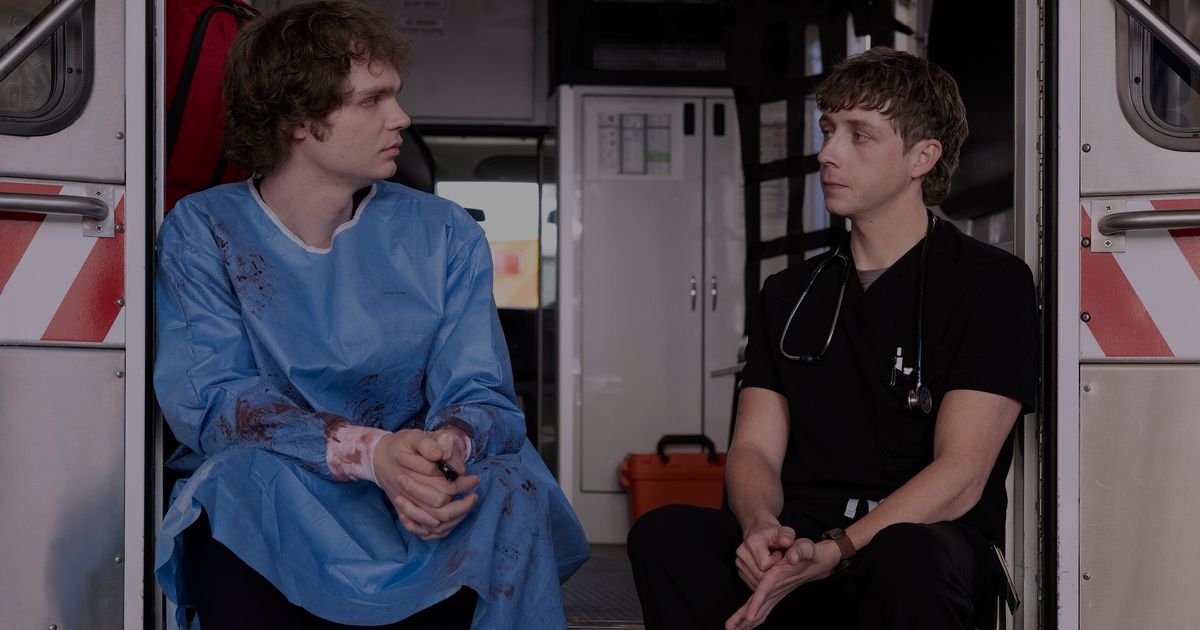
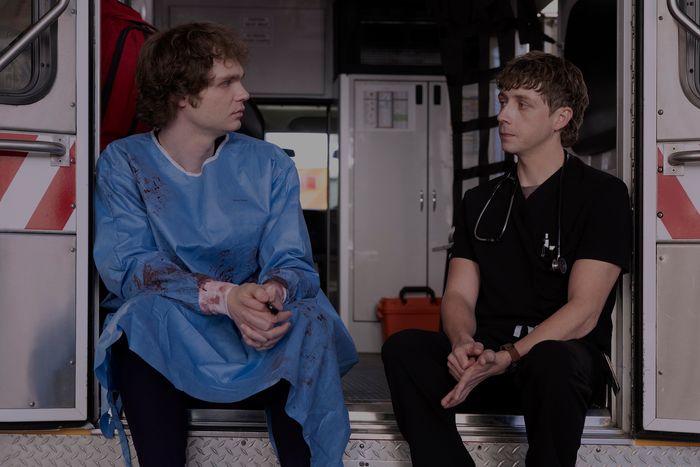
Ogilvie’s last scene in the ambulance bay with Whitaker is a great capper.
I put it in terms of my own life. Whenever an actor says, “I want to quit,” what they’re really saying is, “I need a reason to keep going. It’s not that my love for this thing has lessened or that I’m ready to move on from it, but right now the pain of this thing is too much. Somebody help.” In that moment, Ogilvie is experiencing that same crisis of identity. He needs some validation and some understanding and context with which he can frame this experience to know if he can keep doing this. He suggests pedes in that scene. Like he’s going to be good with kids!? He’d rather kill himself than do that. I think he picks pedes because he feels like kids don’t die as much. It’s all about the avoidance of grief.
Whitaker discovers Ogilvie in his privacy. He originally went outside to hide this experience from everybody; he felt some degree of shame from this experience. He has no choice but to unfurl himself to Whitaker, who, thank God, is Whitaker. Whitaker is seeing some degree of himself in Ogilvie, and he beautifully mirrors that speech with Robby in season one, about finding the balance.
What was it like to join this cast at the height of hype for the show?
I was so afraid of joining the show, but I began to settle, and then the awards hype happened and I freaked out all over again, like, Oh man, what are the odds that my first job is the job? Everybody on that set is generous to a fault. Noah and I would sit next to each other in the family room most mornings, and we would both journal. We would have really tender, sweet conversations about our dads or acting and how we got here and our lives thus far. And he had patience for when I would come in and be like, “How do you learn what the camera is actually seeing?” All of these very beginner questions.
I also have to mention the poop cannon. Whitaker famously got sprayed with various bodily fluids in season one, and now he has passed the torch to you.
That’s what everybody was saying. Noah had a video on his phone of the dummy when they were testing. One mannequin was getting hit with the shit cannon, and it got visibly rocked back. Noah would watch it over and over again, like, crying from laughing. “This is you, this is going to be you!”
I was so nervous going into that day. Damian Marcano, the director, comes out, and he’s like, “Hey, we’ll do as many as we need to do, but there’s no practice. Get ready. Don’t break.” I felt like we were a group of schoolchildren going into the scene. We knew what was coming and mocked it a bunch of times without doing an actual cannon, and then the writer — Simran Baidwan, she’s amazing — comes in and is like, “Lucas, you look like you’re getting shot. Calm down. It’s not going to be that bad.” It was. The first time we did it, it was so forceful that it went all over my face, and a little bit of poop got in my mouth. It didn’t taste like anything, thank goodness. Our makeup person took a picture of the flecks of shit on my face, so now we have the mini-wall of Lucas above the wall of Gerran from season one. And we didn’t end up using that take at all.
What do you see for Ogilvie’s future?
The writers landed the plane really beautifully. It would’ve been a little too easy to give him a typical redemption arc. What they’ve opted for instead is this arc of destruction. He puts his heart out on the line and pow, someone smacks him on the chin. His world is shattered. His idea of medicine is destroyed; he looks around the ED, and all he sees is people being destroyed. That’s one of the themes of this season. Robby, one of the most caring doctors you’ll ever meet, can’t take it anymore. He’s at his breaking point. Langdon had a breaking point. Samira, breaking point. It’s all these big hearts being crushed, which I think means that’s a prerequisite.
That’s not to say Ogilvie isn’t cut out for it or should quit. But I think he has cleared out enough of his dream to where a calling can now begin. Whether we see it or not, I hope he stays. That’s a good message for the world: that there’s a path forward when maybe your heart has been closed. What a beautiful place to begin with a true understanding of what this work takes.
Sign up for the Vulture Daily
An entertainment newsletter for the pop-culture obsessed.
Vox Media, LLC Terms and Privacy Notice
Related