
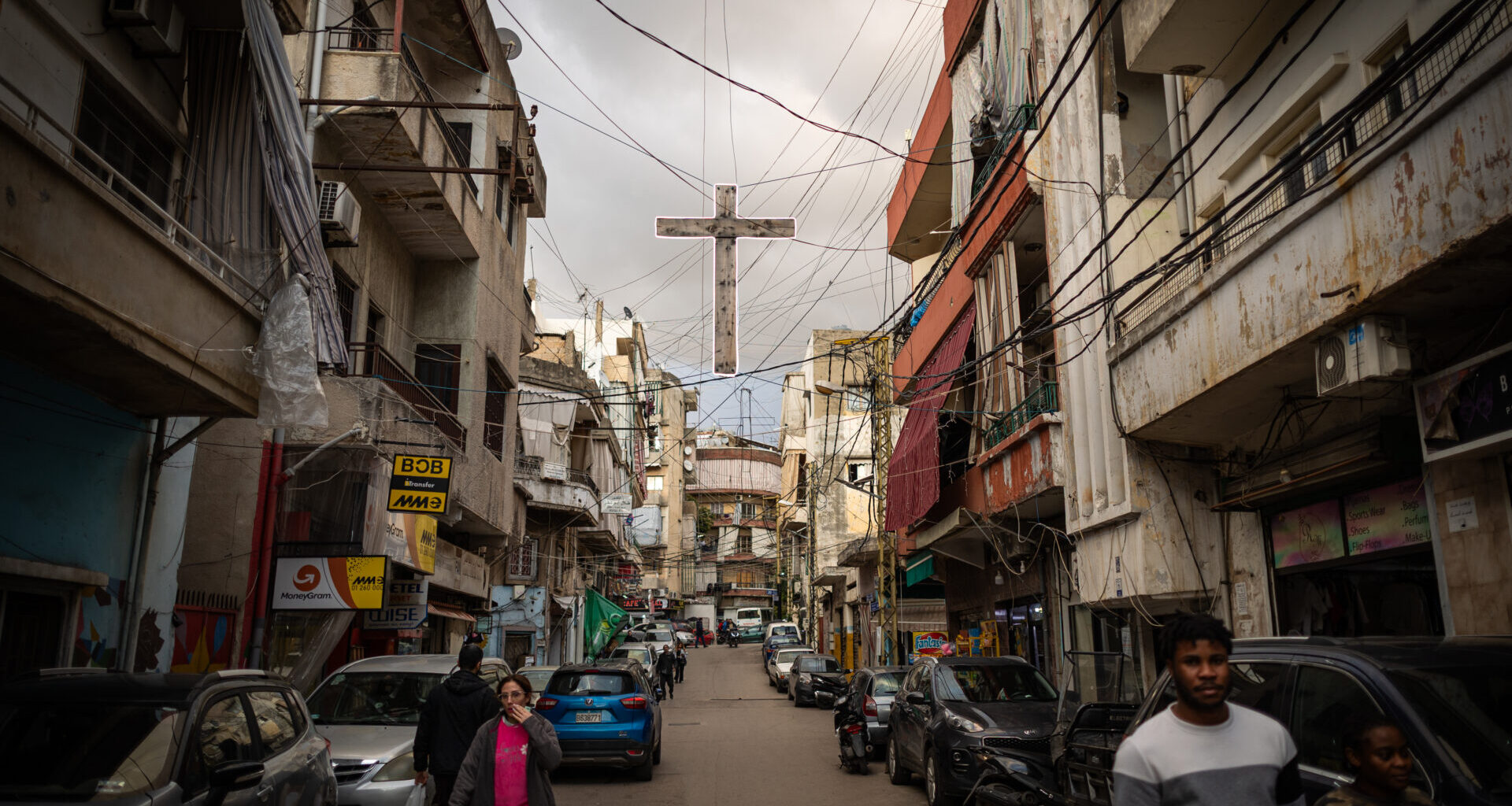
Israeli strikes on so-called safe areas tend to be accurate and far less destructive than the attacks it carries out on Shia communities and Hezbollah-aligned areas, where entire buildings are often destroyed, even when civilians are inside. In attacks like the one in Nabaa, Israel utilizes highly precise ordinances with smaller payloads that seem intended to mainly damage and kill people in specific apartments within a building.
But even in these more reserved strikes, civilians are sometimes injured and killed. The back-to-back attacks on the building in Nabaa killed at least one person and injured four others. On Sunday evening, March 5, an Israeli strike on a largely Christian town outside of Beirut killed three civilians, including an official in the Lebanese Forces, a Christian political party that is staunchly anti-Hezbollah.
Such attacks have inflamed Lebanon’s social tensions as some areas have moved to enact strict security measures and restrict or ban Shia families from renting homes. When I met Hagop a couple weeks ago, he said there was no indication that such measures had been put in place in Bourj Hammoud, at least officially. But residents did fear that more attacks like the one in Nabaa could follow.
Hagop, however, seemed a bit more relaxed.
“Here, you know almost everyone,” he said. “It’s such a small place, and it’s mostly Armenians here, so it’s very unlikely that we would have Hezbollah facilities or anything like that.”
Still, that reassurance didn’t mean he was unaffected by the war.
The sound of airstrikes sometimes kept him awake at night. With social venues closed or feeling it was insensitive to post on social media, he had less work. And in the somber atmosphere of war, he and his friends weren’t going out much.
Like many Lebanese Christians, Hagop saw himself as caught in the crossfire of a conflict that wasn’t his and that he never wanted.
“I don’t feel like this is Lebanon’s war,” he said. “Definitely it’s Hezbollah’s war. We are just caught in the middle.”
After the end of Lebanon’s civil war, all of the various militias involved in the conflict were required to relinquish their weapons — except for Hezbollah, which, though not specifically named, was allowed to keep its arms under the auspices of fighting the Israeli occupation in the country’s south.
In 2000, Israel withdrew its military forces, winning Hezbollah widespread popular support and legitimizing its claim to fame as a resistance movement. Over the next two decades, Hezbollah held onto its weapons as it grew in power with support from its patron Iran.
But its rise did not come without controversy. Hezbollah’s de-facto control over national security issues and its intervention in neighboring Syria led to widespread opposition towards the group and calls that it be disarmed, especially in the wake of its decisions to enter into conflict with Israel.
While Hagop is one of the people who would like to see the government strip Hezbollah of its weapons, he is doubtful that it can. “The state is not super effective, they’re not super capable,” he said. “It’s long been known that the army doesn’t have good enough weapons, or enough soldiers, or enough anything to disarm Hezbollah.”
Such cynicism is widespread in Lebanon, especially in the wake of a controversial government plan cautiously launched by the Lebanese military to disarm Hezbollah.
“I don’t think the army really engaged in a serious disarmament process of Hezbollah,” said Michael Young, a Lebanon analyst at the Malcolm H. Kerr Carnegie Middle East Center think tank in Beirut. “The simple reason is that the army was not willing to get into a military confrontation with Hezbollah. It’s as simple as that, because I think the army believes, probably correctly, that it would not be able to prevail in such a situation.”
But inferiority was not the only factor that gave the military pause. In a country still carrying the trauma of civil war, there is little desire for another one. To confront Hezbollah militarily, Young noted, would also mean to confront the Shia community. “The Lebanese state is not going to enter into a civil war with one of its communities on behalf of Israel and the United States,” he said.
With Israel expanding its military campaign in Lebanon, the government finds itself between a rock and a hard place as Israeli officials issue a dire ultimatum: disarm Hezbollah, or suffer a fate similar to Gaza.
In recent weeks, the Lebanese government seemed to bend to pressure as it issued a ban on Hezbollah’s military activities and declared Iran’s ambassador persona non grata, ordering him to leave the country before the end of March. But with Hezbollah continuing to launch attacks and the ambassador refusing to leave the country, such measures seem to be little more than symbolic.
Still, some Lebanese fear that they could push the country towards a civil war.
On a cold, wet night in March, Mano Ashodian sat in his shop in one of Bourj Hammoud’s labyrinth of narrow streets, tinkering on a few gems at his desk.
The diamond setter had far less work now than before the war. So did other jewelers in the suburb. Fear and uncertainty had disrupted supply and demand. It had also led shop owners to move their gold from display windows to closets, worried that an airstrike could destroy the glass and make them vulnerable to theft.
Several days prior, rumors suddenly spread that Israel would bomb a popular gold and currency exchange provider in Bourj Hammoud. Panic ensued, employees went home, and shops closed. But no airstrike ever came. The rumor, it turned out, was nothing more than a rumor.
“In this situation, you don’t know which news is fake and which news is real,” Ashodian said. “You’re afraid.”
But as terrifying and challenging as the conflict may be at times, what Ashodian fears even more than the war now is a return to civil war in Lebanon.
“If this becomes a civil war, it will be a very, very bad situation,” Ashodian said.