
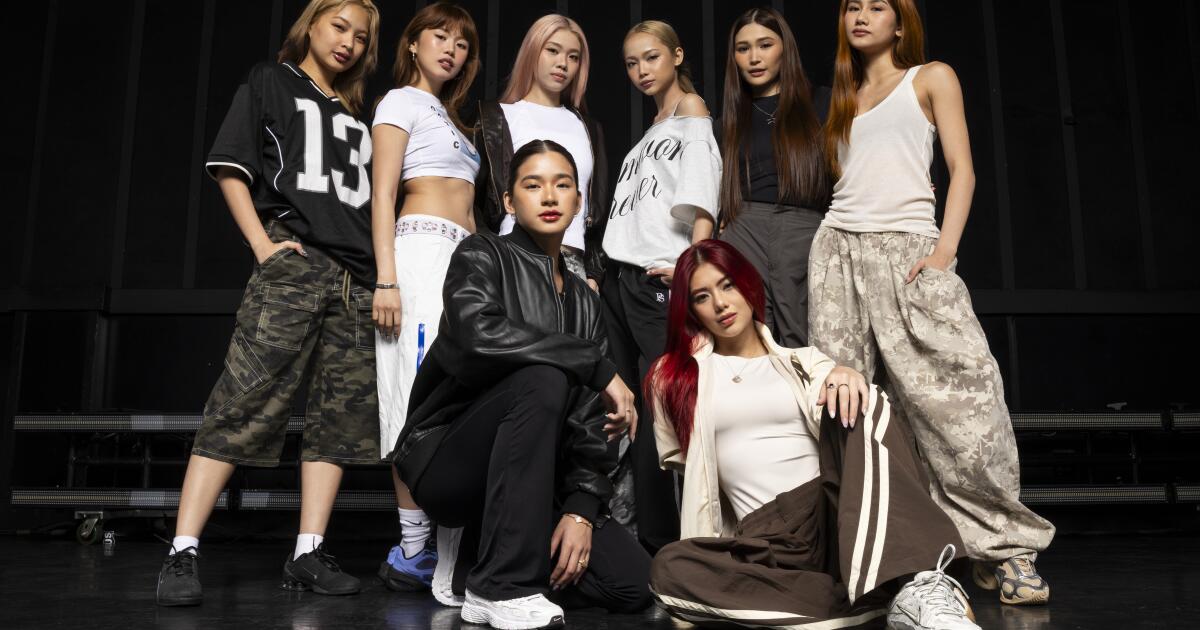
The eight members of the Filipina girl group Bini learned they were playing Coachella the same way their fans did: from people freaking out on social media when the lineup dropped.
“We were at an event in the Philippines, and then I found out from a fan on X,” Bini member Stacey said. “I was shocked. At first, I didn’t believe it, because I thought it was just a joke. But when I messaged our group chat, we found out that it’s true, we are performing for Coachella. It was a surprise from the management. I think history was made.”
Bini will indeed make history when its members take the Mojave stage on Friday at 4:15 p.m., becoming the first group from their country to perform at the world’s most influential music festival. Bini — already stadium-sized superstars in Asia — is the latest emissary in Coachella’s reach for new sounds from around the globe. Now that K-pop is a fixture on the fest’s biggest stages, Bini could make a major impression as an ambassador for a country that is a great crossroads for music.
“It’s not the first time that a Filipino act has been able to step on a global stage,” the band’s Aiah said. “But we do feel that sense of responsibility as well, especially for Coachella.”
“It’s a great responsibility for us,” Colet added. “Because we want to open the door to more Filipino art.”
Five days before showtime, it was bright and early at a blacked-out soundstage near the Burbank airport when Bini rolled in for rehearsals. The band (Gwen, Jhoanna, Maloi, Colet, Aiah, Mikha, Stacey and Sheena) were still in street clothes — bootlegged Sonic Youth T-shirts, massive bomber jackets — and fighting some lingering jet lag. But the group and its half a dozen dancers, already performing perilous splits before breakfast, were prepping to run through the steps of the big intro to their set.
“Growing up hearing things about Coachella, I believed it’s a festival for people who really love music, and want to discover new music,” Maloi said. “For us, performing there is such a big deal, it’s nerve-racking.”
Bini — first formed under the Philippine media giant ABS-CBN series “Star Hunt Academy” — released its debut album in 2021. The global prominence of K-pop provided a model for training and a ready fanbase for its zingy, powerfully sung forays through pop, club and hip-hop.
By 2024, the band had a breezy Latin-infused TikTok hit in “Pantropiko” and debuted at KCON in Los Angeles, the first Filipino act to play that elite showcase. The next year, it played the Peacock Theater, soon to be the home of the Oscars. L.A.’s massive Filipino community turned out in droves.
The Philippines — with a long, if fraught colonial relationship to American pop culture — punches above its weight in music. Veteran Pinoy rock bands like Eraserheads and current acts like Cup of Joe and Lola Amour are cutting-edge, virtuosic and exquisitely emotive. The karaoke culture is, of course, legendary.
Yet Bini arrives in the desert at an important pivot point for Filipino artists around the world. American superstars like Olivia Rodrigo, Bruno Mars and H.E.R. have championed their Pinoy heritage. Festivals have recognized that, while K-pop broke a lot of ground, many other countries have distinct twists on the formula worth exploring.
Bini’s music is broadly appealing, undeniably lovestruck and hooky. A new EP, “Signals,” kicks off with a pair of songs, “Unang Kilig” and “Honey Honey,” that keep pace with Coachella headliner Sabrina Carpenter’s velvety neo-disco. But the nonchalance of the sapphic romance portrayed in the video for 2025’s “First Luv,” and the ferocious rapping of “Shagidi” show this is an ambitious band with influence and inventiveness, too.
“We have this big platform, so it’s important for us to make people feel that they’re included in everything that we do,” Maloi said. “The LGBTQIA+ community in the Philippines is so big, and the actors that we got for that music video [Klarisse de Guzman and her partner Trina Rey] are big names in the Philippines. So seeing that representation in a music video, you’ll get inspiration, and you’ll be more empowered to be yourself and just feel what you want to feel.”
Watching a K-pop groups like Blackpink headline Coachella — and a veteran act like Bigbang return to the stage this year — broadened their aspirations for performing in the U.S. They’re huge stars at home and have a devoted Filipino diaspora audience abroad— the band effortlessly snaps between Tagalog and English lyrics. But they saw potential in a Coachella audience eager to learn where they come from.
“For Coachella, we became more intentional with everything — the music, the arrangements, we’re involved,” Jhoanna said. “It’s our first time here, it’s a much bigger audience, so we want to make an impression and prove that Filipinos deserve to be on that stage.”
The band takes care with its stages as a platform for Filipino culture — it champions local fashion designers in stage outfits, and its backup dancers are from elite troupes in the Philippines. At early Coachella rehearsals, you could see a well-seasoned group working to underline its distinct cultural voice, while still delivering the exuberant pop it’s beloved for.
While they’re in L.A., the band members will flank their Coachella gigs with a packed schedule introducing themselves to the broader U.S. music industry (the group is now signed to The Team, formerly the Wasserman Agency). They have a gig at the Grammy Museum on April 21.
Bini‘s members lit up at the mention that they share a kinship — a sense of kababayan — with the Filipino American artists who have had enormous success here. Bruno Mars worked his magic with Rosé on the Hot 100 smash “APT.” based on a Korean drinking-game chant — perhaps he’d dig the like-minded “Shagidi.” But they are really holding out to bump into a certain fellow Filipina in Indio.
“We’re very big fans of Olivia Rodrigo, and honestly, we are really hoping to to meet her here,” Gwen said, beaming at the possibility. “Maybe we can collaborate with her with a song in the future, or just cook lumpia together.”