
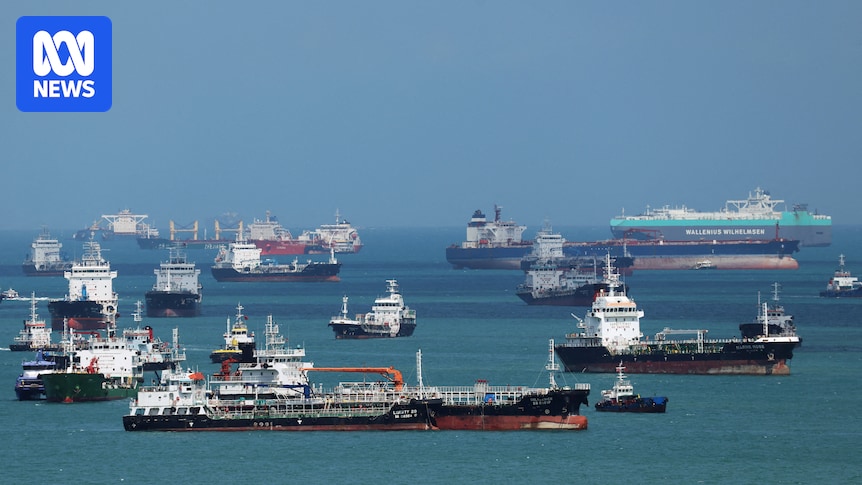
Prime Minister Anthony Albanese is in Singapore today to discuss locking in fuel supplies with his counterpart, Prime Minister Lawrence Wong.
Singapore is a major oil refining hub — it is one of Australia’s most important sources of refined petroleum products and our largest source of petrol.
However, about two-thirds of the crude oil that normally goes into the city state’s refineries has been significantly disrupted by the effective closure of the Strait of Hormuz for more than a month now, and they have had to cut output.
Iran war live updates: For the latest news on the Middle East crisis, read our blog
Regardless of what happens with the “ceasefire” between the US and Iran, over the coming weeks and months some customers could have their deliveries restricted — and Australia does not want to be one of them.
We have a strong card to play — our liquid natural gas resources, which are critical for the Singaporean government.
But Singapore’s oil refineries are owned by companies — not the government — and they are the ones who decide who to sell their product to.
So what can Mr Albanese’s “energy diplomacy” actually achieve?
Albanese in talks with Singapore to put Australia at front of fuel queue
Flavio Macau, an associate professor of supply chain management at Edith Cowan University, said Mr Albanese’s trip was “very necessary”.
“When you don’t have the stock, you need friends,” he said.
“It’s important to nurture those relationships and to find some common ground to assure that if things get complicated, we get … [to be in] the front row when Singapore starts redirecting its exports, if things get more pear-shaped.”
Kevin Morrison, energy finance analyst at the Institute for Energy Economics and Financial Analysis, said Mr Albanese was not the only one making urgent overseas trips.
“South Korea is sending a special envoy to Kazakhstan, Oman and Saudi Arabia to secure oil supplies,” he said.
“The Japanese prime minister, Sanae Takaichi, is visiting Australia at the end of this month, when they will discuss energy among other issues.
“There are a lot of countries in the Asia-Pacific that are missing oil volumes and have to both seek new supplies as well as secure the diminished supplies.”
Where is Australia in the queue?
The Middle East oil crunch is hitting the Asia-Pacific particularly hard and Australia is competing for petrol, diesel and jet-fuel deliveries against countries around the region — such as Cambodia, the Philippines, Vietnam and Thailand — and even further afield.
However, while there is no formal “queue” or priority for Singapore’s exports, experts agree that Australia is already a preferred client.
Mr Morrison said Australia was a big customer for Singapore’s refineries and it helped that ExxonMobil, which operates a refinery in Singapore, and Chevron, which has a 50 per cent stake in another, were also fuel distributors in Australia.
Singapore’s biggest oil source is blocked
Associate professor Rahman Daiyan, a renewable energy and powerfuel specialist at the University of New South Wales, said allocation was largely driven by commercial contracts, pricing and logistics.
However, Australia was likely to be relatively well-positioned within Singapore’s system, he said.
“This reflects a combination of factors: Australia is a large, stable and creditworthy buyer, has long-standing trade relationships with Singapore and benefits from strong government-to-government engagement,” he said.
All the experts spoken to by the ABC agreed that Australia’s position as a large-scale supplier of Singapore’s liquid natural gas (LNG) was a big advantage.
Supplies to Asia of the gas have also been disrupted by the US-Israel war on Iran.
Loading
ISEAS-Yusof Ishak Institute principal fellow Sharon Seah said Singapore’s power generation was 95 per cent dependent on imported LNG with about a third provided by Australia.
She pointed out that a key aspect of Singapore and Australia’s recently upgraded Comprehensive Strategic Partnership 2.0 was the pledge to “support the stable supply of natural gas as the region transitions to net zero”.
“Regardless of the current crisis, this is already a pillar of cooperation that our countries are pursuing,” she said.
“This will be a good starting point for the two sides to begin enhanced energy trade between us because, even if the two-week ceasefire holds and the conflicting parties move to work towards durable peace, the events of the past five weeks will continue to put downward pressures on our economies.”
Dr Macau called it a “two-way highway”.
“So you give me your diesel, Singapore, and I will continue to give you preference as I export my gas to other countries,” he said.
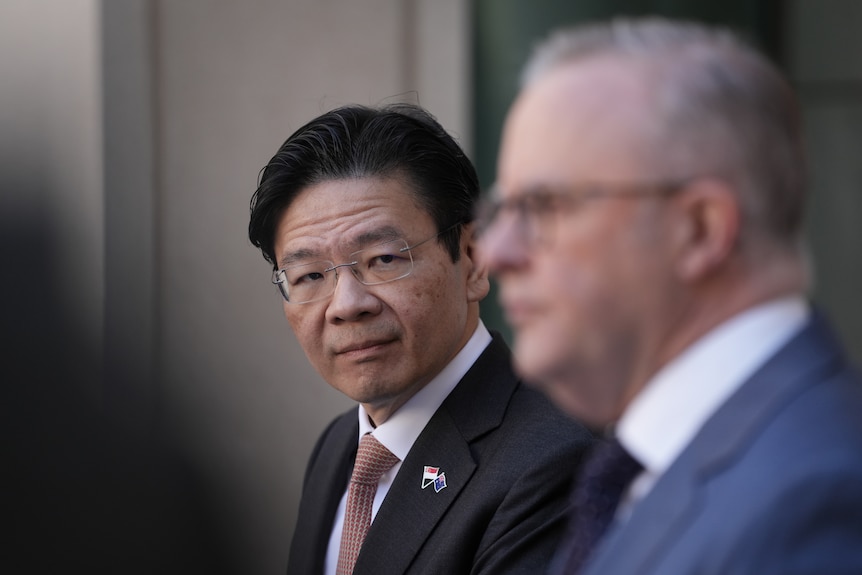
Singapore’s Prime Minister Lawrence Wong visited Australia in October. (ABC News: Matt Roberts)
How much leverage does Australia’s LNG provide?
While Australia’s LNG assets may offer leverage, experts are split on whether Singapore would intervene to steer fuel exports towards Australia in return — or stick to a more hands-off, market-based approach.
Dr Daiyan said the major refining and trading players operated on commercial terms, making independent decisions on where cargoes were sold based on contracts, pricing and logistics.
“This limits the government’s ability to directly mandate destination-specific supply in normal conditions,” he said.
“As a result, Singapore’s assurances are not hard guarantees of volume.
“Instead, their value lies in reducing policy risk and improving coordination through commitments to keep trade open, avoid export restrictions and provide early warning of disruptions.”
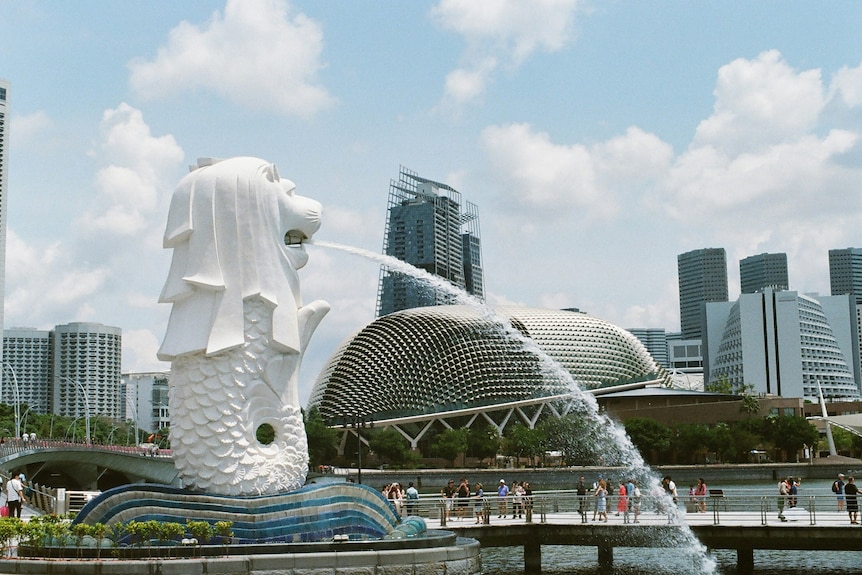
Singapore is looking for alternative sources of crude supply after disruptions to shipments from Gulf states. (Unsplash: Jisun Han)
Dr Daiyan said these signals were important when markets got tight, as they supported confidence, enabled better planning and could influence how commercial players prioritised flows.
“For Australia, this translates into practical advantages rather than certainty,” he said.
“Strong bilateral engagement can improve visibility, access and informal prioritisation within Singapore’s system, but outcomes will still be shaped by market conditions and regional competition.”
He said that if supply was “ring fenced” it would likely result in even higher costs being passed onto Australian consumers.
“Over time, it could reduce flexibility, raise costs and create regional tensions by distorting Singapore’s open trading model, ultimately forcing a trade-off between immediate security and longer-term efficiency and resilience,” he said.
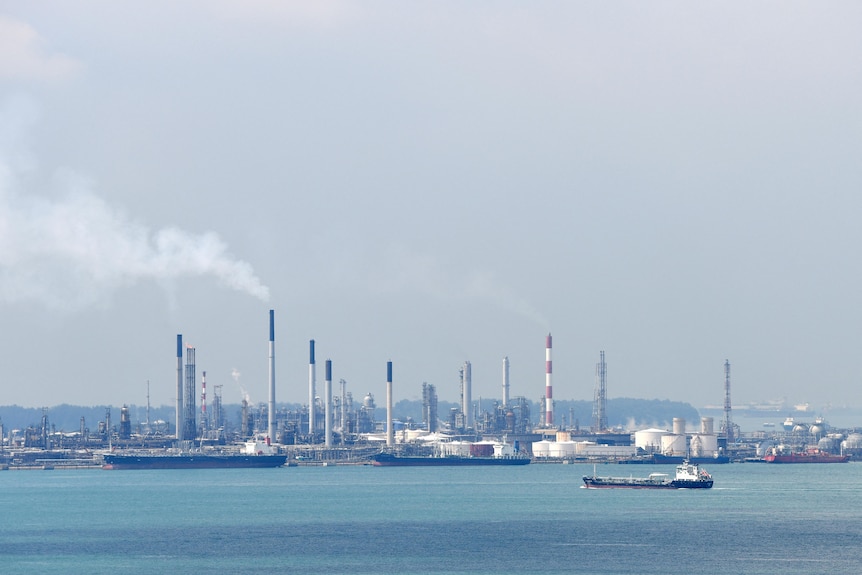
Bukom Island hosts one of Singapore’s major oil refineries. (AFP: Roslan Rahman)
A ‘very complex dance’
However, Dr Macau said that if the oil crunch became really serious then government influence could become more of a factor.
He described it as a “very complex dance”.
If it came to a point where refiners were being forced to renegotiate or cancel supply contracts because of the war, then they would have some discretion, he said, and such decisions could be influenced by the government.
“The companies, they will want to be on good terms with government because government … can change some rules that can hurt a business considerably,” he said.
“So yes at the end of the day, it is the companies that make the business company-to-company, but they will be in active talks with governments to also make decisions in a way that it preserves their position with their governments.”
He said that Mr Albanese may not be able to fly home with a formal guarantee of supply.
“But it kind of paves the way, it gives the direction about who should have preference if things, again, get pear-shaped,” he said.
Loading…