
When Earth faced its worst mass extinction 252 million years ago, survival was anything but guaranteed. The planet turned hot, dry, and unstable, and most species simply could not adapt to the rapid changes.
But one animal stood out. Lystrosaurus, a small plant eater, not only survived but became one of the most common land animals of its time.

Scientists have long wondered how it managed to thrive in such a harsh world – and a new discovery may finally provide the answer.
Lystrosaurus quickly adapted
The End Permian Mass Extinction changed everything. Forests disappeared, rivers dried up, and food became scarce.
Many animals could not adapt to these changes. Lystrosaurus, however, adjusted quickly and became one of the most common land animals.
Scientists have studied this animal for years, trying to understand its success. A recent study by researchers from the University of the Witwatersrand and the European Synchrotron Research Facility has revealed a major clue.
The discovery of a fossil egg with an embryo inside has changed how scientists view early mammal ancestors.
Lystrosaurus fossil egg found
For a long time, scientists believed that early relatives of mammals laid eggs. However, no direct fossil proof existed, which made the idea uncertain for nearly two centuries.
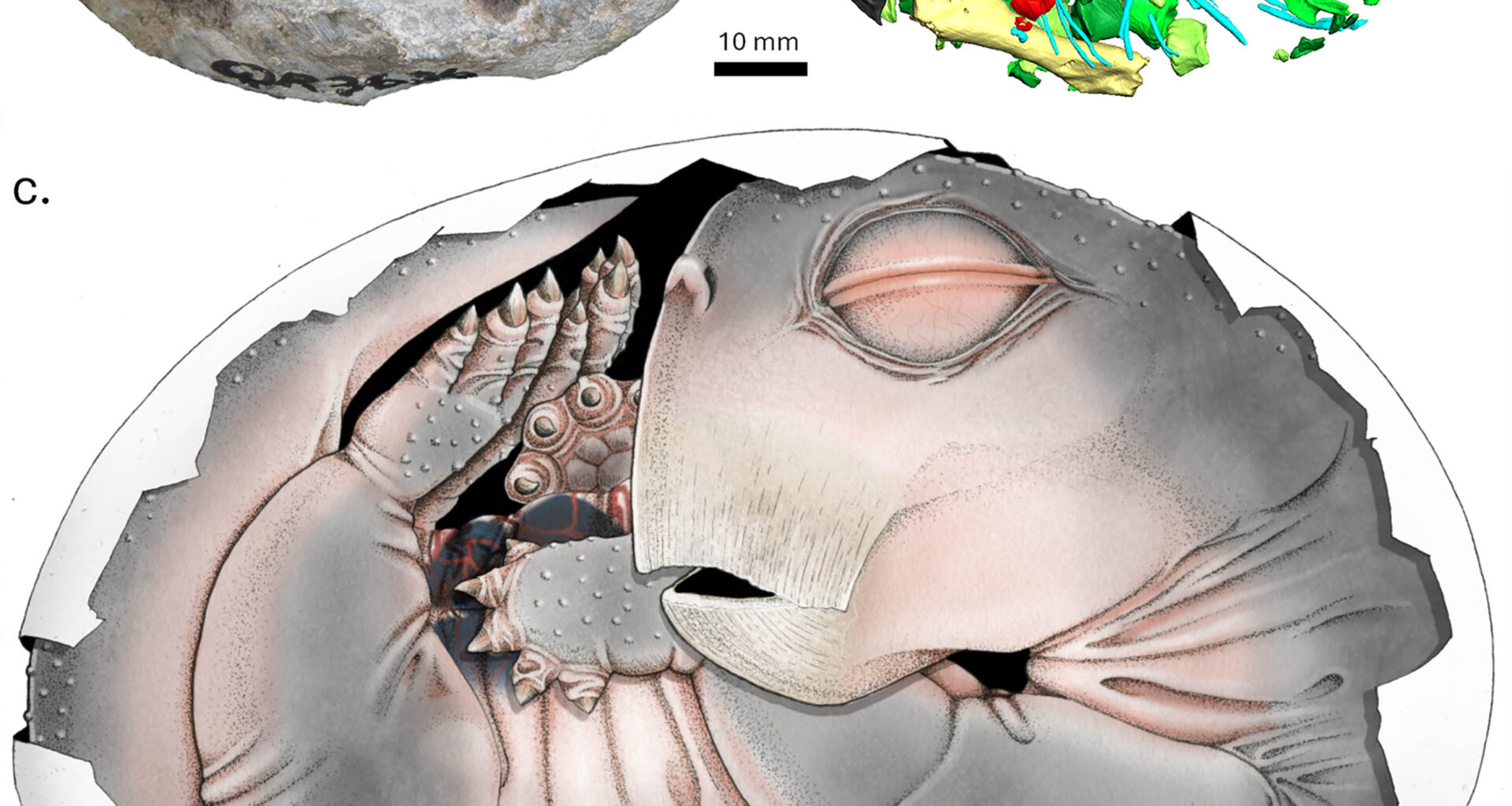
Now, that mystery is solved. Researchers found a Lystrosaurus embryo curled inside what was once an egg. This is the first confirmed egg from a non-mammalian synapsid, the group that later gave rise to mammals.
The fossil shows that egg-laying was likely the original way these animals reproduced. It also supports ideas about how modern mammals later evolved different ways of caring for their young.
“This fossil was discovered during a field excursion I led in 2008, nearly 17 years ago,” said Professor Jennifer Botha, one of the study’s authors.
A small nodule initially showed only tiny flecks of bone. As it was prepared, it became clear that it was a perfectly curled-up Lystrosaurus hatchling. Researchers suspected it had died within the egg but did not yet have the technology to confirm it.
At first, scientists could not confirm whether the fossil was truly inside an egg. The bones were too delicate to study using older methods. Years later, advanced scanning technology helped solve the mystery.
Scanning the Lystrosaurus egg
“Understanding reproduction in mammal ancestors has been a long-lasting enigma, and this fossil provides a key piece to this puzzle,” said Dr. Vincent Fernandez, co-author of the study.
“It was essential that we scanned the fossil just right to capture the level of detail needed to resolve such tiny, delicate bones.”
Using powerful X-ray scans, scientists studied the fossil without breaking it. The scans showed that the skeleton was tightly curled, a position seen in embryos inside eggs.
The fossil also lacked a hard shell, suggesting that the egg was soft and leathery. Soft eggs do not fossilize easily, which explains why scientists had not found such fossils before.
Embryo was not ready to hatch
The embryo showed clear signs that it had not yet hatched. “When I saw the incomplete mandibular symphysis, I was genuinely excited,” said Professor Julien Benoit, first author of the study.
“The mandible, or lower jaw, is made up of two halves that must fuse before the animal can feed. The fact that this fusion had not yet occurred shows that the individual would have been incapable of feeding itself.”
The study also found that the bones were not fully developed. The jaw had not fused, and some parts of the skeleton were still soft. These features show that the animal was still growing inside the egg.
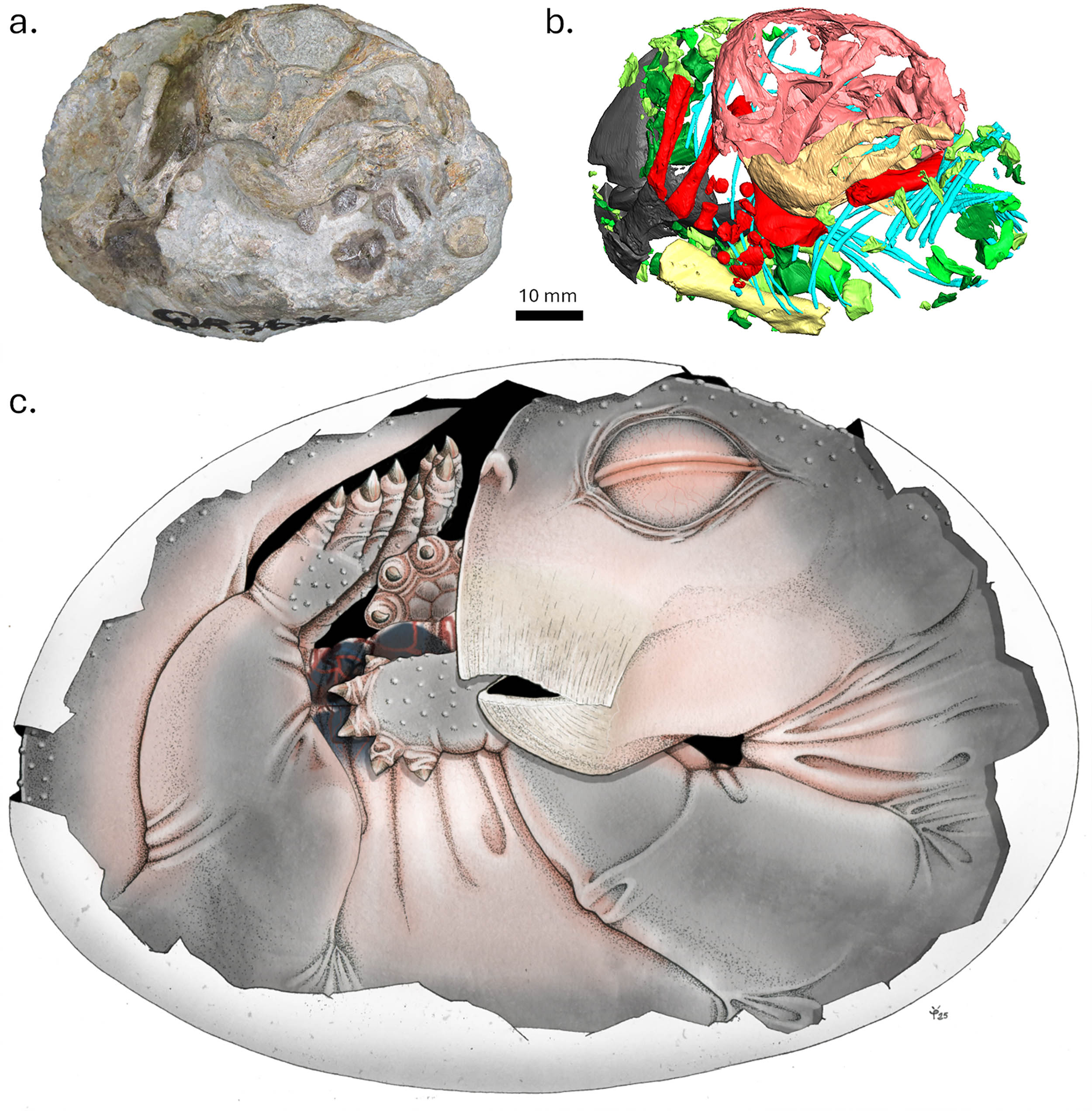 Lystrosaurus egg – The first non-mammalian synapsid embryo from the Triassic of South Africa. (A) photograph of the specimen; (B) 3D digital reconstruction of the segmented bones; (C) live reconstruction by artist Sophie Vrard. Color code for b: vertebral elements in shades of green, ribs in blue, forelimb elements in red, femur in yellow, pelvic girdle elements in grey, skull in light red, mandible in light orange. Credit: PLOS One. Click image to enlarge.Large eggs for a harsh world
The research shows that Lystrosaurus laid relatively large eggs. Scientists estimated that the eggs were quite large for its body size.
Large eggs contain more yolk, giving the developing embryo enough nutrients to grow stronger before hatching. This also means the young animal does not depend on parents for food.
Large eggs also help in dry conditions because they lose less water, which is important in hot environments.
After the extinction, the Earth was dry and harsh. These eggs likely helped Lystrosaurus survive when other species struggled.
Babies were ready after hatching
Lystrosaurus babies were likely well developed at birth, a trait scientists call precocial development. These young animals could move, feed, and avoid danger soon after hatching.
Fossils show that young Lystrosaurus were often found alone or in small groups. This suggests small clutch sizes but strong, independent offspring.
This strategy worked well in a dangerous world. Faster growth and early independence helped the species spread quickly. High juvenile death rates during that time also made early reproduction important for survival.
No milk feeding in early mammals
Unlike modern mammals, Lystrosaurus likely did not produce milk. Its large eggs provided enough nutrients for development.
In contrast, modern egg-laying mammals like the platypus lay smaller eggs and feed their young after hatching.
This shows that milk feeding evolved later in mammal history. Lystrosaurus represents an earlier stage, where survival depended more on egg size and early independence.
Lessons from the Lystrosaurus egg
The story of Lystrosaurus shows how life adapts during extreme crises. This animal survived by using simple but effective strategies. It laid large eggs, produced strong young, and reproduced quickly.
This discovery does more than solve a scientific mystery. It shows that survival depends on adapting to change. In a world close to collapse, Lystrosaurus found a way to live on.
The study is published in the journal PLOS One.
—–
Like what you read? Subscribe to our newsletter for engaging articles, exclusive content, and the latest updates.
Check us out on EarthSnap, a free app brought to you by Eric Ralls and Earth.com.
—–