
Scientists have identified a previously unknown species of chiton, a small, armored marine mollusk, living along South Korea’s coasts.
The finding shows that even one of Earth’s most ancient animal lineages can still hide distinct species behind nearly identical outer forms.
Clues from coastal rocks

Along muddy, stone-covered tidal flats on South Korea’s west and south coasts, the odd chiton kept turning up under rocks.
By comparing those finds, Kyungpook National University (KNU) tied the animal to a pattern no named species shared.
Ui Wook Hwang, Ph.D., a biologist at KNU, linked its sharp body needles and central tooth shape to that deeper split.
That problem grows when chitons look so alike on the outside that shape alone can fold separate species into one label.
DNA reveals true identity
Inside each specimen, the team read mitochondrial DNA, the small genome inside cell power centers, to track recent genetic change.
They also checked COI, a short identifying gene widely used to sort closely related animal species.
Across five South Korean Acanthochitona species, those sequences and whole genomes separated the newcomer from similar neighbors.
Genetic distance gave the visible differences real weight, instead of leaving them as small quirks on familiar shells.
An ancient body plan
Chitons belong to an old marine group whose basic body plan has stayed recognizable for about 300 million years.
Eight overlapping shell plates let them bend against rough surfaces while still clinging tightly in moving water.
That long stability helps explain why a new species can hide in plain sight inside a familiar outline.
Once shells stop giving easy answers, mouthparts and genes start carrying more of the burden.
Named for sharp spines
Researchers named the animal Acanthochitona feroxa, drawing on the Latin ferox, or “fierce,” for its bristling look.
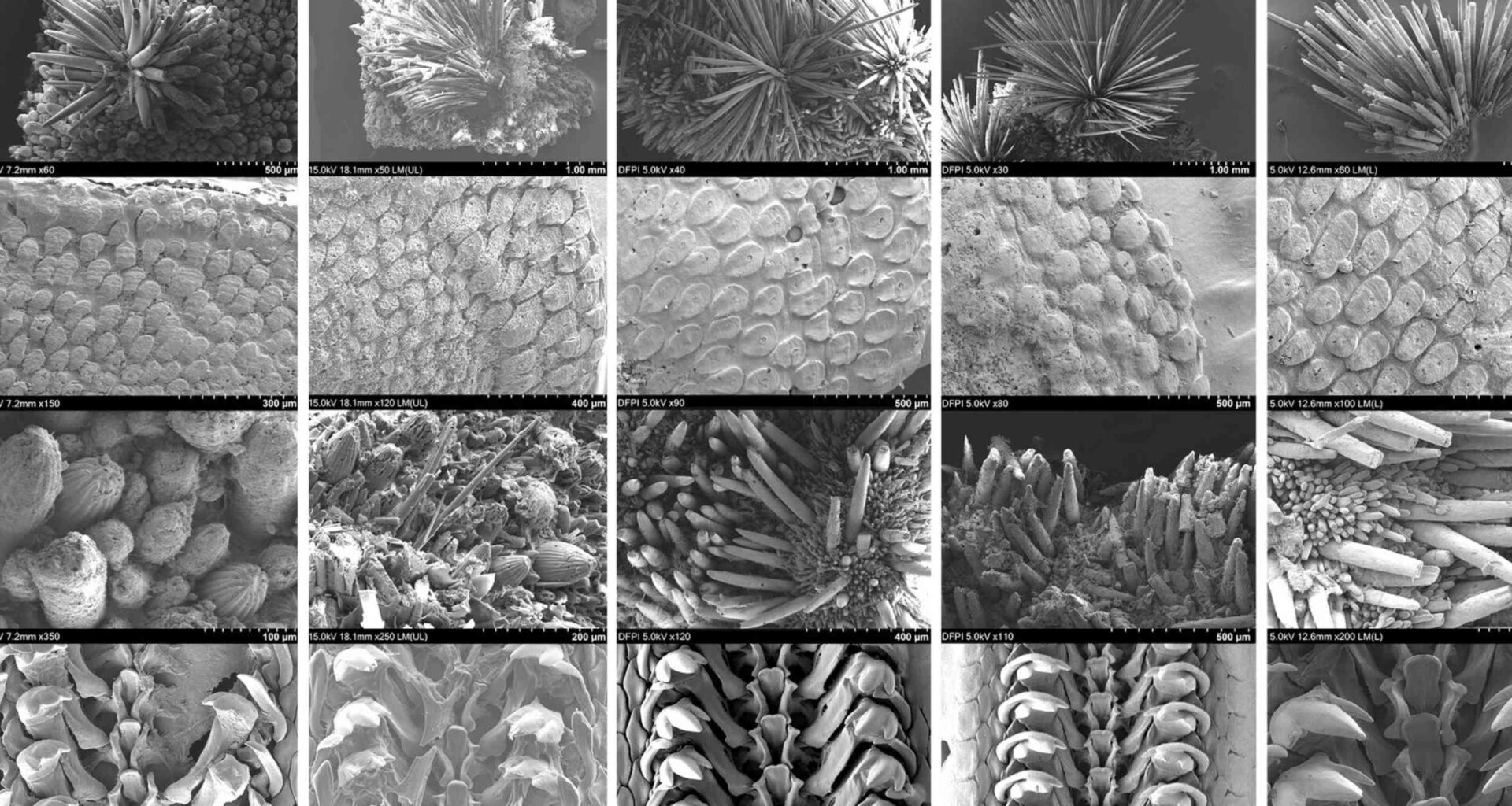
Under magnification, its pointed girdle needles and packed shell granules stopped matching the closest known species.
Its radula, a ribbon of feeding teeth, also carried a central tooth shape that separated it from a close lookalike.
Those details mattered most against A. defilippii, the species whose overall shell form came closest to the newcomer.
Numbers that separated
Hard numbers ended the debate when the team compared COI sequences from 295 animals taken from shores and databases.
Those records collapsed into 97 haplotypes, distinct sequence versions within a species, and then into three clear genetic groups.
One lookalike species sat 23 stepwise mutations away from a relative, while the newcomer stood 36 steps from another.
That pattern turned an odd specimen into a repeatable identity, which matters when scientists search other coasts for matches.
A late Cretaceous branch
Beyond identification, the wider family tree placed the South Korean animal inside Acanthochitona and traced the genus back about 83.94 million years.
Using full mitochondrial genomes from 28 chiton species across nine families, the researchers dated that split to the Late Cretaceous.
High seas during that period expanded shallow habitat, giving marine animals more room to separate into distinct lines.
Timing alone cannot prove cause, but the match fits an ocean world opening new space for diversification.
Old labels shift
A second surprise reached beyond the new species and into how scientists sort whole branches of chitons.
Earlier phylogenies, evolutionary family trees built from genetic evidence, had already hinted that some chiton family labels would not hold up cleanly.
In this study, the family Mopaliidae broke into three lines instead of clustering as a single natural group.
That kind of taxonomic repair sounds narrow, but names shape biodiversity records, comparisons, and decisions about what is rare.
Hidden in plain sight
For now, every confirmed record places the species on South Korea’s west and south coasts.
Because it lived under stones in muddy lower shores, ordinary collecting could miss it or misread worn features.
Some specimens showed heavy wear on bristles and shell plates, exactly the kind of damage that blurs species clues.
That mix of hidden habitat and physical wear helps explain how a distinct chiton stayed unnamed this long.
To keep the new species from slipping back into the crowd, KNU published genetic markers and a pictorial guide built from microscopic images.
That guide should help researchers test similar chitons across the western Pacific without relying on shell shape alone.
“These findings contribute to the understanding of speciation and phylogenetic relationships within the Acanthochitonidae,” Hwang wrote.
Better identifications will make biodiversity surveys, museum records, and future climate tracking far more trustworthy.
What this changes
An animal that looked like one more armored grazer on a tidal rock ended up redrawing part of the chiton family map.
That is the larger lesson of Acanthochitona feroxa: very old body plans still hide new species when evidence sees past the shell.
The study is published in Marine Life Science & Technology.
—–
Like what you read? Subscribe to our newsletter for engaging articles, exclusive content, and the latest updates.
Check us out on EarthSnap, a free app brought to you by Eric Ralls and Earth.com.
—–