
Artemis III, currently slated for 2027, will test spaceflight operations in low-Earth orbit: a crew will pilot the Orion spacecraft—the same type used by the Artemis II astronauts—and attempt to dock with landers sourced from SpaceX or Blue Origin (or both at the same time). These landers are designed to shepherd the crew of future Artemis missions to the lunar surface, including Artemis IV (scheduled for early 2028) and Artemis V (late 2028).
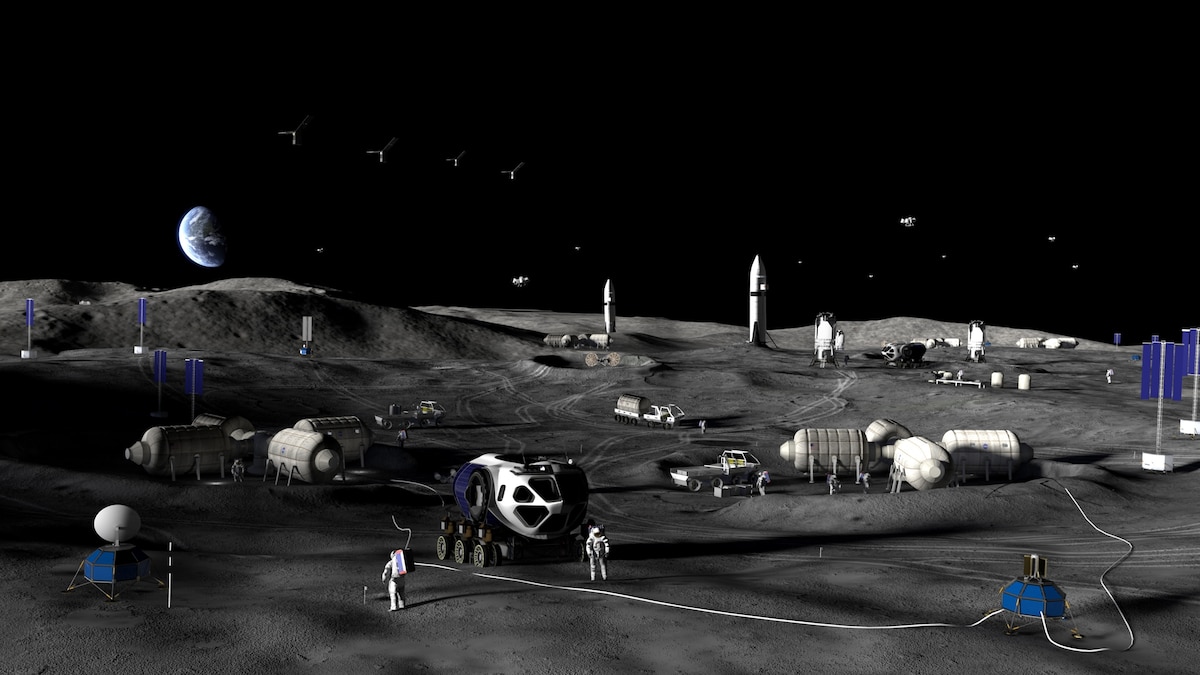
All those missions will enable NASA to start on its ultimate goal: building a base, which will probably be situated somewhere in the lunar south pole region—a benighted swath of land, with some incredibly inhospitable conditions. It is essentially a volcanic desert, one with temperature swings of hundreds of degrees, abrasive lunar dust, and a near-constant shower of cosmic radiation from the jet-black sky above. But what makes this deathtrap so desirable is that it’s home to reserves of frozen water.
“This is really a blueprint of how … to make Mars a reality.”
Clive Neal, lunar geoscientist at the University of Notre Dame
The most promising locations, based largely on orbital data, are in craters that haven’t seen sunlight in several billion years. “That’s where we believe it’s cold enough that you can keep the ice in a frozen state for very long periods of time,” says Glaze. It’s open to debate as to how much ice is actually present there, and in what form—but some of the lower estimates are still sufficient to get experts excited.
George Sowers, a mechanical engineer at the Colorado School of Mines, previously told National Geographic that “water is the oil of space,” important for establishing an energy resource for a lunar economy. If you expose water to electrical currents, you split it, generating oxygen and hydrogen; the former can be used to create breathable air, while both can be combined to make rocket fuel. That water can also be used to hydrate both astronauts and crops. Altogether, this would make the moon base—and any future crewed parts of the moon—self-sufficient, and not reliant on staggeringly expensive deliveries from Earth.
The moon, then, won’t just become a collection of new flags in the dust. A base will turn it into a home for astronauts and a steppingstone to crewed missions to the red planet next door. Launching rockets from the moon is, thanks to a lack of atmosphere and low gravity, far cheaper than doing so from Earth. Or as Clive Neal, a lunar geoscientist at the University of Notre Dame, puts it, “this is really a blueprint of how you need to do things in order to make Mars a reality.”