
Back to Article List
Following a transit of Europa across Jupiter’s disk, the icy moon slides past Io, a fellow Galilean moon, west of Jupiter.
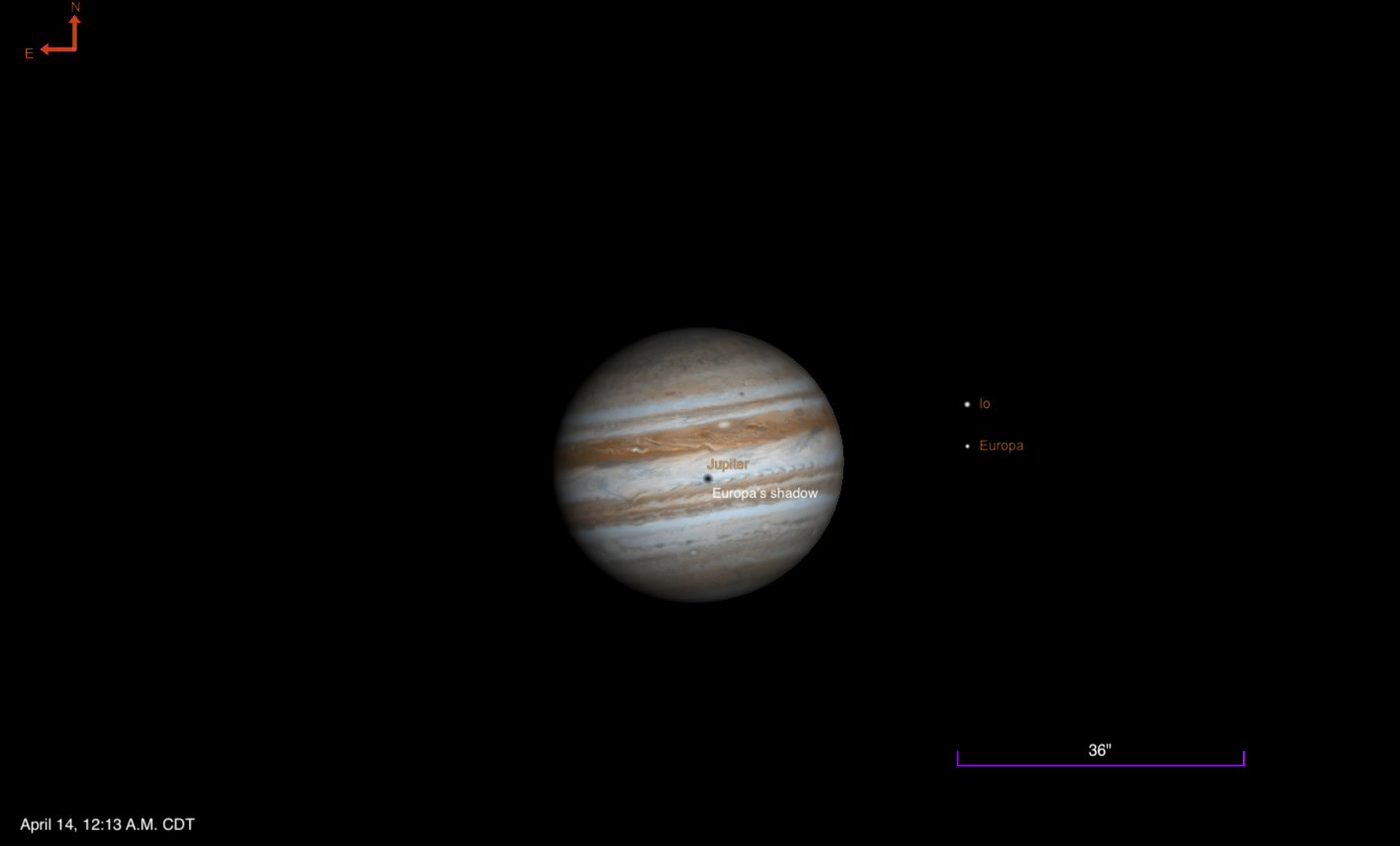
Shortly after midnight CDT on April 13 (early on the 14th in the Eastern and Central time zones), Io stands just a few arcseconds north of Europa, while Europa’s shadow is transiting Jupiter’s disk. Ganymede and Callisto lie to the east, outside this field of view. Credit: Alison Klesman (via TheSkyX)
Looking for a sky event this week? Check out our full Sky This Week column.
April 12: Comet C/2025 R3 (PanSTARRS) grows bright
Over at Jupiter, the solar system’s largest planet, the Galilean moons are showing off orbital mechanics in motion.
After sunset, Jupiter is slowly sinking in the west, the brightest point of light in Gemini the Twins. Tonight, as twilight fades across the middle of the U.S., Europa is already transiting the gas giant’s disk, moving from east to west. It travels alone until shortly before midnight on the East Coast — at 11:42 P.M. EDT, look for the small, dark blot of its shadow at the eastern limb. It may take a few minutes for you to notice its appearance. Europa slips off the western edge of the disk less than 20 minutes later and keeps moving, toward where Io previously stood alone west of the planet. (Ganymede and Callisto are east of Jupiter, in that order from closest to farthest.)
Even as Europa moves westward, Io is tracking eastward, headed toward Jupiter. The two finally cross paths, with Io standing 5” north of Europa, shortly after midnight in the Central time zone. After that, Io is closer to Jupiter, while Europa pulls away to the west. Io reaches the planet and disappears behind the western limb in an occultation at 1:15 A.M. CDT on the 14th, after the planet has set in the Eastern time zone. Europa’s shadow finally reaches that same limb and disappears roughly 20 minutes later, visible for the western two-thirds of the U.S.
Sunrise: 6:25 A.M.
Sunset: 7:37 P.M.
Moonrise: 4:26 A.M.
Moonset: 3:52 P.M.
Moon Phase: Waning crescent (14%)
*Times for sunrise, sunset, moonrise, and moonset are given in local time from 40° N 90° W. The Moon’s illumination is given at 10 P.M. local time from the same location.