
Criticism is one thing; turning the world’s only Jewish state into a political punching bag is quite another
There are moments in public life when disagreement is understandable, even necessary. And then there are moments when disagreement mutates into something else entirely – something obsessive, disproportionate, and, frankly, puzzling.
My reflections on Zack Polanski fall squarely into the latter category.
I found myself thinking about this not in a vacuum, but in the midst of a world once again convulsed by conflict – Israel under pressure, confronting threats not only at its borders but far beyond them. In such moments, one expects nuance, seriousness, even empathy from political leaders. What one does not expect – at least not from a Jewish leader – is a relentless rhetorical barrage that seems to single out the world’s only Jewish state as a perpetual offender.
And yet, here we are.
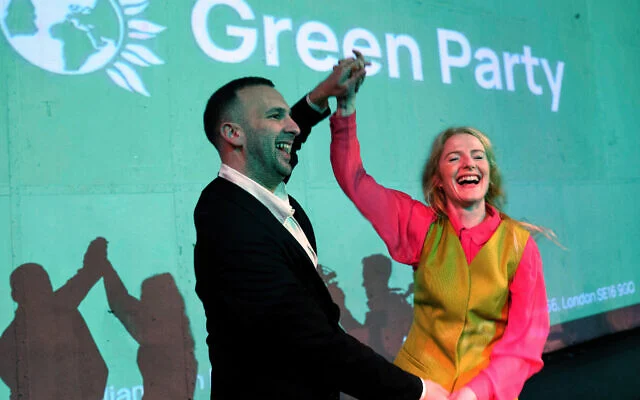
Polanski, the Jewish leader of the Green Party of England and Wales, has positioned himself as one of Israel’s most consistent and vocal critics in British politics. Not just a critic – that would be fair game in any democracy – but something closer to a habitual antagonist. His calls to sever diplomatic ties, halt trade, and isolate Israel internationally go well beyond policy disagreement. They signal something deeper: a fixation that borders on turning Israel into a convenient political punching bag.
I confess: I struggle to wrap my head around it.
Let me be clear from the outset – Israel is a democracy. Criticism of its policies is not only legitimate; it is part of the lifeblood of democratic discourse. Israelis themselves argue fiercely about their government’s decisions. No one, least of all a political leader, is required to agree with everything Israel does.
But there is a difference – a profound one – between criticism and caricature.
When every major statement, every political opportunity, every moment of international tension becomes another occasion to denounce Israel in the harshest possible terms, something shifts. The critique ceases to be constructive. It becomes performative. And worse, it becomes selective.
Because here is the uncomfortable question: why Israel, again and again, as the singular focus?
Why the urgency to cut ties with Israel, while far more egregious actors across the globe escape such singular intensity? Why the language that frames Israel as uniquely illegitimate, uniquely beyond the pale?
This is where Polanski’s stance begins to look less like principled dissent and more like political positioning.
We are told that his views stem from his Jewish identity – that he speaks “because” of it, not in spite of it. That may be sincere. But sincerity does not automatically confer balance. Nor does it shield one from scrutiny.
In fact, it raises a deeper question: what does it mean to carry a Jewish identity in public life, especially in relation to Israel?
For me, the answer is not about blind allegiance. It is not about uncritical support. It is about something simpler, yet more profound: a sense of connection, responsibility, and care for the future of the only Jewish state.
That is the baseline.
And this is where Polanski’s posture becomes so difficult to reconcile. Because what one sees is not merely critique, but detachment – almost an eagerness to distance himself from Israel at every turn, as though proximity itself were a liability.
Even more striking is the contrast with his own background. By his own account, he grew up in a Zionist household. Members of his family, including his mother, have publicly expressed support for Israel. One cannot help but pause here.
What changed?
Of course, people evolve. Views shift. That is part of intellectual life. But evolution should ideally bring greater depth, greater nuance – not a flattening of complexity into slogans.
And yet, what we often hear is precisely that flattening.
Take, for instance, the recurring debate around “Zionism.” I have never quite understood the obsession with this semantic battleground. What does it truly achieve? Endless parsing of definitions, endless attempts to redraw lines between “acceptable” and “unacceptable” forms of Jewish self-determination.
But at its core, Zionism – stripped of political weaponization – is something far more elemental: the belief that the Jewish people, after millennia of persecution, have the right to a homeland where they are not a vulnerable minority.
Why is this so difficult to acknowledge plainly?
Why must it be endlessly reframed, qualified, or condemned?
In my own writing, I have tried to express this in a way that transcends political jargon. In the dedication to my book, The Future of Israel: How a Nation’s Courage, Creativity, and Faith Rebuilt the Promise of Tomorrow, I wrote:
“To the people of Israel – whose courage rebuilds what hatred destroys, whose faith outlasts fear, and whose light – tested by exile, the Holocaust, the October 7 massacre, and the many wars that followed – has never gone out. …And to all who believe – in the God who keeps His covenant, in the miracle of renewal, and in the promise that light will always return to Zion.”
That, to me, is the heart of the matter.
Not ideology. Not labels. But a recognition of continuity – of a people, a history, and a promise that has endured against extraordinary odds.
Which brings me back to Polanski.
What is to be gained from this relentless posture toward Israel? Politically, one might argue it plays well in certain constituencies. The Green Party is, after all, navigating a complex electoral landscape, and aligning with vocal activist – Islamist – currents may yield short-term gains.
But leadership is not merely about riding currents. It is about shaping them.
And here lies the missed opportunity.
Imagine, for a moment, a different approach. A Jewish political leader in the UK who speaks honestly about Israel’s challenges, who acknowledges its imperfections, but who also affirms its legitimacy, its resilience, its right to exist and defend itself.
Imagine a voice that bridges rather than deepens divides. That critiques without delegitimizing. That understands that Israel is not an abstraction, but a living society – complex, flawed, dynamic, and profoundly human.
That would be a contribution.
Instead, what we see too often is a narrowing of discourse – where Israel is reduced to a symbol, a target, a convenient vessel for broader ideological battles.
And that, I fear, does a disservice not only to Israel, but to the very values Polanski claims to uphold.
Because if justice is truly universal, it must be applied with consistency. If “never again” is to mean anything, it must include the Jewish people as well – not exclude them from its moral protection.
This is not about demanding loyalty. It is about calling for balance.
Polanski does not have to agree with every Israeli policy. No one does. But as a Jewish leader, there is, at the very least, a moral expectation of care – care for the future of the Jewish state, care for the people who call it home, care for the broader implications of one’s words in an increasingly volatile world.
Silence, at times, might even be preferable to distortion.
Or better yet, a recalibration.
Because Israel today stands, as it has so often, at the intersection of history and possibility. It is a nation defined not only by conflict, but by resilience and renewal – by its ability to rebuild, rethink, and reimagine itself in the face of adversity.
It is also a nation at the forefront of innovating its future – in technology, in defense, in culture, in the very idea of what a small state can achieve against overwhelming odds.
To reduce such a country to a caricature is not only unfair. It is intellectually lazy.
And so I return to my original sense of puzzlement.
Why this path, Mr. Polanski? Why this relentless focus?
History, if it teaches us anything, teaches us that Israel endures – not because it is perfect, but because it is necessary. Because it represents something that transcends politics: the restoration of agency to a people who were once denied it.
That is a story worth engaging with seriously. Not dismissing. Not distorting.
And certainly not using as a convenient punching bag.