
The fragile ceasefire 72 hours leading to the true Holy Fire!
The experience of Holy Saturday in the City of the Resurrection, amidst the weight of the 40-days war
An article by: Heba Hrimat | 12 April 2026
Jerusalem… amidst the scent of ancient stones and the 33 freshly lit candles from the very Tomb where He who unequivocally proclaimed victory over the power of death rose. Such is the atmosphere of Holy Saturday in the streets of the Old City, specifically the alleys of the Christian Quarter in Jerusalem on April 11, 2026, a year we had all anticipated would be remembered for its melancholy, the absence of any glimmer of hope, and the silence of the scouts’ drumbeats heralding the Lord’s resurrection from the dead.
Usually, by Holy Monday, the Way of the Cross “Via Dolorosa” transforms into a square teeming with pilgrims from Athens to Addis Ababa. This year, that path was more like a ghost town with a better architectural design. I remember speaking earlier that week with an Orthodox priest, and I asked him: “What will the Holy Fire ceremony look like this year?” He shrugged, a gesture so Middle Eastern that it needs to be on the flag, “The Holy Light doesn’t follow the news, my child. It doesn’t care about ceasefires or the course of negotiations. It’s comes anyways. The question is: Are we ready to let it in?”
With that same unshakable faith and stubborn steadfastness, the rhythm of the silver staffs of the Kawwas, the men in traditional Ottoman guard uniforms leading the processions of the Patriarchs of Jerusalem, striking the cold stone pavement, and that distinctive sound that is only heard in the neighborhoods of the Holy City, Thump. Thump. Thump. Such is the pulse of this city that refuses to die, even when the world thinks it is on life support.
This is a stark reminder that while people in the West view the Holy Land as nothing more than a museum or a news ticker in an endless news broadcast, for its people it is, as Nizar Qabbani, the legendary Syrian poet, said in describing his beloved, “You are the land… you are the tribe… you are the poem before creation, you are the notebooks… you are the journeys… you are the childhood… and you are the Song of Songs… you are the Psalms… you are the light… and you… you are the Prophet…” as heavy and as unbearable of a burden sometimes it becomes, but it is home, nonetheless.
The scenery of reverence mixed with fear and anticipation in the heart of the Church of the Holy Sepulchre, where the air is thick, not only due to the heat and humidity rising from the packed bodies, but from the echoes of a war that has spent the past forty days attempting to shatter the people’s morale. Crowds inside the church, those who were permitted to enter, and the other hundreds surrounding the church outside and at the city’s historic gates, from those who were not guaranteed access, carry bundles of thirty-three golden beeswax candles, awaiting to share the flame of the Resurrection… A participation that, for forty days, seemed impossible.
For weeks, the region of West Asia, or what is politically referred to as the Middle East, was the world’s scar. The war did not merely shake the windows of the Holy City; it shut its heart. During Latin Easter, the previous week, these very gates were barred. The streets of the Old City were empty, its shops closed, and its children isolated in their homes. The concept of “Resurrection” seemed less joyful and felt more like a cruel joke recounted in history books.
Then, on Holy Thursday, as we were all preparing for a Pascha that resembled Covid era Pascha of 2020, the news broke. A two-week ceasefire. Fragile? It was made of glass. It was a diplomatic high-wire act performed over an abyss. But it was enough. The locks turned. The bolts slid. And the people flooded in.
The sight of the procession of Greek Orthodox priests, both local and Greek, descending in two columns in their black robes down the steps leading to the Church of the Holy Sepulchre, makes one wonder of whether a city has the right to take a respite or a time-out? For Jerusalem, with its century old history fraught with psychological trauma and physical wounds, as if it’s living in a state of constant alert and deep anxiety, may well be one of the first cities in the world entitled to such a wish! Yet today, the remedy came in a different form, more like a feverish, desperate electric charge for people who were suddenly and unexpectedly given a chance to breathe.
Inside the Church of the Holy Sepulchre, the atmosphere was closer to a “spiritual revolution” than to “religious rituals.” It is the Christian church with the oldest and most significant link to Christianity in the world, built precisely on the very spot where “A man named Jesus” (John 9:11) was crucified, buried, and then rose from the dead! Its architecture, like that of its believers, blends elements of Roman arches and Byzantine mosaics with traces of smoke dating back centuries. It is much like the hearts of the region’s inhabitants: ancient, scarred, yet still beating with life. At the heart of it all lies “the great miracle,” the empty Tomb.
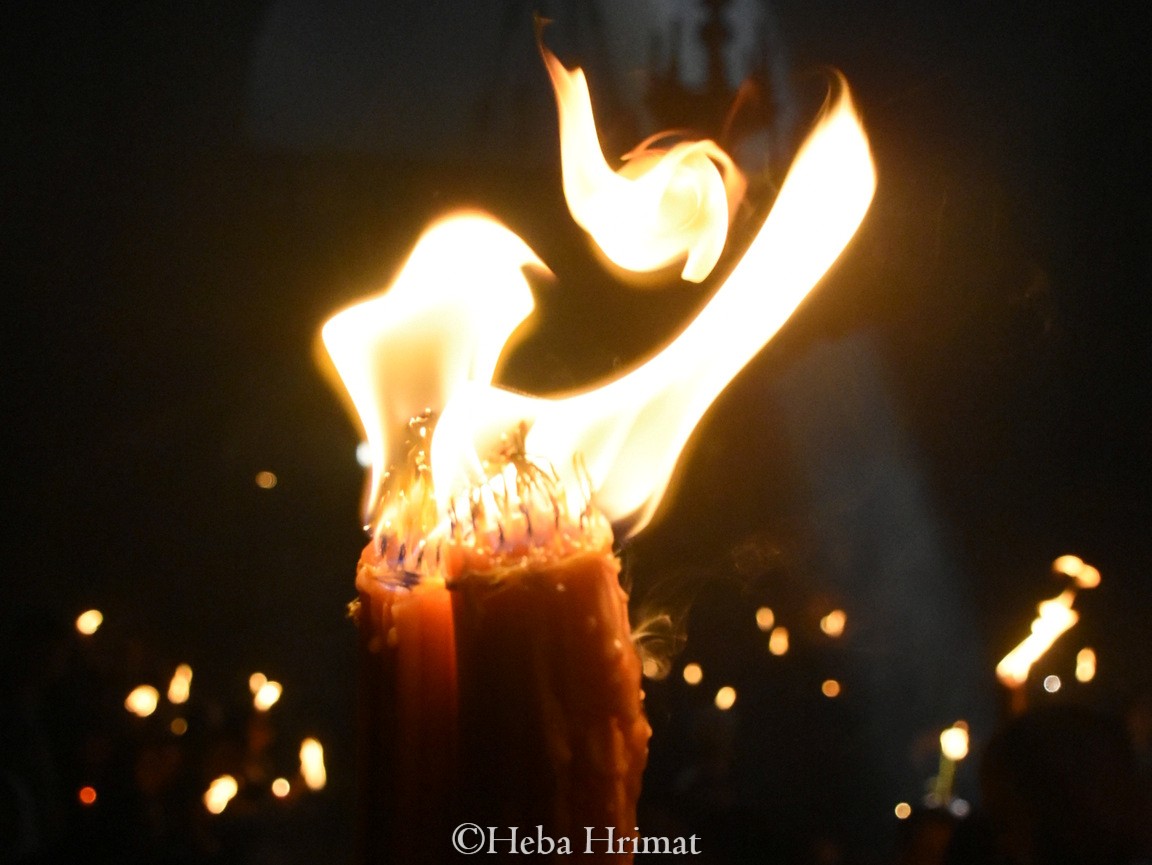
Holy Saturday is the most significant event in the Christian calendar. According to tradition, the Greek Orthodox Patriarch enters the tomb of Christ alone, and all the lights in the church are extinguished. Outside, thousands wait. Then he emerges carrying 33 bundles of candles, one in each hand, lit from within the tomb by an unquenchable flame, a direct spark from the divine resurrection.
This year, the wait was different. It was not merely a ritual; it was a referendum. We were not merely waiting for fire; we were waiting for proof that darkness does not prevail.
The Patriarch, Theophilos III, was relieved of his liturgical vestments and remained in his basic white robes. The tomb’s door closed behind him. Silence reigned, a silence so loud that it pierced through the domes. He entered the empty tomb, the ultimate symbol of hope, a place defined by what was no longer there: the body of the Holy One.
Then the miracle happens….
You do not see the flame first; you hear it. A thunderous roar, a sound wave emanating from the tomb and rushing toward the entrance. “Almaseeh Qam!” (Christ is Risen) the local Christian crowds cheer at the top of their lungs. “Let there be light” (Genesis 1:3). The Patriarch emerges, his face radiant, holding a blazing flame and unbreakable hope.
Then the domino effect begins; the young people surrounding the tomb rush to receive the blessing of the first spark, and before the eye can register it, light. Light. Light… The flame surges through the darkness as a ceasefire is imposed on the front lines. Suddenly, the church is filled with a flood of divine light.
Amid the tears of women weeping at the power of what they’re witnessing, and men running the flame over their beards to dispel doubt with certainty, that the Savior’s light does not burn but heals hearts weighed down by the burden of war! One cannot help but stand in awe and wonder, eyes brimming with tears before an unmistakable divine majesty!
Our nights, which tranquility has been stolen by war, and our children, whose eyes have been robbed of sparkle by the sound of explosions, today we stand to see that the fire of Holy Saturday teach us a lesson: Light does not ignore darkness, but harnesses it to assert its true power!
Hope, then, is not a state of mind, but an act of resilience. It is the decision to stand in an empty tomb surrounded by smoke and fear, holding an unlit candle to your chest, waiting for a spark.
As the ritual ends and people slowly begin to emerge from the church into the bright Jerusalem sun at midday, the candles are placed inside lanterns, destined within hours to be on planes and in cars, traveling to Nazareth, to Bethlehem, to Amman, and to Athens. So that the Mediterranean region may be illuminated by a light whose true form it has forgotten.
We all know that the ceasefire won’t last. Politics is too complicated, and the wounds are too deep. The empty tomb will be sealed again, and instability may return. But for 72 hours, the stone was rolled away. We were allowed to stand in a place where death did not triumph.
The empty tomb is not a museum of a miracle that is over and done with. It is a promise. A promise that when the night seems longest, the light is on its way to us. And I believe that this year’s miracle lies not only in the emergence of the light, but also in the fact that, despite the sirens, despite the closed borders, despite life’s complications, people came and brought their candles along with the firm belief that they would be lit… and they were lit!
Xristos Anesti!