

One Piece. Iñaki Godoy as Monkey D. Luffy in season 2 of One Piece. Cr. Courtesy of Netflix © 2026
Nielsen numbers for One Piece season 2 dropped last week, leading to some conflicting reports with Netflix’s own numbers… GamesRadar perhaps best cemented this, claiming that any reporting that season 2 was clocking in lower than season 1 was fake news and that Nielsen numbers contradict Netflix. What the heck is going on? Let’s have a look.
Covering viewership between March 9th and March 15th, Nielsen published its numbers on April 9th and wrote the following about the return of One Piece:
“One Piece Claims #1 Original with New Season on Netflix
…
Netflix’s live-action adaptation of anime favorite One Piece dropped its second season on March 10, and climbed to a new weekly high of 1.62 billion minutes—good for #2 overall and #1 among originals—with 82% of watch time going to the new season. One Piece led Originals among Men 18-34, and was second only to Family Guy across all Top 10 titles in concentration of that demo. It also attracted a very balanced multicultural audience: 27% Hispanic, 9% Asian, 17% Black, and 46% White.”
From there came claims that the show broke records, which it technically did, but there are some caveats to how Nielsen’s data works. Unlike Netflix’s top 10s, which split viewership across seasons, Nielsen clumps all viewership together for both seasons 1 and 2 (hence it says 16 episodes, not eight).
As a reminder, season 1 of One Piece launched on Netflix for the weekend of August 18th, with 1,311 million minutes viewed. According to that 82% split, season 2 picked up 1,326.76 million minutes, but obviously, there’s the extra two days to account for. Like with Netflix numbers, we’re getting a fixed weekly snapshot, and the day of the week a title launches can make a big difference. As you’ll know, One Piece season 2 launched on a different day (Tuesday vs. Thursday for season 1), so we have to adjust the numbers accordingly. You also need to take into account that season 2 was about 30 minutes longer.

This is in addition to the fact that Nielsen is only for United States viewing and for connected TVs, so it won’t cover mobile devices, and given the younger demographic this show appeals to, that should be sizable.
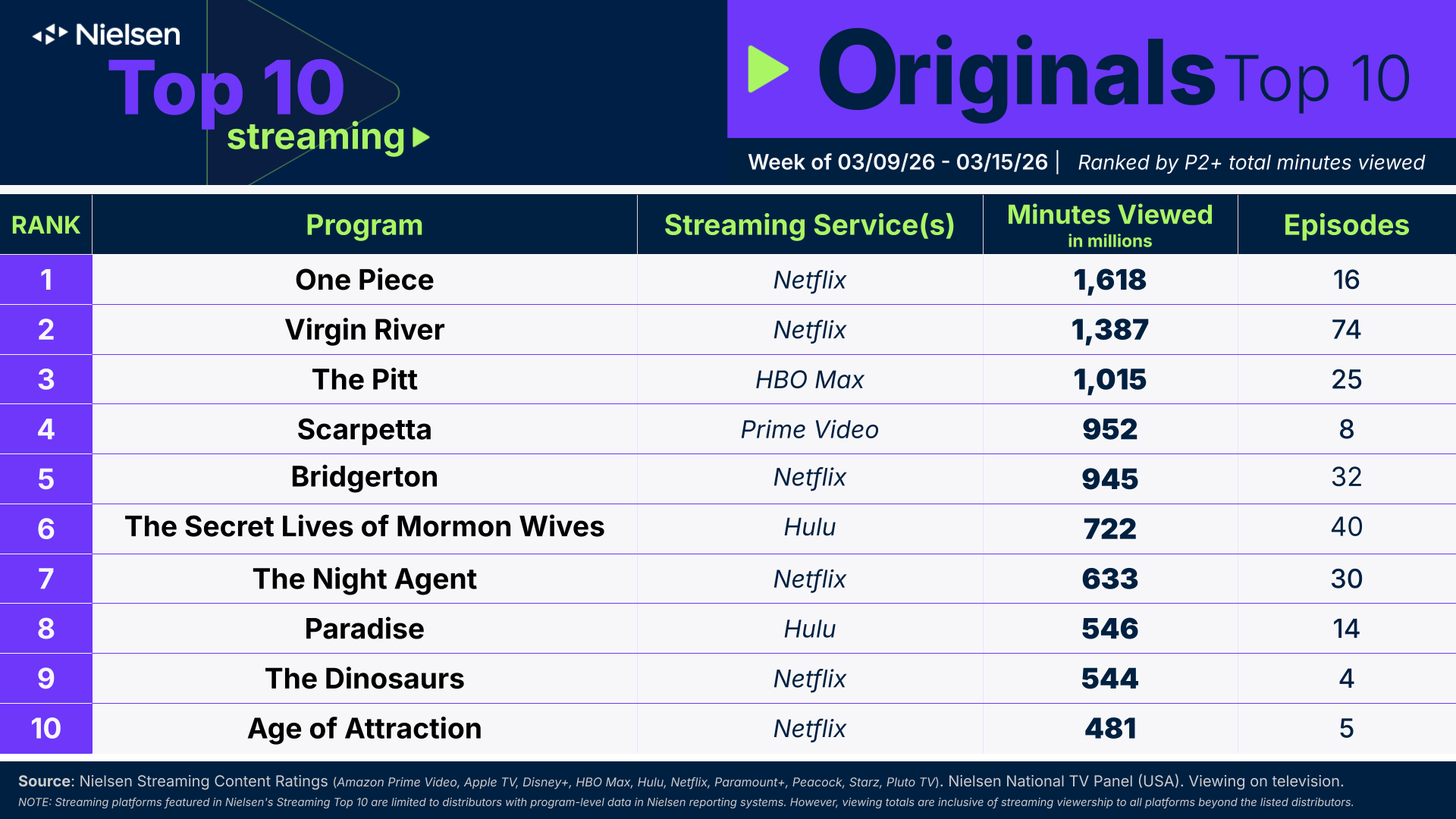
So yes, while this technically was the biggest week for One Piece viewing, that claim needs a heavy asterisk and is at risk of being misinterpreted (as demonstrated by the link quoted above).
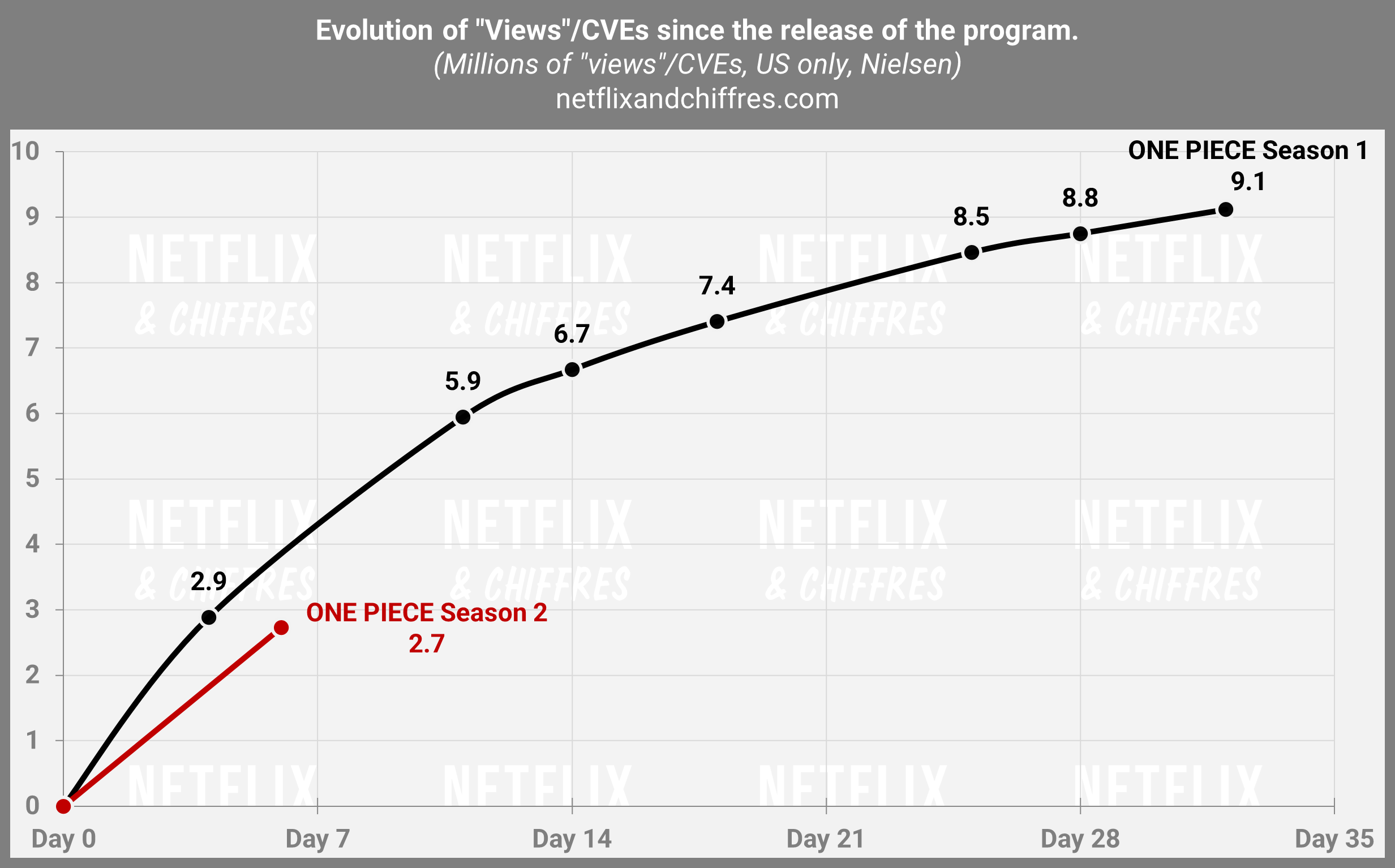
How well is it doing then? Well, for this, we turn to a friend of the website, Frederic, who recaps the Nielsen numbers every single week at Netflix and Chiffres.
He published a graph showing the evolution of views (note that he’s not using the raw hours), again dispelling the myth that season 2 is above season 1, but it is notably closer than the global figures, as we’ll come to.
What are Netflix’s numbers saying as of week 4?
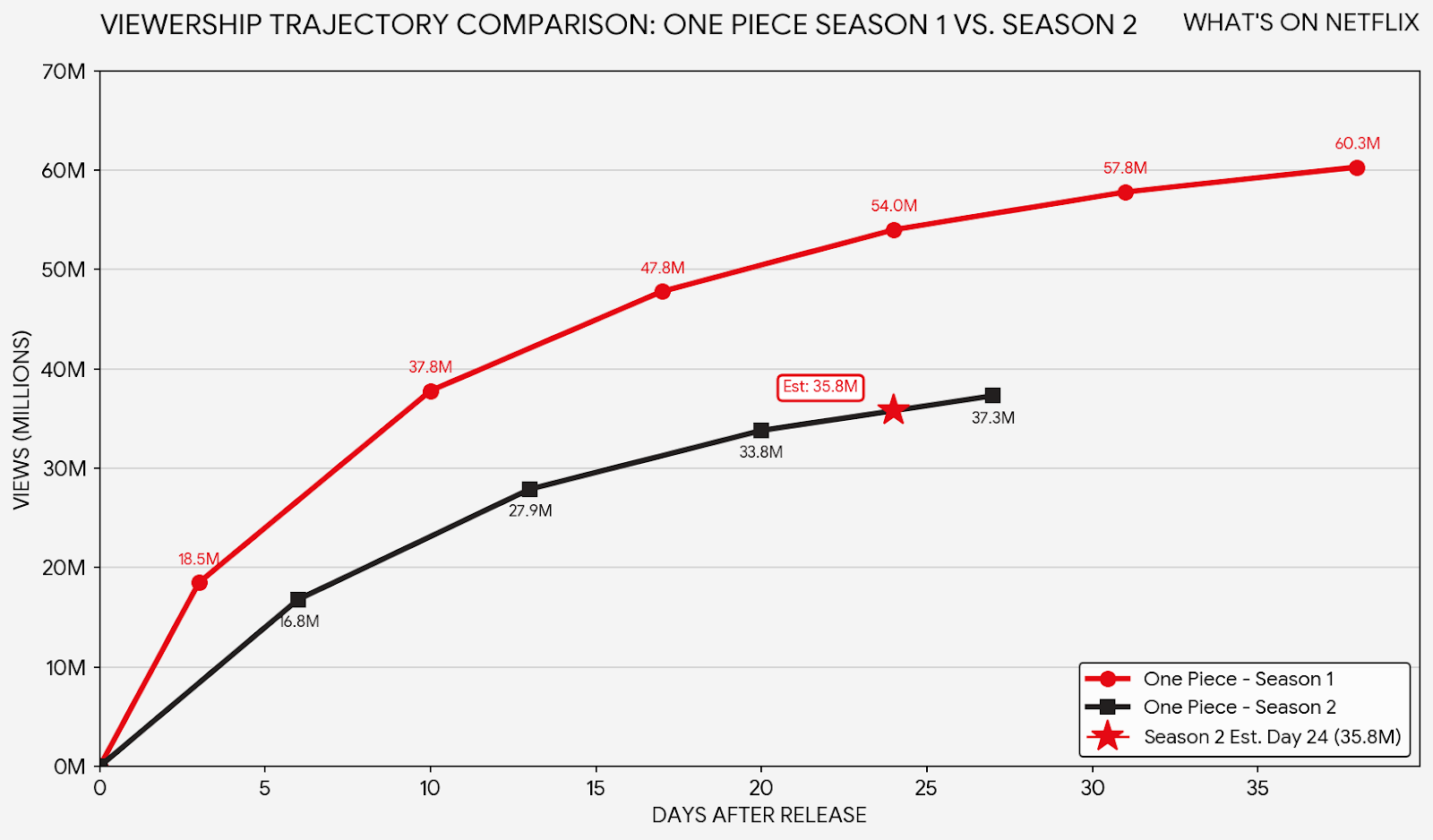
We’ve already gone in-depth about Netflix’s numbers numerous times, but here’s an update. We’ve had four weeks of numbers for season 2 of One Piece thus far, and it’s currently sitting at 302.5 million viewing hours and 37.3 million completed viewing equivalents.
Stacked up against season 1 (again taking the release day into account), we know that season 2 is still ~30% down on season 1.
Day
One Piece – Season 1
One Piece – Season 2
3
18,500,000
8,400,000*
6
26,800,000*
16,800,000
10
37,800,000
23,100,000*
13
42,100,000*
27,900,000
17
47,800,000
31,300,000*
20
50,500,000*
33,800,000
24
54,000,000
35,800,000*
27
55,600,000*
37,300,000
31
57,800,000
39,300,000*
38
60,300,000
42,800,000*
More Netflix numbers are expected on April 14th, and we’ll get additional metrics this Summer when the Netflix Engagement Report for the first half of 2026 drops.
Should we be worried about the future of One Piece?
Although season 2 isn’t beating season 1, we should stress that it’s tough to ask for any series to retain its audience, let alone grow from season to season. That’s the case with the majority of Netflix titles and especially those that have to factor in a 2.5-year wait. There are very few examples on Netflix of a series growing its audience beyond the first season; the only exceptions so far have been Stranger Things and Bridgerton.
As for the future of the show, it’s safe for the meantime. The third season is already shaping up to be the biggest yet. The stakes have never been higher, with the fate of an entire country on the line, as Luffy and the Straw Hats attempt to help Princess Vivi liberate the kingdom of Alabasta from Mr. 0, who is working from the shadows, orchestrating a civil war. We’ll also see the introduction of some fan favorites in season 3, such as Ace and Bon Clay. Thanks to the upcoming events of the Alabasta Saga, the audience could grow.
The creators have spoken at length to various outlets about their plans for future seasons, though how long it’ll realistically run depends a bit on pessimism and on how far Netflix series can run before running out of steam. That’s in addition to Netflix being all in on the One Piece brand with numerous spin-offs, such as the LEGO one and the new anime (both of which have been in the works for at least 1-3 years), and it’s clearly a big brand for the streamer even if not quite at the height of titles like Bridgerton or Stranger Things.
If you were to put me on the spot, I’d predict a comfortable season 4 renewal, possibly this year, but unless it’s a double final renewal (see Avatar: The Last Airbender or 3 Body Problem), we’ll likely have to wait to see if there’s another major drop for season 3.