
Microbes built some of the oldest living things on Earth, but most people wouldn’t notice them. They quietly form in shallow waters, where they resemble dark, unremarkable rocks.
These formations are stromatolites, and they have been shaping life on Earth for billions of years.

Long before trees or animals existed, these tiny communities were already at work. They helped fill Earth’s atmosphere with oxygen.
Now, scientists think they may also explain how life moved from simple cells to the complex ones found in plants, animals, and humans today.
Hidden partnership comes into view
Deep within these living formations, researchers have found something unexpected – two microscopic organisms working together in a way that hints at how complex life first began.
It’s not just coexistence. It’s cooperation at a level that could have changed the course of evolution.
This discovery didn’t come easy. It took years of patient work, careful observation, and a bit of persistence.
But what scientists finally saw was worth the wait. They found a type of microbe physically connected to a bacterium through tiny tube-like structures.
These connections allowed the organisms to exchange essential materials, helping each other survive.
More than just a cradle of life
The research was led by Professor Brendan Burns, an evolutionary microbiologist at the University of New South Wales (UNSW Sydney).
The team focused on stromatolites found in Shark Bay, a protected site in Western Australia where these ancient formations still grow today.
“Stromatolites could be more than ‘just’ a cradle of life where early microbial life flourished,” said Professor Burns. “They could also tell us how complex life first emerged.”
The team identified a previously unknown microbe belonging to a group called Asgard archaea.
These organisms are thought to be closely related to the ancestors of eukaryotes, the complex cells that make up all visible life.
Simple but powerful partnership
For years, scientists have believed that complex cells formed when two simpler cells joined forces.
One cell likely engulfed the other, and instead of digesting it, the two formed a lasting partnership. This relationship eventually gave rise to mitochondria, the part of the cell that produces energy.
What researchers lacked was direct evidence of how this kind of partnership actually looked in real life. That gap has now started to close.
“This could be a little model for how these kinds of partnerships started and ultimately formed eukaryotes,” said Professor Burns.
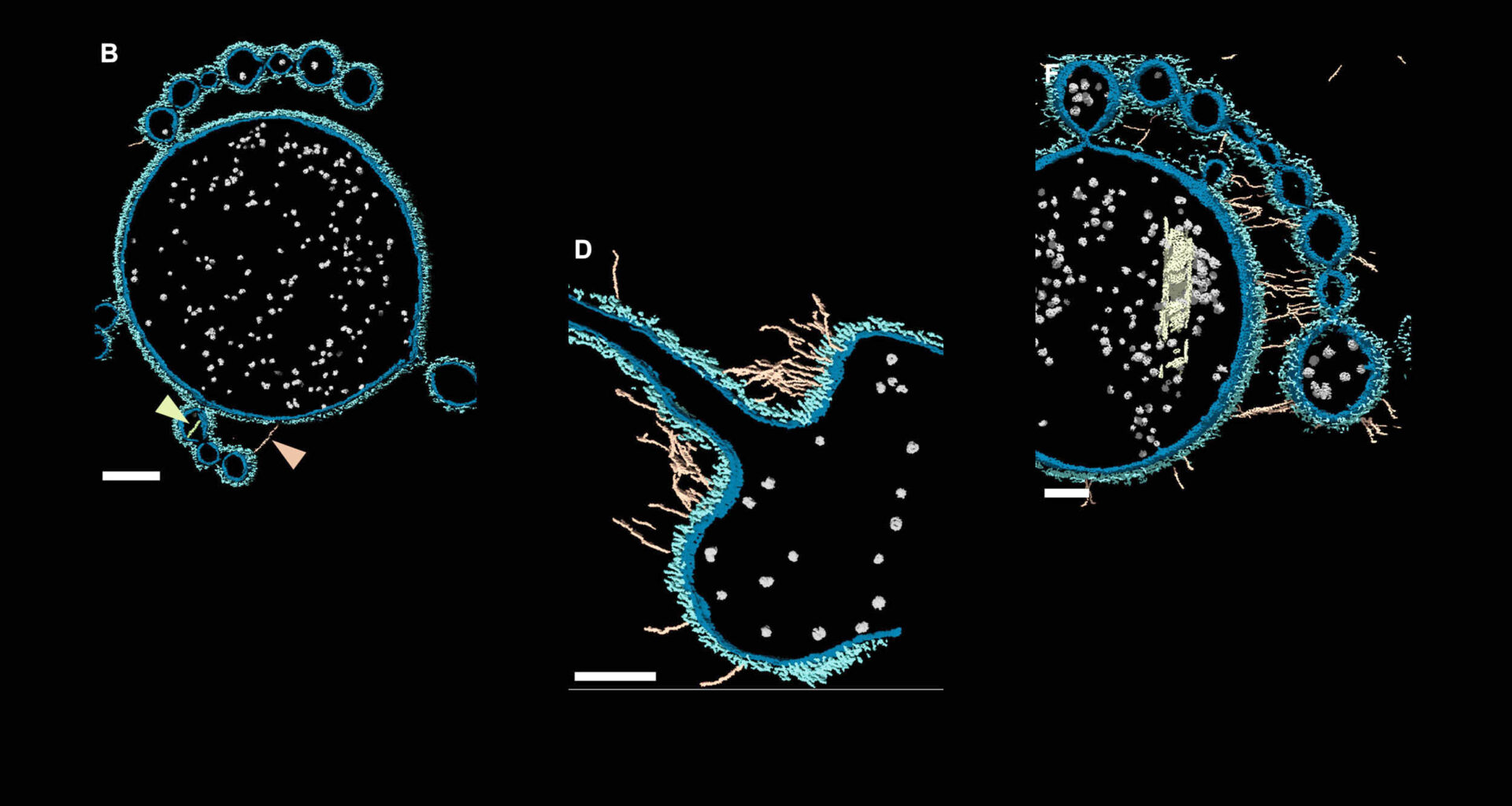
The images captured during the study show the two microbes physically linked, exchanging nutrients like vitamins and hydrogen.
Each organism produced something the other needed. It was a simple but powerful system.
Years of trial and error
Getting to this point took time. “It took four or five years in the lab,” said Professor Burns. “A lot of time, optimizing and chasing different shadows.”
One challenge stood out. The researchers couldn’t grow the Asgard archaea on their own.
“The fact that we could never get these organisms into pure culture is probably because they always depend on other organisms to survive,” noted Professor Burns.
That dependence may be the key. It suggests that cooperation isn’t just helpful for these microbes. It may be essential.
Complex life from simple microbes
The breakthrough came with a powerful imaging method called electron cryotomography. This technique creates detailed 3D images at an incredibly small scale, down to a millionth of a millimeter.
Through this lens, scientists saw the fine connections between the microbes. They also observed tiny bubble-like structures and complex tube systems extending from the archaeon.
These features may play a role in how the organisms communicate and share resources.
Professor Debnath Ghosal from The University of Melbourne highlighted the significance of the research.
“This discovery brings us a few steps closer towards understanding how complex cells evolved from relatively simpler microbial life forms,” said Professor Ghosal.
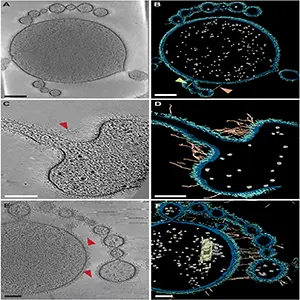 A composite image of the Asgard archaeon and structural features of Nerearchaeum marumarumayae cells. Credit: Current Biology. Click image to enlarge.A deeper look into ancient biology
The study didn’t stop at imaging. Researchers also turned to advanced computing to take a closer look at what’s happening inside these microbes.
“We used this to predict the structures of proteins in these microbes,” said Professor Katharine A. Mitchie. “And that’s exciting because we can start to see ancient versions of the cellular machinery that later became central to complex life.”
These findings suggest that some of the building blocks of modern cells were already taking shape billions of years ago, hidden inside these tiny partnerships.
A living link to the past
Professor Iain Duggin from the University of Technology Sydney reflected on the bigger picture.
“It’s if we have slowly arisen from the bottom of the sea,” said Professor Duggin.
That idea isn’t just poetic. It connects directly to the evidence. These microbes, living in harsh environments and relying on each other, may represent an early step in the path that led to all complex life.
The newly discovered archaeon has been named Nerearchaeum marumarumayae. The name combines a reference to an ancient Greek sea god with a word from the Malgana language, meaning “ancient home.”
The naming process involved close consultation with local Indigenous communities, whose connection to the land stretches back around 30,000 years.
Life advanced through cooperation
The study points to a simple idea with big implications. Life didn’t advance through isolation. It moved forward through cooperation.
“Part of what makes this exciting is that it’s not just discovery, but connection. Not just across many years, but at a time when these fragile ecosystems face mounting threats from climate change and human activity,” said Professor Burns.
“Those microbes remind us that even the smallest partners can leave the deepest mark on our history.”
The lesson feels clear. Even at the smallest scale, working together can shape the future in ways that last for billions of years.
The full study was published in the journal Current Biology.
—–
Like what you read? Subscribe to our newsletter for engaging articles, exclusive content, and the latest updates.
Check us out on EarthSnap, a free app brought to you by Eric Ralls and Earth.com.
—–