
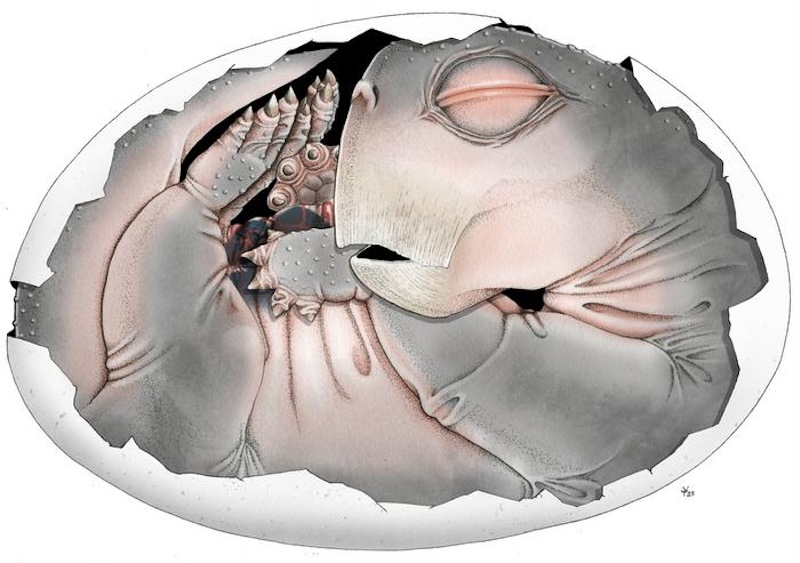
 Artist’s concept of the embryonic Lystrosaurus in its shell. The reconstruction is based on a fossil found in South Africa. It’s evidence that the ancestors of mammals laid eggs. Image via Sophie Vrard and Julien Benoit/ University of the Witwatersrand.
A 250-million-year-old fossil of an embryonic Lystrosaurus — an extinct animal that’s an ancestor of mammals — shows these creatures laid eggs.
Lystrosaurus, a piglike herbivore with a turtlelike beak and tusks, survived Earth’s worst mass extinction at the end of the Permian Epoch.
Advanced CT scanning revealed the tiny skeleton inside a rock nodule. And it had characteristics that confirmed the animal died before hatching.
CT scans of a rock nodule reveal a tiny skeleton
When researchers found a 250-million-year-old rock nodule with bits of fossil bone on its surface, they were curious to know what was inside. So they used advanced x-ray CT scans to study the rock’s interior. What they discovered was a tiny curled-up skeleton, tightly packed as if inside an egg. It was an embryonic Lystrosaurus, an animal that’s an evolutionary ancestor of mammals. The team said on April 9, 2026, that this fossil is strong evidence that the precursors to mammals laid eggs, instead of giving birth to live offspring.
Co-author Jennifer Botha of the University of the Witwatersrand said:
This fossil was discovered during a field excursion I led in 2008, nearly 17 years ago. My preparator and exceptional fossil finder, John Nyaphuli, identified a small nodule that at first revealed only tiny flecks of bone. As he carefully prepared the specimen, it became clear that it was a perfectly curled-up Lystrosaurus hatchling. I suspected even then that it had died within the egg, but at the time, we simply didn’t have the technology to confirm it.
The scientists published their study in the peer-reviewed journal PLOS One on April 9, 2026.
Lystrosaurus was a precursor to mammals
Lystrosaurus was a strange-looking beast. It had a sprawling piglike body, with a horny turtlelike beak on its head, as well as two tusklike teeth. These herbivorous creatures lived during the Late Permian and Early Triassic, approximately 259 to 247 million years ago.
At least four species of Lystrosaurus once roamed Pangea, an ancient supercontinent. Scientists have found fossils of these creatures in Antarctica, India, China, Mongolia, Russia and South Africa.
At the end of the Permian Epoch, about 252 million years ago, Earth underwent its most severe mass extinction. Major volcanic eruptions were the main triggers of this extinction. As a result, many animal species vanished forever. But Lystrosaurus survived and went on to thrive despite the unstable environment with hot conditions and long dry spells.
Scientists interested in mammalian reproduction have wondered if mammal ancestors gave birth to live young or laid eggs. They also wondered how they cared for their young. Most mammals today give birth to live young. But there’s a type of mammal called monotremes that lay eggs. They also nurse their young with milk. Monotremes – the platypus and four species of echidnas – are only found in Australia and New Guinea.
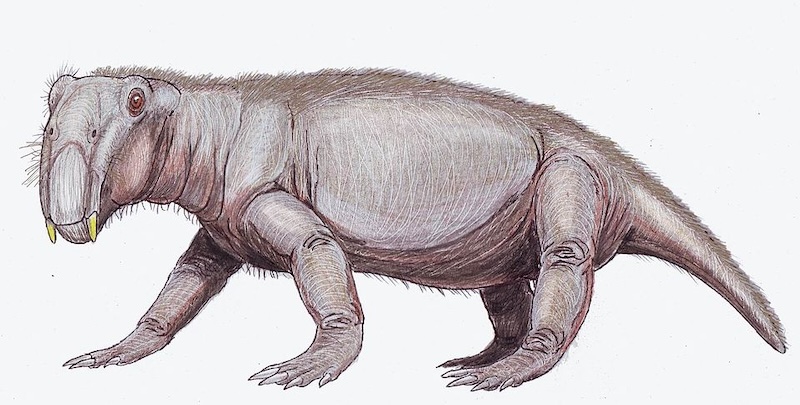 This is an artist’s depiction of Lystrosaurus georgi. It’s 1 of at least 4 known species of Lystrosaurus. Image via Dmitry Bogdanov/ Wikimedia Commons (GNU FDL).
Using the latest tech to see inside the rock
The scientists could not fully extract the fragile fossil from the rock without risking damage to it. So, they turned to advanced synchrotron x-ray computed tomography (CT). Here, x-ray pulses probed the interior of the rock nodule to reveal its internal structure, in this case, the fossilized bones of Lystrosaurus. The result was a three-dimensional image reconstruction of the bones.
The team carried out this work at The European Synchrotron in France. Vincent Fernandez, who works at this facility, commented:
Understanding reproduction in mammal ancestors has been a long-lasting enigma and this fossil provides a key piece to this puzzle. It was essential that we scanned the fossil just right to capture the level of detail needed to resolve such tiny, delicate bones.
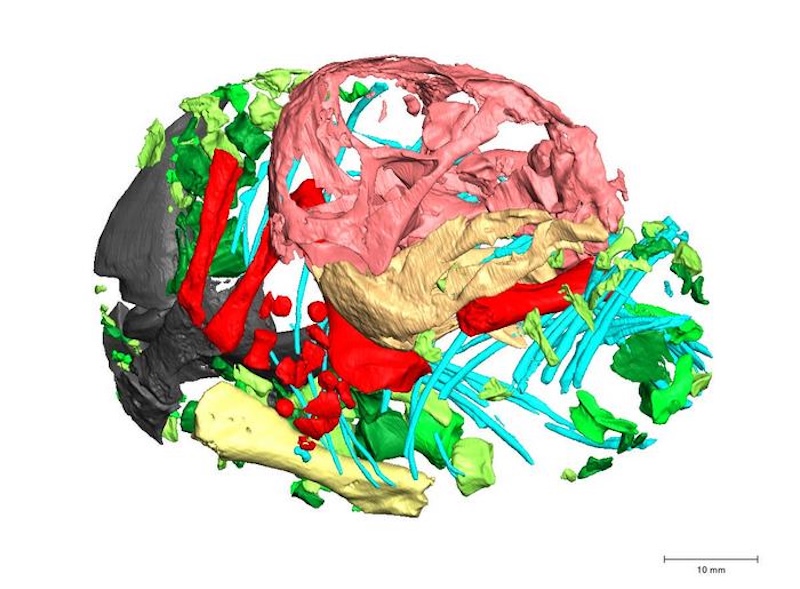 The Lystrosaurus embryo skeleton parts are color-coded in this three-dimensional image derived from the CT scan. The ribs are blue, backbones are shades of green, forelimbs are red, the femur is yellow, the skull is light red and the mandible is light orange. Image via Julien Benoit/ University of the Witwatersrand.
How scientists established this fossil was in an egg
How did the scientists know that this fossil was an embryonic Lystrosaurus? Lead author Julien Benoit of the University of the Witwatersrand said:
When I saw the incomplete mandibular symphysis [process of growing together], I was genuinely excited. The mandible, the lower jaw, is made up of two halves that must fuse before the animal can feed. The fact that this fusion had not yet occurred shows that the individual would have been incapable of feeding itself.
There were additional signs as well. For instance, other skeletal features – its shape, size, curled posture, weak limbs and the condition of its pelvis — indicated that this was an animal that was not capable of surviving on its own. In fact, it was still in its final stages of development. And the way it was curled up, in such a compact way, indicated it was in an egg.
So why haven’t scientists found Lystrosaurus eggs before? The researchers suggest that these eggs could have been soft-shelled, and therefore not preserved during the fossilization process.
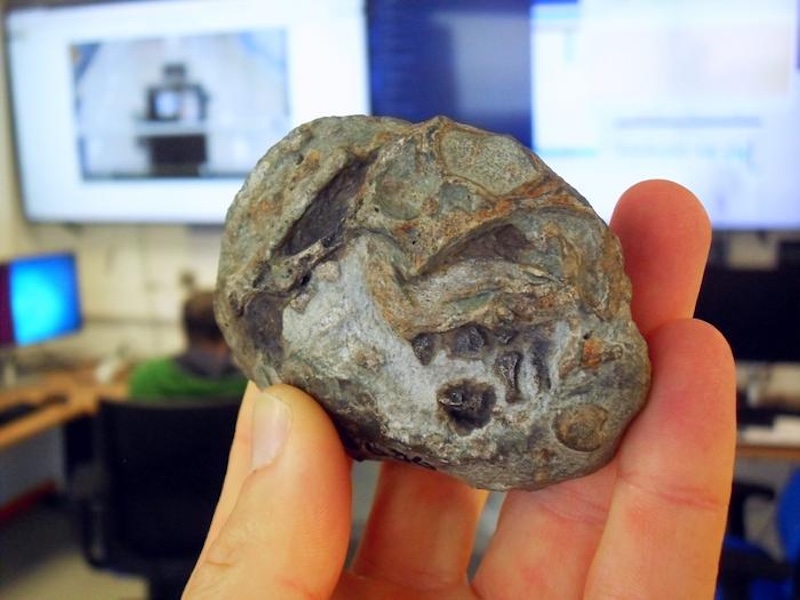 This is the rock nodule containing the embryonic Lystrosaurus fossil. The researchers used an advanced x-ray CT scanner to see the skeleton inside the rock. Image via Julien Benoit/ University of the Witwatersrand.
What the egg tells us about the ancestors of mammals
Lystrosaurus was a medium-sized animal, ranging in length from 2 to 8 feet (0.6 to 2.4 meters), depending on the species. On average, they were about 3 feet (0.9 meters) long.
Based on the size of the fossil, the researchers think the egg was about 3 inches long (7.6 cm) and 2 inches (5 cm) wide. It may have weighed about 4 ounces (113 grams). In addition, the animal’s skull was about 1.4 inches in length (35.5 mm).
This suggested that Lystrosaurus laid relatively large eggs for its body size. In modern-day animals, a large egg means there is more yolk in it, providing food for the embryo to develop into a fairly mature juvenile form. In other words, Lystrosaurus could move around shortly after birth and feed itself.
So the researchers think Lystrosaurus did not produce milk for its young, like mammals do today.
The team also said large eggs are better able to survive drought conditions because they are more resistant to drying out. This could be the reason why Lystrosaurus was able to survive the Permian extinction.
Bottom line: Scientists discovered a 250-million-year-old Lystrosaurus fossil that was still in its egg. Its shows these ancestors of mammals laid eggs.
Source: The first non-mammalian synapsid embryo from the Triassic of South Africa
Read more: Some tropical mammals shy away from the full moon