
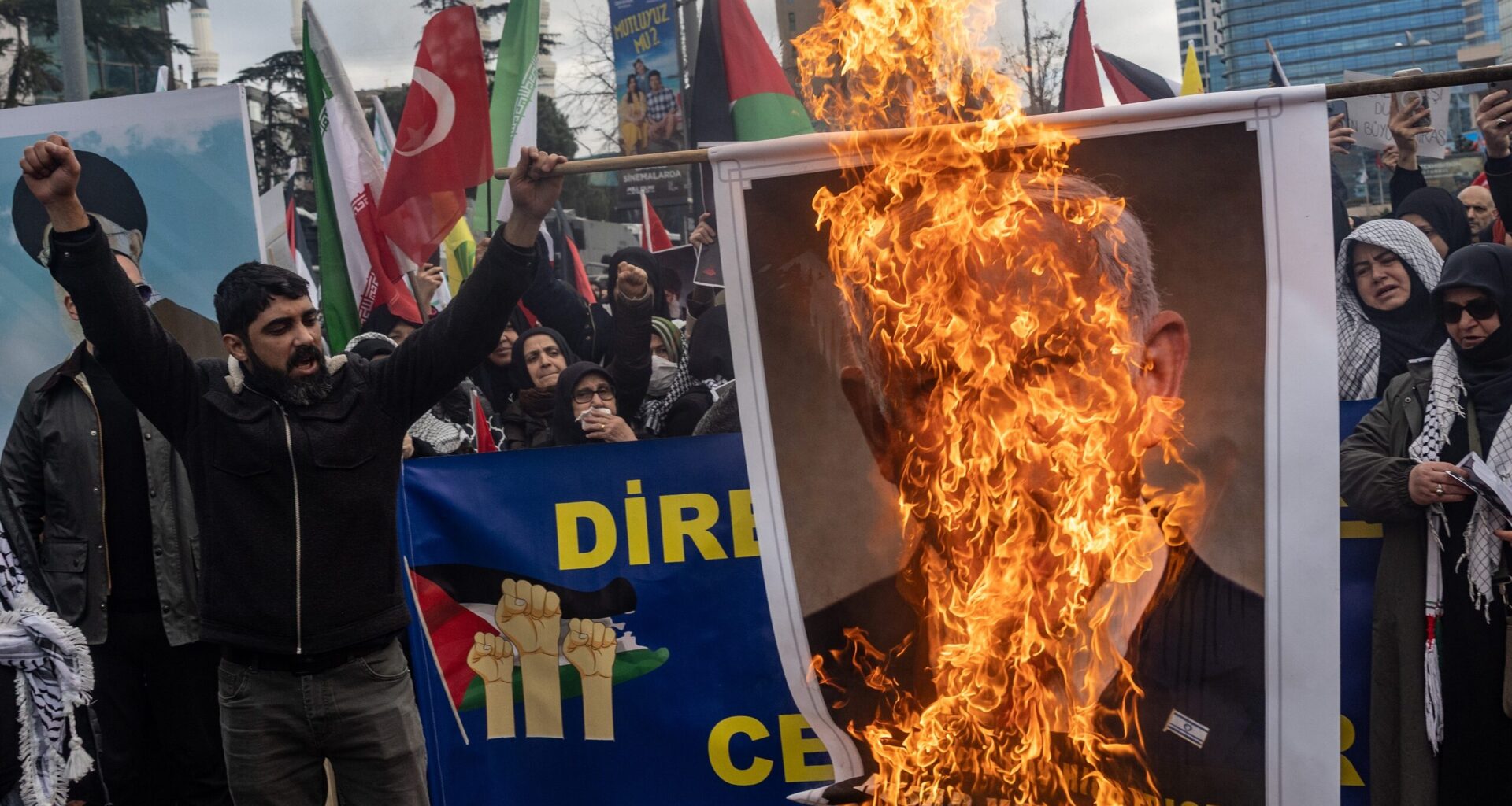
Competing claims over deterrence, restraint, and regional credibility are turning an already damaged relationship into a sharper strategic confrontation
Turkish President Recep Tayyip Erdoğan condemned the US-Israeli strikes on Iran from the outset. Then Iranian missiles entered Turkish airspace, and Israeli officials accused Ankara of directing more fury at Jerusalem than at Tehran. Those exchanges have sharpened the already damaged Israel-Turkey relationship and turned it into a dispute not only over rhetoric, but over deterrence, regional order, and who is truly escalating the war.
The rupture did not begin with Iran. Once close strategic partners with strong military ties, Israel and Turkey saw relations collapse after the 2010 Mavi Marmara raid. A 2022 restoration of full diplomatic relations and ambassadorial ties did not survive the Gaza war. After October 2023, Ankara recalled its ambassador for consultations, escalated its criticism of Israel, and in 2024 suspended trade with Israel.
By April 2026, the break was visible not only in policy but in tone. Israeli diplomats had long since left the consulate in Istanbul after the diplomatic breakdown that followed the Gaza war. The absence of Israeli staff when gunmen attacked the building housing the Israeli consulate in Istanbul on April 7 underlined how far the relationship had fallen from the short-lived optimism of 2022.
The Iran war gave that deterioration a new arena. On February 28, Erdoğan said the US-Israeli attacks violated Iran’s sovereignty and disturbed the peace of the Iranian people, while also saying Iran’s retaliatory attacks on Gulf countries were unacceptable. Two days later, he described the strikes as a “clear violation” of international law, adding, “As their neighbor and brother, we share the pain of the Iranian people.” That framing fed Israeli accusations that Erdoğan was positioning himself closer to Tehran even while presenting Turkey as a regional mediator.
The sharper dispute came when the war reached Turkish airspace. Reuters and AP reported repeated March incidents involving Iranian ballistic missiles that Turkish authorities said entered Turkish airspace and were intercepted by NATO air defenses, with debris falling in southeastern Turkey but no reported casualties. Ankara formally protested and warned Tehran that such violations were unacceptable. Still, there was no Turkish military retaliation against Iran, and Turkey did not invoke NATO’s Article 4 consultation mechanism or Article 5 collective defense clause.
Turkish officials say that restraint shows Ankara is trying to keep the region from sliding into a broader war. Israeli critics of Erdoğan see the same restraint as proof that Turkey has been harsher toward Israel than toward Iran, even after being exposed to the conflict.
Every drop of blood shed in war sparked by US-Israeli attacks on Iran will prolong Netanyahu’s political survival
The dispute then moved onto social media. In posts circulated by Turkish official and pro-government accounts on X, Erdoğan and other Turkish officials cast the war as destabilizing, illegal, and politically beneficial to Prime Minister Benjamin Netanyahu. One widely circulated Erdoğan message stated: “Every drop of blood shed in war sparked by US-Israeli attacks on Iran will prolong Netanyahu’s political survival.” Turkish presidency accounts also repeated Erdoğan’s position that Turkey approved neither the attacks on Iran nor Iran’s retaliation against countries in the region.
Israeli officials responded publicly. Reports quoting Netanyahu’s April 11 post on X said he wrote that “Israel under my leadership will continue to fight Iran’s terror regime and its proxies, unlike Erdoğan, who accommodates them and massacres his own Kurdish citizens.” Israeli media also reported that Defense Minister Israel Katz accused Erdoğan of failing to respond forcefully even after Iranian missiles entered or threatened Turkish airspace, portraying him as projecting bluster without action. Those reported exchanges reinforced the Israeli case against Ankara, though some of the wording remains filtered through secondary accounts.
Kobi Michael, a political analyst at the Institute for National Security Studies and the Misgav Institute, argued that direct Israeli-Turkish military confrontation remains unlikely because both countries are close US partners and Washington retains strong leverage over each. “That we have already reached the edge, and it cannot be worse than that, because Turkey and Israel are very close allies of the United States. The United States has a very heavy leverage on both countries. I don’t think that Israel wants to escalate the situation, not at all,” he told The Media Line. “But if Turkey tries to escalate the situation, then I think that the Americans will prevent them from doing that. They have the leverage on Turkey. I don’t believe that we will reach a military confrontation with the Turks.”
Erdoğan sees now … a window of opportunity when Iran is weaker
Michael said Erdoğan sees opportunity in Iranian weakness, regional disorder, and Israel’s diplomatic troubles. “Erdoğan has hegemonic aspirations in the broader Middle East. He perceives Turkey and perceives himself as the leader of the Sunni world and of a future Ottoman empire,” he said. “Erdoğan sees now an opportunity, a window of opportunity when Iran is weaker.” In his view, that opportunity is reinforced by Israel’s weaker international standing and by ideological changes inside Turkey that make a near-term reset unlikely.
“Israel is in sort of a problematic situation when it comes to its position and standing vis-à-vis the international community,” he said. “So, actually, this is a geostrategic game. … Erdoğan is trying to improve its strategic position amid the regional chaos and a very strong anti-Israel sentiment worldwide.”
He does not expect relations to improve soon. “I don’t think that something will be changed dramatically in the foreseeable future because Turkey has become sort of a theocracy. … It is a Muslim Brotherhood country,” he said. “I don’t think that there will be any substantial changes in diplomatic terms between the two countries, unless there is a very significant political change in Turkey itself that will bring the opposition to power.”
Barın Kayaoğlu, chair of American studies at the Social Sciences University of Ankara, offered a sharply different reading. He presented Turkey not as a state drifting toward Iran, but as an independent actor whose restraint and regional posture are being misread by Israel. “Turkey did take on Iran’s biggest proxy in the region, the Assad regime, and helped with its overthrow,” he told The Media Line, while also pointing to Ankara’s role in Iraq, even if constrained by Tehran’s influence there. “On both counts, Turkey has proven itself to be a more useful regional security actor than Israel,” he said.
Kayaoğlu also rejected the NATO-centered Israeli framing. “It’s silly of the Israelis to claim that. Iran did not attack NATO. No one asked for Art. 4 consultations or for Art. 5 to be invoked,” he said. “Had the US government wanted NATO, they should’ve called for a meeting of the NAC.” He further downplayed the scale of the airspace incidents, saying, “Of the four Iranian ballistic missiles that strayed into Turkey’s airspace … only one went considerably well into Turkish airspace.”
He also warned against any assumption in Israel that Turkey could be pressured or contained militarily. “Now, there seems to be some hope among the Israeli leadership that they could provoke the United States to attack Turkey. Very bad idea,” he said. “Turkey’s ability to hurt Israel is even more varied than that of Iran.”
Any military conflict between the two sides would be a disaster for both
“Any military conflict between the two sides would be a disaster for both,” he further added. On diplomatic normalization, Kayaoğlu said it would eventually resume only after a major political change in Israel.
The two analysts offer sharply different readings of the same crisis. Michael sees Erdoğan exploiting war, Iranian weakness, and Israel’s diplomatic troubles to improve Turkey’s strategic position. Kayaoğlu sees Turkey as an independent actor whose restraint and regional posture are being misread by Israel.
What emerges is a relationship no longer defined mainly by diplomatic disputes, but by competing strategic narratives reinforced in real time through public statements, military incidents, and political messaging. Neither side appears to want a direct war, and both remain tied to the United States and, in Turkey’s case, to NATO.
Yet each new regional crisis now gives both governments more reason to harden the claim that the other is not merely a rival, but part of the threat.