
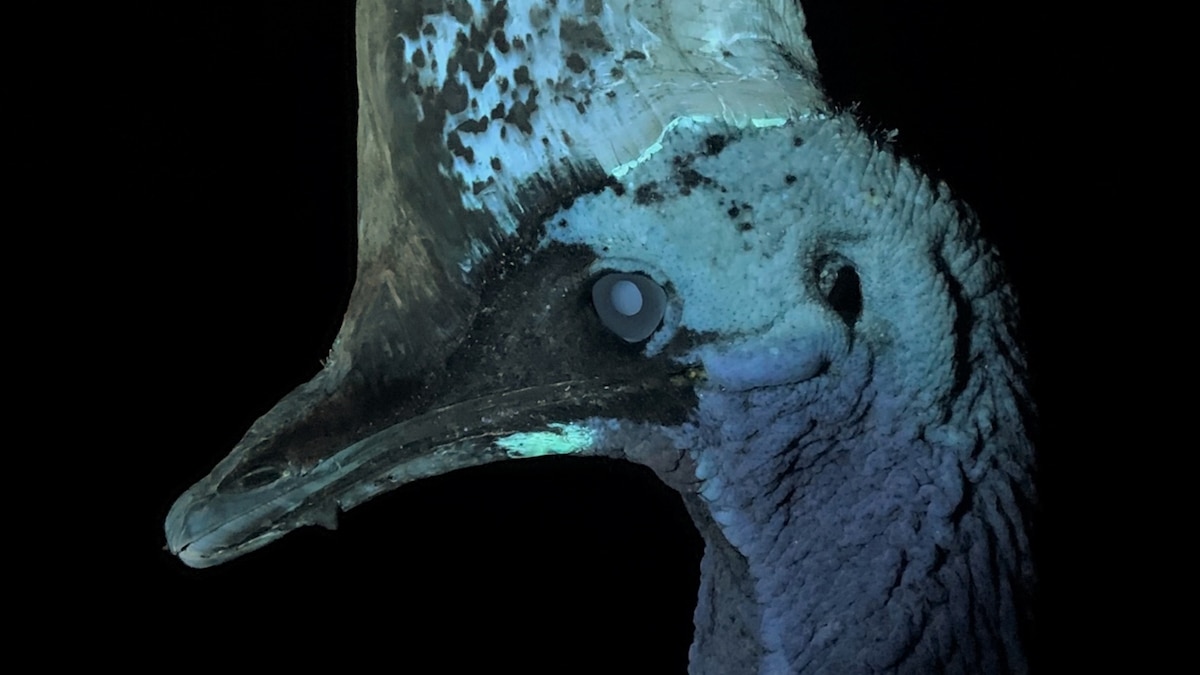
Prehistoric headgear
Researchers have long held an interest in cassowaries and their casques. “Cassowaries are among the best living analogs of many extinct kinds of dinosaurs,” says Naish. Paleontologists often look to these casques to better understand weird headgear on extinct dinosaurs like hadrosaurs or ceratopsians.
Yet cassowaries are understudied and their casques remain enigmatic. Hypotheses about the horn-like structure’s function have varied from roles in defense, heat regulation, visual displays, or to help them bellow out unique low-frequency vocalizations. Casque means “helmet” in French, but the structure is actually fragile, says Green, suggesting they probably did not develop them for defensive purposes. And unlike deer antlers that evolved to help males compete over females during the rutting season, both female and male cassowaries have casques. The leading hypothesis is that they play some role in visual display.
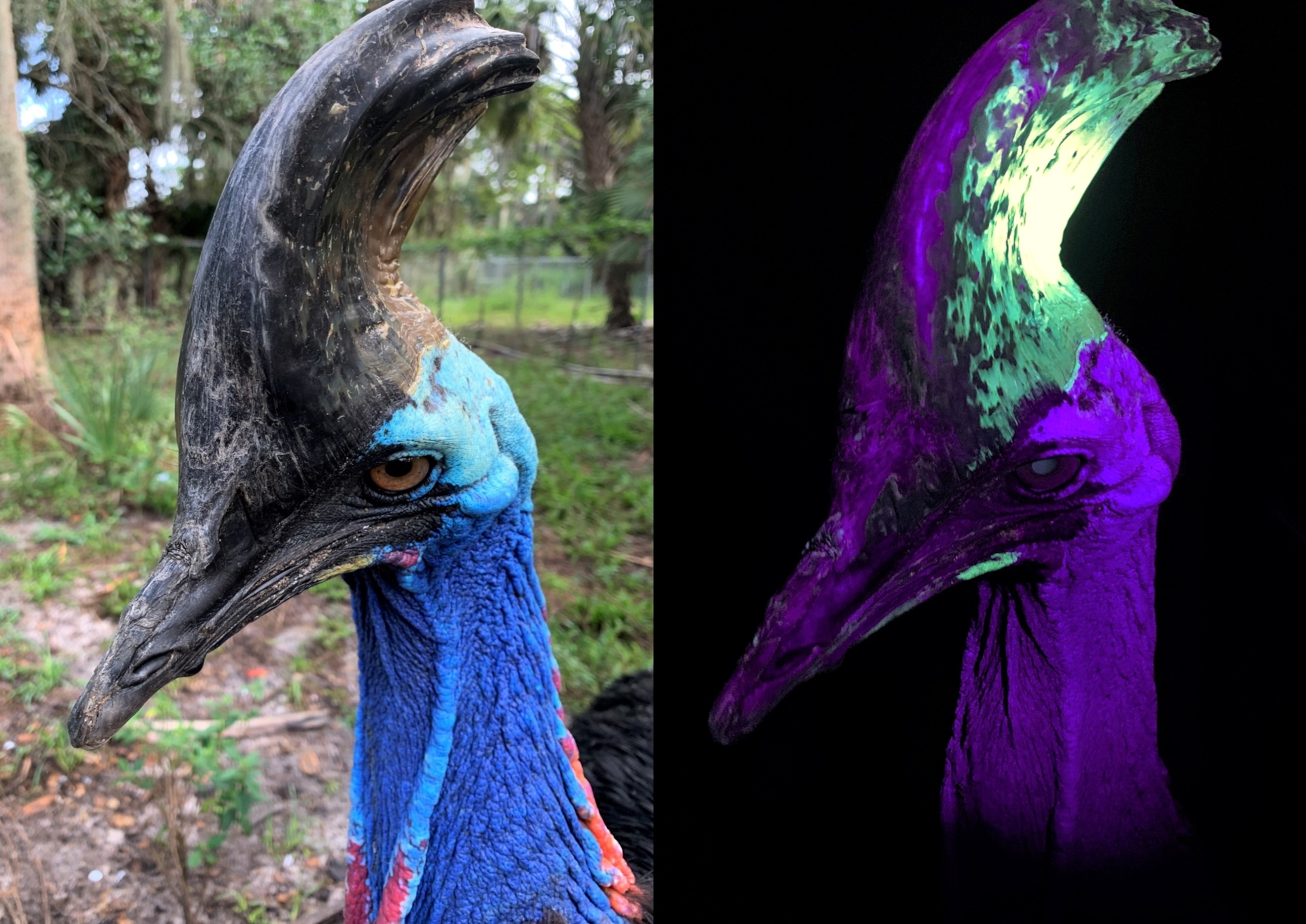
A southern cassowary under visible (left) and ultraviolet light (right) illustrating the bright green-blue ultraviolet biofluorescence of the casque surface
Todd L. Green
To investigate further, Green and his colleagues wanted to see whether cassowary casques glow under ultraviolet light. Studies have found that most birds can see ultraviolet wavelengths—so if the casque glowed under ultraviolet light, that could suggest the structure plays a role in visual signaling.
The work began in 2020, when many parts of the world had implemented COVID-19-related lockdowns and travel restrictions. Researchers were looking for ways to use available resources without having to go far.
“We couldn’t travel to Papua New Guinea where these birds were, but we had access to museum specimens and specimens in the lab,” says Paul Gignac, an anatomist at University of Arizona and co-author of the study.