
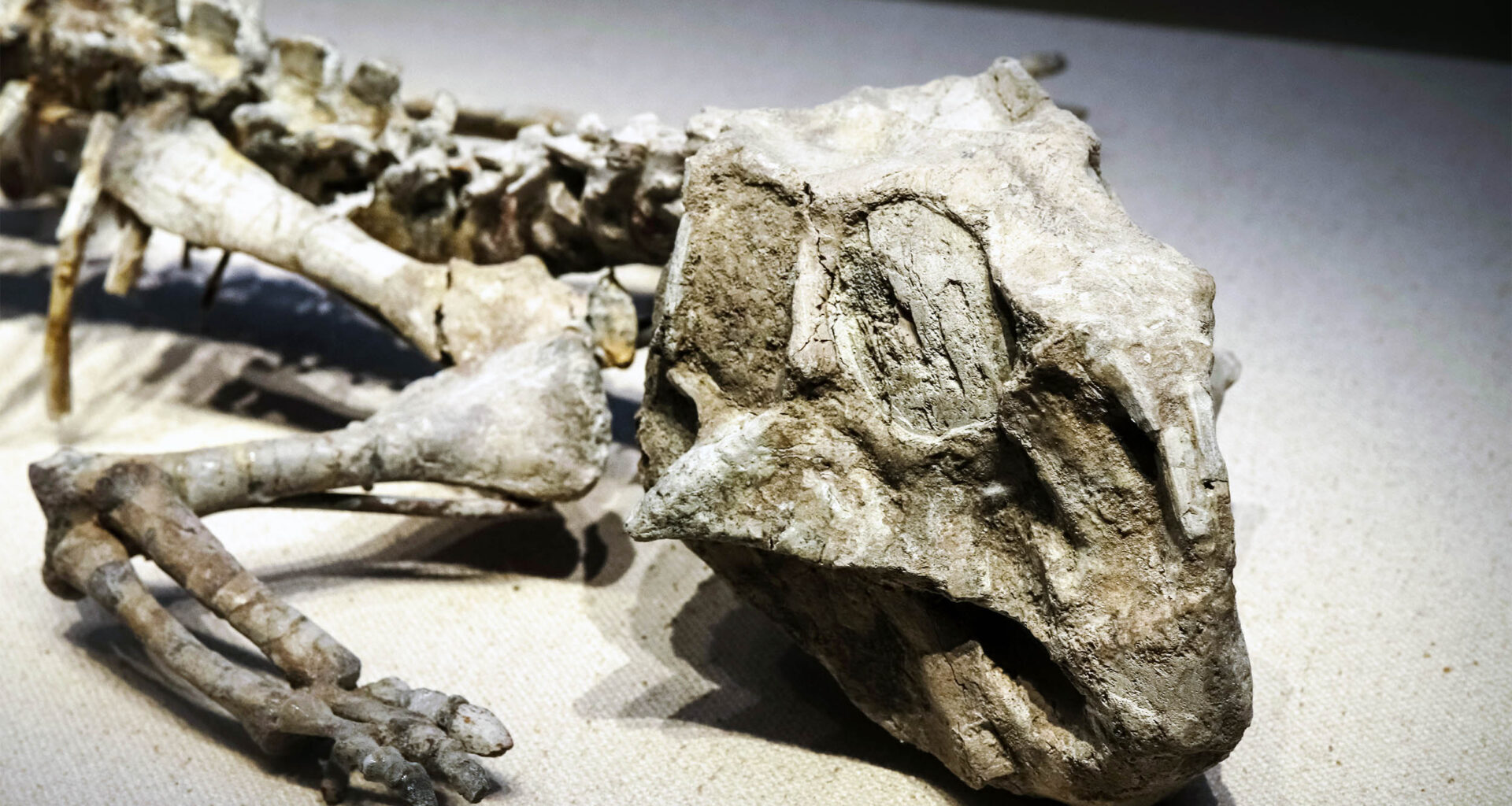
Researchers found that a baby dinosaur known as Psittacosaurus was swallowing stones before it was even a year old.
The discovery suggests that this plant-eater adopted an adult-style feeding strategy almost from the very beginning.

The research recasts these hatchlings as far less dependent on soft food and pushes a key survival behavior into the earliest stage of life.
Stones in one nest
In a single nest from northeastern China, 13 young bodies preserved stone clusters exactly where a working stomach would have held them.
Longhan Wang at Jilin University proposed that the stones had been swallowed rather than washed in after burial.
Because every youngster in the nest was still less than one year old, the habit appeared much earlier than paleontologists had assumed.
That early timing leaves little room for a later dietary transition and sets up the larger question of what those stones were doing inside such small animals.
Digestive role of hard pebbles
Paleontologists call these swallowed stones gastroliths, hard pebbles that help break food apart inside the gut.
In birds, stomach muscles press food against them, so the stones physically break tough mouthfuls into smaller pieces.
For Psittacosaurus, that mattered because its beak could slice plants, but its teeth could not fully grind them.
Once those limits are clear, the swallowed stones stop looking odd and start looking necessary.
Steady feeding from the start
Earlier work on jaws and tooth wear had suggested that young animals might not have fed exactly like adults.
On the surface, that idea made sense considering that smaller bodies and growing bones might have favored softer, easier meals.
Every hatchling in the new nest carried stones anyway, so the expected nursery menu now looks much less certain.
Instead of a dramatic handoff between childhood and adulthood, feeding may have stayed surprisingly steady from the start.
Adult Psittacosaurus strategies
Adult Psittacosaurus had already hinted at this system, because larger skeletons sometimes preserved many stomach stones.
Those older animals could crop and slice plants, yet they still lacked the kind of grinding bite many herbivores depend on.
Finding the same stone habit in hatchlings links baby feeding directly to that adult solution instead of separating them.
Seen across ages, the animal’s life history looks simpler, but its early toughness also becomes harder to dismiss.
Clues from the rocks
One youngster gave up dozens of stones, enough to test where they came from and what they were made of.
Most proved to be pieces of volcanic and other local rock – not stray pebbles hauled in from far away.
In one specimen, the average stone measured 0.35 inches, and the largest reached 0.60 inches, despite the animals’ tiny size.
Because the stones match nearby geology, they point toward short-range foraging and a small home range near the nest.
An early feeding system
When the team compared one youngster’s stone load with living birds, the match landed close to a known digestive pattern.
In that test, birds matter because stomach stones work only when muscles keep food rubbing against them inside the gut.
The fit does not prove identical anatomy, but it strengthens the idea that the pebbles were doing real work.
Instead of acting like accidental grit, they behave like part of a feeding system that started astonishingly early.
Hints of group life
Clusters of young Psittacosaurus have been found before, and one earlier group hinted that these dinosaurs may have lived in mixed-age communities.
This new nest does not prove parental care, because a crowded fossil bed can record death as well as daily life.
Still, 13 youngsters preserved together suggest these animals stayed near one another during a vulnerable part of growth.
As a limit, that social possibility reminds us not to mistake a striking scene for a settled answer.
Why young fossils matter
Young skeletons rarely preserve this kind of detail, which is why they can rewrite an animal’s life story so quickly.
Instead of showing a halfway stage, these hatchlings lock behavior, growth, and local habitat into the same small scene.
“The presence of these gastroliths provides valuable insights and contributes significantly to the reconstruction of the paleobiology of this keystone herbivorous dinosaur,” wrote Wang.
Because the evidence comes from the first year of life, later debates about diet now start from a different baseline.
Implications beyond one dinosaur
For paleontologists studying plant-eating dinosaurs, the discovery sharpens a basic rule: feeding tools can arrive very early.
From there, cleaner comparisons open with other young herbivores whose bellies, teeth, or bone chemistry preserve only part of the story.
It also pressures researchers to look harder at juvenile fossils, which often sit in collections without getting the same attention.
Once the youngest animals enter the picture, whole life histories can change without a single new adult skeleton.
What emerges is a dinosaur that began solving the problem of tough food almost as soon as it hatched.
Future finds may test how widespread that early strategy was, but this nest already makes baby herbivores look far less delicate.
The study is published in the journal Science China Earth Sciences.
—–
Like what you read? Subscribe to our newsletter for engaging articles, exclusive content, and the latest updates.
Check us out on EarthSnap, a free app brought to you by Eric Ralls and Earth.com.
—–