
Source | IMDEA
Recently published research from IMDEA Materials Institute (Madrid, Spain) and the Technical University of Madrid (UPM) aims to advance real-time simulation capabilities for composite manufacturing processes.
The study, “A deep surrogate model for filling simulations in liquid composite moulding on unstructured 3D grids,” is co-authored by Prof. Carlos González, Dr. Davide Mocerino and predoctoral researcher Sofia Fernández León from IMDEA Materials, and the UPM’s Profs. Roberto Valle Fernández and Luis Baumela.
The researchers say their research addresses key limitations of current deep learning surrogate models for simulating fluid flow in composite manufacturing processes, and the results highlight the potential of data-driven approaches to enhance efficiency, adaptability and resilience in advanced manufacturing processes.
According to the researchers, liquid composite molding (LCM) simulations are essential for optimizing manufacturing processes and reducing defects such as void formation. However, their high computational cost has traditionally limited their use in real-time applications. This research addresses that challenge by introducing a deep learning-based surrogate modeling framework capable of delivering accurate predictions in milliseconds, unlocking new possibilities for digital twins and adaptive process control.
“A key innovation here lies in overcoming one of the main bottlenecks in this field by achieving computational efficiency, high accuracy and robustness to the irregular and unstructured meshes commonly found in industrial settings,” explains Fernández León. “These requirements are rarely satisfied simultaneously by existing neural network approaches.”
The researchers also introduced a multi-branched encoder-decoder architecture to model complex geometries, such as T-shaped stringers, by breaking them down into planar regions and ensuring consistency across interfaces.
In parallel, “The proposed grid mapping technique enables the use of convolutional neural networks on unstructured 3D domains, preserving accuracy while extending applicability to realistic manufacturing scenarios,” adds Fernández León.
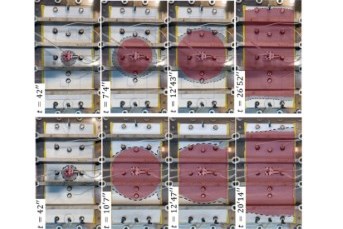
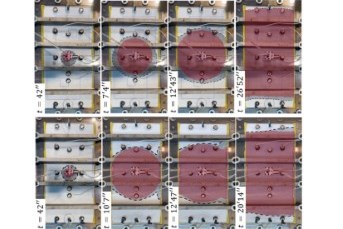
The resulting surrogate models are said to demonstrate strong agreement with both high-fidelity simulations and experimental data, while achieving speed-ups of four to five orders of magnitude compared to conventional methods. This level of performance aims to enable real-time deployment in digital manufacturing environments, supporting more efficient, adaptive and resilient composite production processes.
“This study highlights the transformative potential of combining advanced manufacturing with artificial intelligence, paving the way towards fully integrated, data-driven production systems,” says Fernández León.