
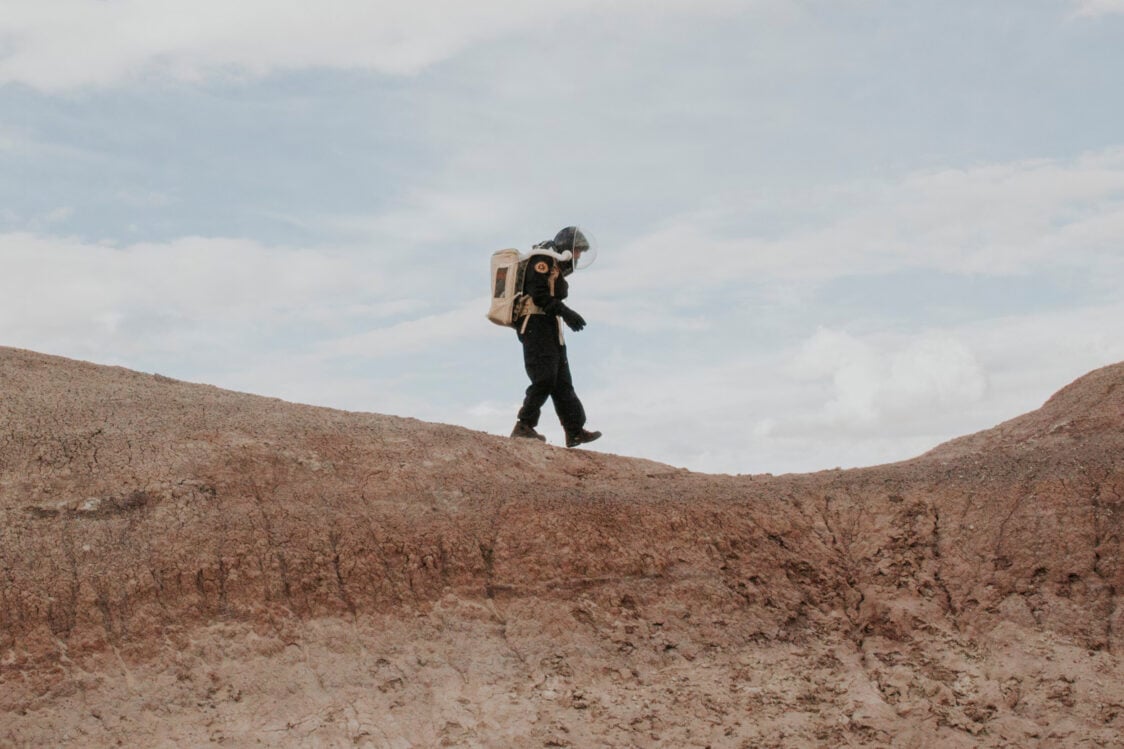
To become a Martian colonist, I first had to fill out a Google Form. It asked me about my aviation know-how, medical training, and experience “working in extreme environments.” I sheepishly wrote “N/A” each time, adding a note that highlighted my cooking and social skills. It turned out that this was okay: I was only going to Utah, after all, and the institution running the show was not a multibillion-dollar federal agency but the Mars Society, a scrappy nonprofit. The organization was founded in 1998 by the aerospace engineer Robert Zubrin to advocate for human settlement of the red planet. In 2002, it opened the Mars Desert Research Station, a simulated Martian settlement—laboratory, theater, and summer camp all at once. Located in a corner of rural southeastern Utah, the MDRS’s environment looks enough like Mars to play the part while still being accessible to participants and potential donors. (Antarctica and the Atacama Desert, arguably the best Martian analogues on Earth, are harder sells.)
I was accepted into a crew in late 2024, but our plans for a November launch date were quickly foiled when the man who was supposed to be our commander stopped replying to emails from mission support. Plenty of real-life space missions experience delays—over the thirty-year course of the U.S. Space Shuttle program, at least eighty missions were scrapped—but the obstacles here seemed avoidable. A month before we were meant to depart, Sergii Iakymov, the Ukrainian aerospace engineer who helps run the MDRS, told us our mission had been called off. “This decision is final,” he wrote. “We wish you all the best!”
Fortunately, there was another Google Form, and I managed to join a new crew that would be heading out in April. The commander of this mission, Dave, was a founding member of the Mars Society. He emailed to welcome me (“Howdy Elena”) and attached a photo of himself in aviator sunglasses, brandishing a small troll doll in front of the rotund white structure where we would soon be living together.
The MDRS is the longest-running Martian habitat in the world; more than three hundred crews have traveled there to live together, eat freeze-dried food, drive “rovers” through the desert in helmeted space suits, and work on research projects. Most Martian simulations are lengthy affairs: one conducting NASA-sponsored research on the slopes of Mauna Loa, in Hawaii, lasts at least four months, while NASA’s simulations at the Johnson Space Center, in Houston, span a full year. The longest-ever Martian simulation, beginning in 2010 at the Institute of Biomedical Problems in Moscow, went on for 520 days.
The Mars Society’s simulations, on the other hand, are usually two weeks long. Crew members’ research projects can seem a bit perfunctory, often involving testing gadgets or mimicking the sort of fieldwork that might someday be done on Mars. (This isn’t to say that the longer-term missions always produce mountains of technical research. In Russia, the six crew members played a lot of Guitar Hero, and mission control had to fake a fire to keep them alert.) Most participants are either graduate students or ordinary Mars enthusiasts, the majority of whom pay the Mars Society between $2,000 and $3,500 to attend. Only a handful of them have ever actually made it into space. It wasn’t initially clear to me what, exactly, the organization’s simulation had done to nudge humanity toward the red planet. It seemed more like an elaborate team-building exercise, a logistically complicated and expensive ropes course for space-travel diehards.
In the months before the mission, I attended regular Zoom meetings with my fellow crew members. There were two younger professionals in their thirties: Michael, who would be the crew’s engineer, and Koi, our health-and-safety officer. Then there were two retirees: Tim, who was serving as a “crew artist,” and Dave, who I learned had taken part in five previous MDRS simulations. These were people who could list every one of NASA’s rocket types, who had opinions on whether Mars was best reached directly from Earth or from a base on the moon. I would be the crew journalist, a traditional MDRS position best described as a kind of pro bono PR rep. My tasks would consist of writing daily summaries of our days on the planet that the Mars Society could then post on its website and Facebook pages. (I would also water the plants in the greenhouse.) Together we made up Crew 315, or, as we called ourselves, Crew Phoenix—a name that had been chosen by the rest of the team before I joined, supposedly for its connotations of rebirth; we wanted to revive a planet that may have once hosted life, but that had died long ago.
As our launch date approached, we prepared our proposals for research projects that could conceivably be completed in two weeks. The ones I designed were rudimentary, to say the least: one involved collecting samples of desiccated soil in order to, I claimed, “better understand how similar features on Mars might have formed”; the other had me monitoring a store-bought oyster-mushroom growth kit on a shelf in the greenhouse. We booked our flights and bought blue one-piece flight suits on Amazon that were almost certainly intended as Halloween costumes. We spent hours discussing the logistics of ordering customized mission patches.
There would be no anti-gravitational technology, nor enough time to test our responses to extended isolation. News of what we accomplished or screwed up would not be submitted to NASA. We were about to go through the same motions that hundreds if not thousands of other people had gone through before us. What had been accomplished out in Utah during those many fortnights? What would these Martian drills really prepare us for? We were taking part in a story that had been replayed over and over in the desert, but determining where it might eventually get us was not the easiest question to answer.
Though I was going to simulated Mars as a journalist, I had felt the pull of the real thing myself. As a high school student in Albuquerque, I used money saved from tips I earned as a barista to buy a telescope the size of a rocket launcher. At night, I would haul it into our backyard to observe easy targets like the Orion Nebula or Saturn, all the more stunning in their tiny blurriness compared with the bright, crisp images that were ubiquitous across desktop backgrounds and school-library posters. I found my hobby a little embarrassing at the time, but I would sometimes cry standing barefoot in the grass, struck as much by the sublimity of what I saw through the lens as I was by how little else in my life could make me feel that way. One summer, when I was seventeen, I went to an astronomy camp at an observatory outside Tucson, where we studied exoplanets with stunningly expensive instruments and made Dippin’ Dots—the ice cream of the future—with tanks of liquid nitrogen. I even tried to go to the real Mars that same year by applying for Mars One, a doomed Dutch startup that aspired to send a party on a one-way trip to the planet and planned to finance its colony by somehow turning the whole thing into a reality-TV show.
I’m not sure why I was even allowed past Mars One’s landing page as a minor. But at the time, it seemed like going to Mars would be a far more productive way of dealing with my adolescent depression than watching Six Feet Under until 5 am on school nights. I worried that either the world would disappoint me or, more likely, that I would be a disappointment to it. Going to space would be a good way to solve both problems.
In 2019, six years after receiving my application, Mars One went bankrupt and was liquidated in a Swiss court. By then my interest in the trip had waned, along with any expectations I’d had of a mission to Mars occurring in my lifetime. The private sector, however, thought otherwise. A small collection of companies had been steadily making remarkable technological progress toward creating powerful, relatively affordable reusable rockets. At the center of this innovation was Elon Musk, who joined the Mars Society board in 2001, donated $100,000, and went on to found SpaceX the following year. Musk quickly left the society behind; he began hoovering up government contracts and saw his net worth soar as he found ever-cheaper ways to launch mass into orbit. Colonizing Mars was an essential part of SpaceX’s mission from the start, with Musk describing the planet as the “Holy Grail” of space. He framed the company’s success as a matter of the human race’s survival, a kind of mandate from heaven—a claim that only fueled his domination of the aerospace market. “That’s what being a spacefaring civilization is all about,” reads a Musk quote on SpaceX’s website. “It’s about believing in the future and thinking that the future will be better than the past.”
Most people I know have been skeptical of SpaceX’s Martian ambitions. Some wonder why we would try to become interplanetary when there are more than enough problems at home. Others think the whole thing just sounds stupid. But I still wonder why, despite all the technological advancements of the past few decades, something as incredible as reaching Mars feels less likely than ever. The MDRS seemed like a place where I might meet Mars enthusiasts who hadn’t lost their optimism, who were confident that the human spirit of the mission they dreamed of would persevere no matter who paid for its rockets.
Shortly before our departure, I called up Dave to ask what drew him to the MDRS. Dave lived near Colorado Springs, in a house so remote that he was recruiting neighbors to serve as fire watchers while he was in Utah. A true autodidact, he would often pan his laptop camera during our Zoom meetings to show us the antique radios he had restored, or the Atari synthesizers from the Eighties that he used to compose music. When he wasn’t at home, Dave said, he was often out camping in his RV, which he would use to drive to the MDRS and, once we were done, to explore the wider desert for a few more weeks. In many respects, Dave seemed definitively earthly, and yet he remained firmly attached to the Martian vision.
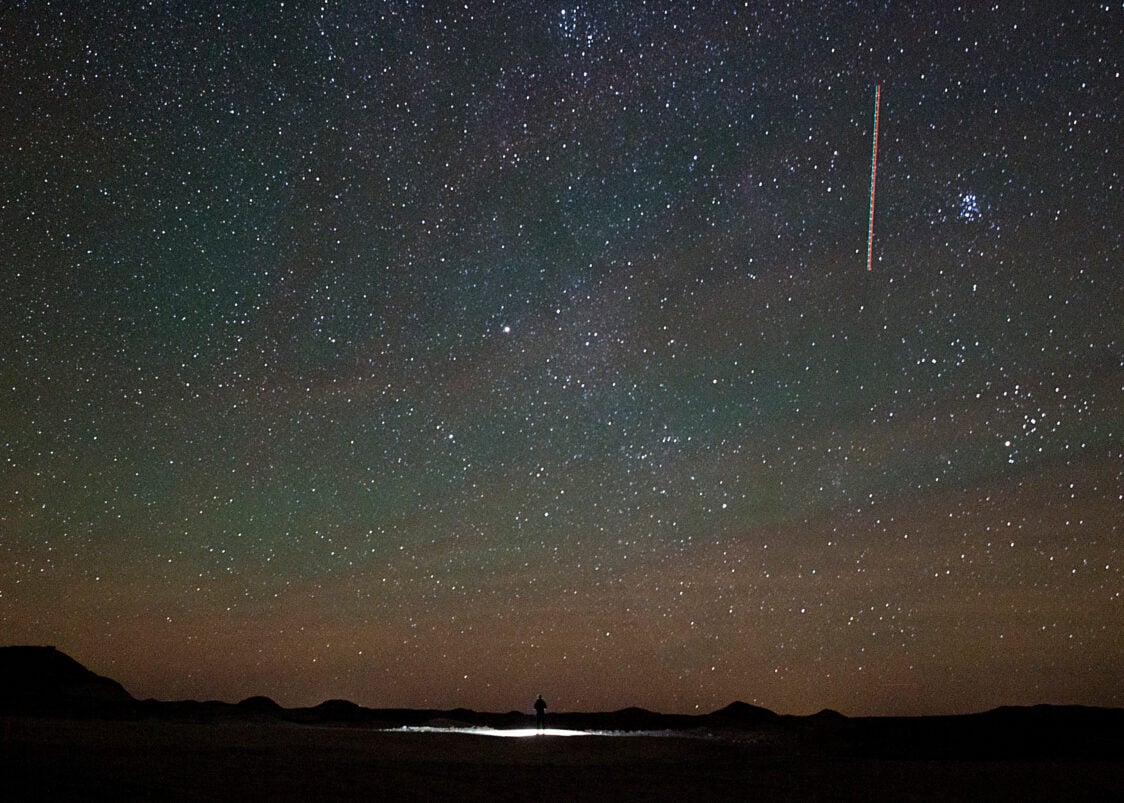
Some of his thinking was common among space expansionists: Mars settlement would inspire future scientists; it would get us closer to knowing whether there was other life in the universe; it would serve as a crucial step for human survival as Earth became uninhabitable. But his particular motivations felt personal. Toward the end of our conversation, he explained what he thought of as a more original theory: When earthworms had been around longer than our ancestors, how had we been the ones to become so advanced—the ones capable of talking over the phone, of considering anything about Mars in the first place? “Would evolution push us to be this far developed, to be able to be spacefaring and save species from Earth way into the future?” Surely, this was an unlikely act of chance. Going to Mars was a kind of human genomic destiny. “It seems, in my mind, some kind of explanation of why we’re so darn overevolved,” he said. He seemed moved by the idea, either by the neatness of intelligent design itself or because it lent his dream a sense of inevitability.
“We are such incredible creatures in so many ways,” he said. “When you retire, you’ll probably have more time to reflect on this.”
In April, not long after Dave’s RV had set off westward for Utah, Tim, Michael, Koi, and I landed in Grand Junction, Colorado, slept at a Days Inn, and ate Grand Slams the following morning at a Denny’s next to the motel. Then, with Michael behind the wheel of the Mars Society’s 2004 Suburban, we made the two-and-a-half-hour trip down to a town called Hanksville, just beyond which lay the MDRS. Michael had done the math: every minute we spent in the car on the way to our Mars was proportionately equal to a day and a half in a rocket on the way to the real thing.
Michael was a thirty-five-year-old with a red beard and a bright set of teeth. He lived alone in L.A. with a beloved cat, his head down in aerospace logistics work most of the time. While he’d recently bought a Cybertruck and loved electronic dance music, he seemed more patient and generous than the average tech bro. Tim, the crew artist, was a folksy, sixty-eight-year-old grandfather from Titusville, Florida, a small city near the Kennedy Space Center. From his house he could almost see the great cube of the Vehicle Assembly Building—one of the largest single-story structures in the world—where the Space Shuttle and other craft are pieced together before launch. He was invited on the mission as a kind of thank-you from the Mars Society for designing mission patches for the organization over the years. He had also designed ours: a giant phoenix hovering flamboyantly over the MDRS campus, depicted on the surface of actual Mars.
Koi, the health-and-safety officer, was the size of a teenage gymnast and wore a buzz cut save for a swoop of bleached blond hair that she kept in a tight bun. She was in her early thirties and lived with her best friend in New York. Koi had a preferred way of telling her story; when I first spoke to her before our mission, she began by reading from a written statement: “From the earliest whispers of my childhood, Leonardo da Vinci cast a radiant glow on my mind, a brilliance that continues to illuminate my path today.” Koi’s goal was to become an astronaut, and she was training to become a viable applicant in somewhat freelance fashion: in addition to the master’s degree she had earned in space-systems engineering at Johns Hopkins, she was putting herself through pilot and scuba training, taking courses at the non-profit International Institute for Astronautical Sciences, and planning to pursue a medical degree with a focus in space medicine. She also had close to 250,000 followers on Instagram, where she had become something I can only describe as a space influencer, posting footage from her training, curated tableaux with aesthetically pleasing star maps, or self-portraits in otherworldly locations such as White Sands National Park, sometimes promoting sponsored laptops or vegan skin-care treatments.
Crammed into the Suburban, I saw how easily a mutual enthusiasm for outer space could smooth over personal differences. Much of the chatter on the drive sounded like that of soldiers trading stories about their deployments. My crewmates all knew people in common, mostly from other simulations, and they spoke to one another in a familiar shorthand. The conversation sometimes grazed the confusing political valence of what we were about to do. Months before our mission, Donald Trump had promised in his inaugural address to “pursue our manifest destiny to the stars” and “plant the Stars and Stripes on the planet Mars.” Musk, of course, was the man behind this goal. As we spun across the desert, he was about to begin gleefully dismantling the federal government as the head of the so-called Department of Government Efficiency, often while wearing a T-shirt that read occupy mars. For better or worse, the administration seemed bullish on a Mars mission even as it defunded research and otherwise expressed hostility toward science in almost every way imaginable.
“That’s why we need to go to Mars,” Koi said, implying that a mission would revitalize pro-science attitudes in the country.
“And it’s why we need to be careful who we bring up there,” Tim replied, with a single bark of laughter.
Michael countered that any problems of colonization would probably come out in the wash, much as he believed they had throughout American history. “We arrived in this country five hundred years ago, and things could have gone a lot worse,” he said.
Tim threw up his eyebrows. “Ask the Indians!”
“On Mars, we’ll do better,” Michael replied. “And then we’ll do even better on the next planet.”
We passed through Hanksville, then snaked up a dirt road across a plateau of barren rock bordered by red hills. A series of signs on a wooden post announced the MDRS and requested that outsiders view the station from a polite distance.
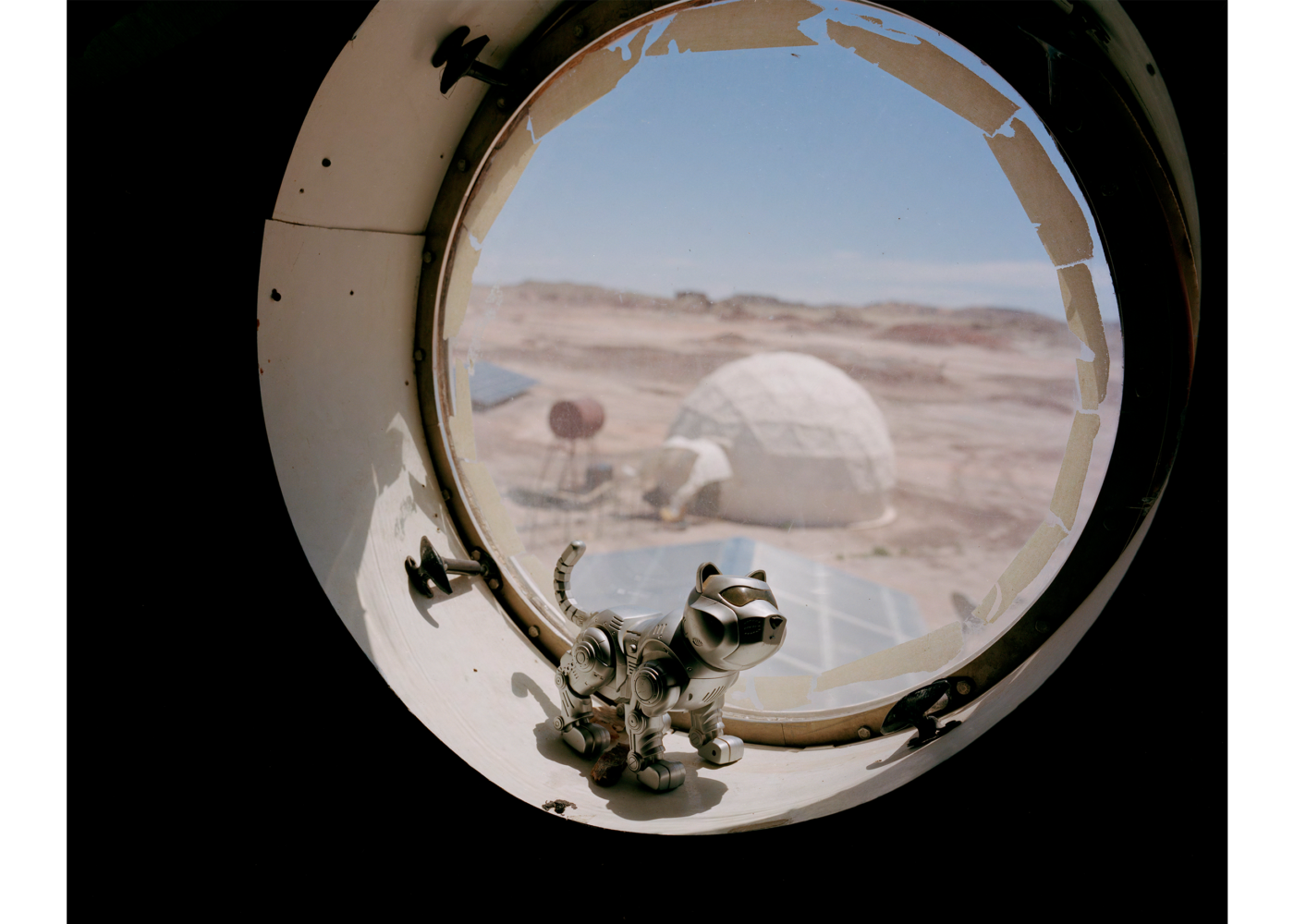
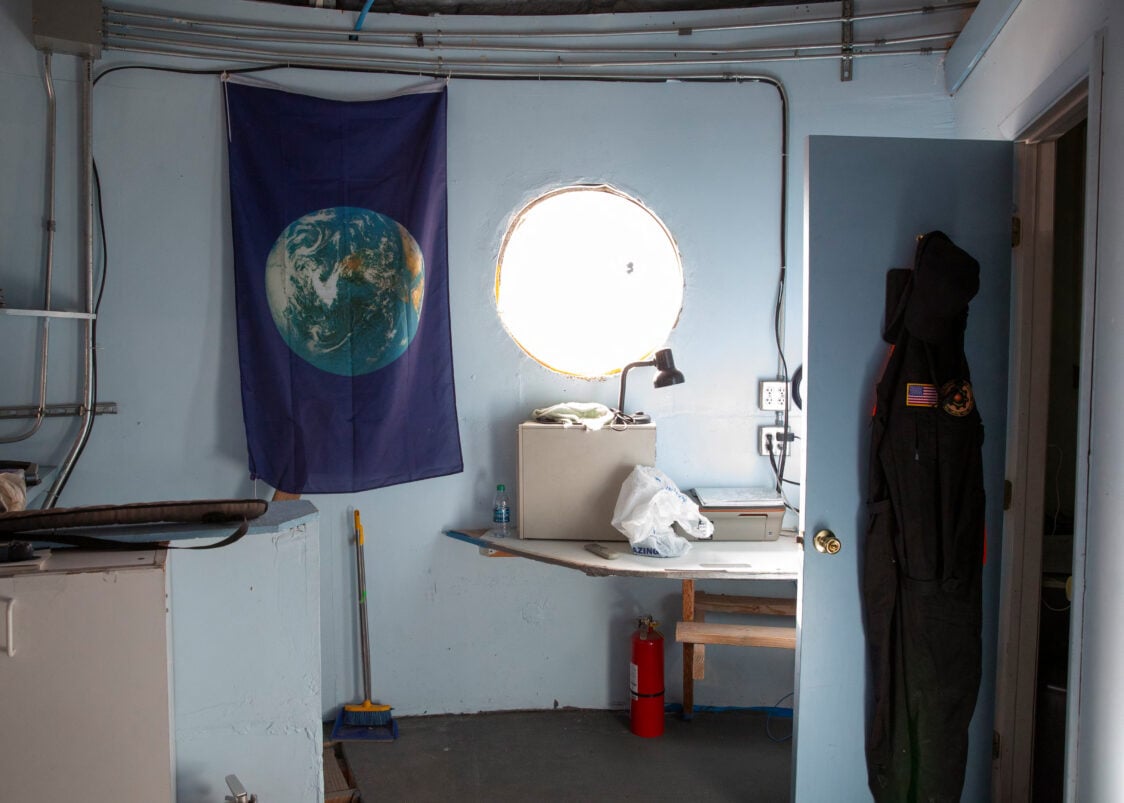
Then it appeared: a cluster of bright hemispheres linked by shining passageways made of wire and tarp, all white. Closest to us was a geodesic dome with a long horizontal window along its equator—it was hard to think of anything other than the command module from 2001: A Space Odyssey. Tunnels led to three other structures: an observatory; a greenhouse; and, set farther out into the hills, the Habitat (or the Hab), our home. It was the tallest building in the complex, a two-story silo with a domed roof and portholes for windows. A decal of the Mars Society logo—a white male astronaut standing in front of three increasingly verdant visions of Mars’s terraformed future—had been stuck above the submarine-style bulkhead door. Printed in Helvetica on the Hab’s siding was a list of major sponsors. There was only one named: the musk foundation.
We made our way inside, past shelves of spherical plastic space helmets and up a steep metal staircase to the carpeted upper deck. Dave was already there, leaning against the kitchen sink. He wasn’t tall, exactly, but he had the able lank of an older man who’s never gone long without a hike. His white hair was tied in a ponytail, and he wore an orange space suit covered in patches from his past missions. We held out our hands for handshakes, but after so much anticipation, we all collapsed into an awkward group hug.
According to the customs of the MDRS, we weren’t actually on Mars yet. We wouldn’t touch down until noon the following day, when we would exit our so-called orbit and make our so-called landing. Our so-called mission-support specialist, David Steinhour, had to show us around the place first. He met us upstairs after a few more minutes of anxious pleasantries. “Has anyone been to Nowheresville, Utah, before?” he asked.
Steinhour was a chatty twenty-nine-year-old in reflective sunglasses who worked for the Mars Society as the MDRS site manager. His duties consisted mostly of fixing power shortages and turning the Wi-Fi on for a few hours each day, to simulate the limited communication windows of the planet. He would be living in a trailer some fifty yards from the Hab, barely concealed from our view. Over the next few hours, he gave us a tour of the property. Our beds were in the Hab’s upper deck, in narrow private bunks with plywood doors, miniature desks, and a few shelves. We would eat food prepared in a kitchen stocked with dehydrated ingredients that were stored in cans the size of bongo drums: onions that looked like toenail clippings, beef that looked like dog food, Red Lobster–branded instant-biscuit powder. In a drawer, I found a binder of handwritten recipes from previous crews and a printed MDRS cookbook. “Keep your Martian explorer well-fed and happy,” the back cover read, “all with those same ingredients that have been sitting in the Hab pantry since you left Earth a year ago.”
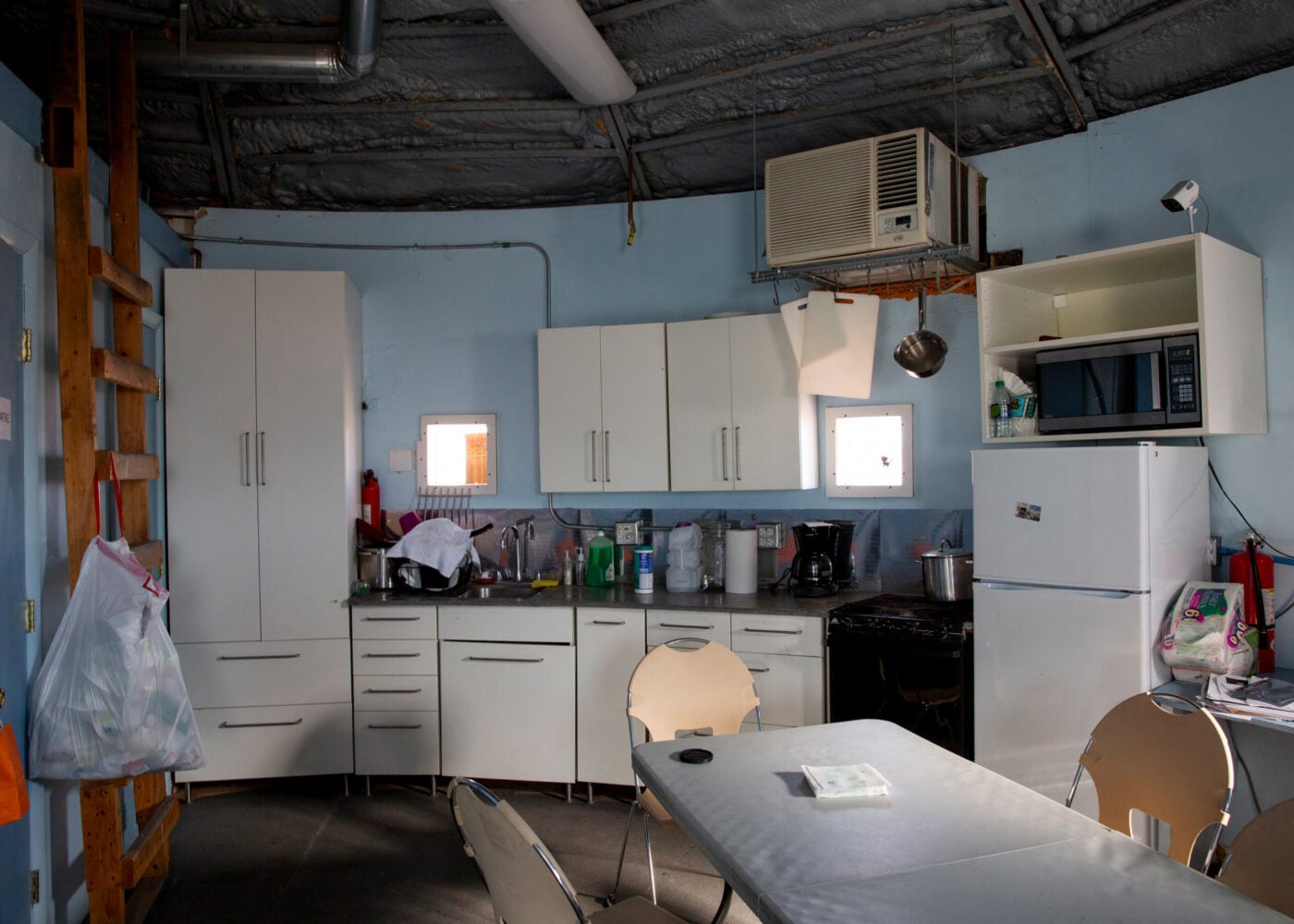
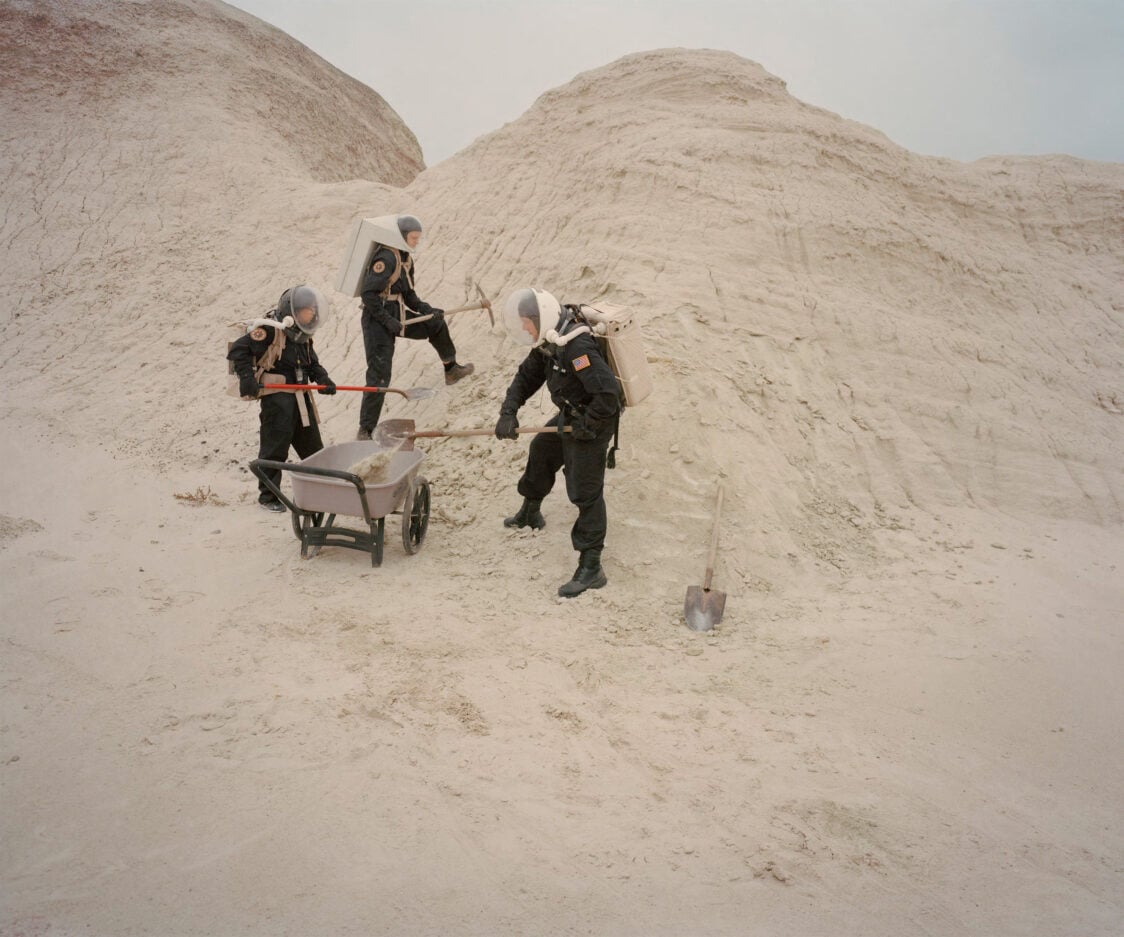
We were introduced to the gravity toilet, the shower, and the greenhouse, where I would be watering the herbs and cherry tomatoes, though most of them had already flowered or shriveled up in the heat. We toured the Science Dome, where crews had access to basic lab equipment, and a workshop made out of the body of a Chinook helicopter, where Michael, the only reliably handy one among us, could repair tools or appliances. Finally, Steinhour showed us the rovers, metal-frame four-wheelers named after actual Mars rovers: Curiosity, Opportunity, Perseverance, and Spirit. Almost every morning and every afternoon, two or three of us were to go on an EVA (extravehicular activity) and travel to different geological formations, nominally to gather data for our various projects.
Steinhour warned us that the public trails nearby would get busy with ATVs and dirt bikes, and that we might be approached by non-colonists. “We have more tourists—more alien activity—than normal,” he said. A cameraman from CNBC was coming to film our crew for a TV spot the day before the mission was set to end, but until then, we should treat anyone outside our crew as an extraterrestrial or, at the very least, as a presumed Chinese or Russian astronaut.
The next day, in the kitchen, I made a utilitarian lunch by shoveling canned tuna onto saltines. Near the staircase was Dave, his body folded into an orange beanbag, staring at the floor in front of him in silence. Our simulation was supposed to begin in just a few minutes, though there didn’t seem to be any kind of formalized ritual to mark the transition. Then, just as the minute hand on the kitchen clock struck twelve, I noticed a walkie-talkie in Dave’s hand. He brought it up to his mouth. “This is Crew 315 to Mission Support,” he said, leaning back and smiling. “We’ve had a successful landing on the surface of Mars.”
In Mars on Earth (2003), one of Robert Zubrin’s many books, he refers to his generation as “Apollo’s Children”: those whose love of space and sense of technological possibility had been shaped by watching the rapid successes of Kennedy’s Apollo program, and who were bitterly disappointed by the fact that nothing had ever surpassed it. It was this frustration that brought Zubrin to the Case for Mars conference in 1987. These events had been held every three years since 1981, in Boulder, Colorado, and were organized by a group of scientists committed to terraforming Mars. When they eventually concluded that this was too ambitious a goal, they pivoted to advocating for a permanent, self-sufficient human presence on the planet. Probes, rovers, and quick visits wouldn’t be enough.
The Case for Mars organizers were attempting to step in where NASA had failed. By the time many of Apollo’s Children went to college, hoping to join the space program and journey beyond the moon, NASA’s funding was drying up, and space travel was losing political momentum. From 1965 to 1975, the agency’s funding had fallen from 4 percent of the federal budget to less than 1. George H. W. Bush’s 1989 Space Exploration Initiative briefly revived hopes of a manned mission to Mars, but his plans came with a $500 billion price tag; the whole thing was dead four years later. Without government commitment, Zubrin knew, progress would have to come from the margins. “There are some people who refuse to ‘face the facts,’ ” he once wrote. “People who are not interested in what everyone knows but devote themselves to thinking about what nobody knows.”
In 1990, Zubrin and another engineer unveiled Mars Direct, a compact agenda for a manned mission with a projected cost of $30 billion. Catered explicitly to an age of government austerity, even this pitch failed to move the needle. For the determined, however, the setback made Mars even more of a priority. Only when we stand on the red dirt of a new world and reap the supposed benefits of its resources, the thinking went, will everyone on Earth realize that this had always been our destiny.
Zubrin’s disappointment and impatience turned to zealotry. In 1996, he wrote The Case for Mars, a manifesto tacked on to a painstakingly detailed plan for colonization. Two years later, he founded the Mars Society. The organization’s first foray into missions was the Flashline Mars Arctic Research Station, a stand-alone, yurtlike habitat on a lonely island in Nunavut that still hosts occasional simulations. (It amounts to an Arctic camping experience; the crews have to burn all their trash, and it’s easy to get stuck thanks to inclement weather.) The MDRS in Utah went operational in February 2002, with Zubrin serving as the first crew’s commander. That year, a windstorm almost blew the top off the Hab, and “the greenhouse tried to take off for Kansas,” as Zubrin put it in a mission report. The crew had to forgo even sponge baths for lack of water. The ATVs were borrowed from local residents, and when they weren’t available, a crew member simply drove a car around and called it a “pressurized exploration vehicle.”
Decades later, the fundamentals of the MDRS experience—semi-isolation, a sense of discipline, and a commitment to the simulation—remain the same. For our crew, each day began in complete darkness, around six o’clock. If we missed our alarms, we’d sometimes be roused by Tiny Diamond, Dave’s troll doll, which happened to sing. He would set it off, place it on the table, and wait in his beanbag for us to stumble out as it cried, “My whole body’s made of glitter / And I’ll throw it in your face.”
Our days mostly revolved around the EVAs. Michael had brought a 3D rock scanner that functioned via SpaceX’s Starlink, and he wanted to test it outside—the idea being that Mars colonists, once a network of satellites orbited the planet, could do something similar. Koi would be conducting a hard-to-explain photography-related psychological survey on the rest of us and had brought a drone, which she used to shoot videos for her social-media accounts. Tim was mostly sketching en plein air in preparation for paintings commissioned by the Mars Society. And I had plenty of soil to collect.
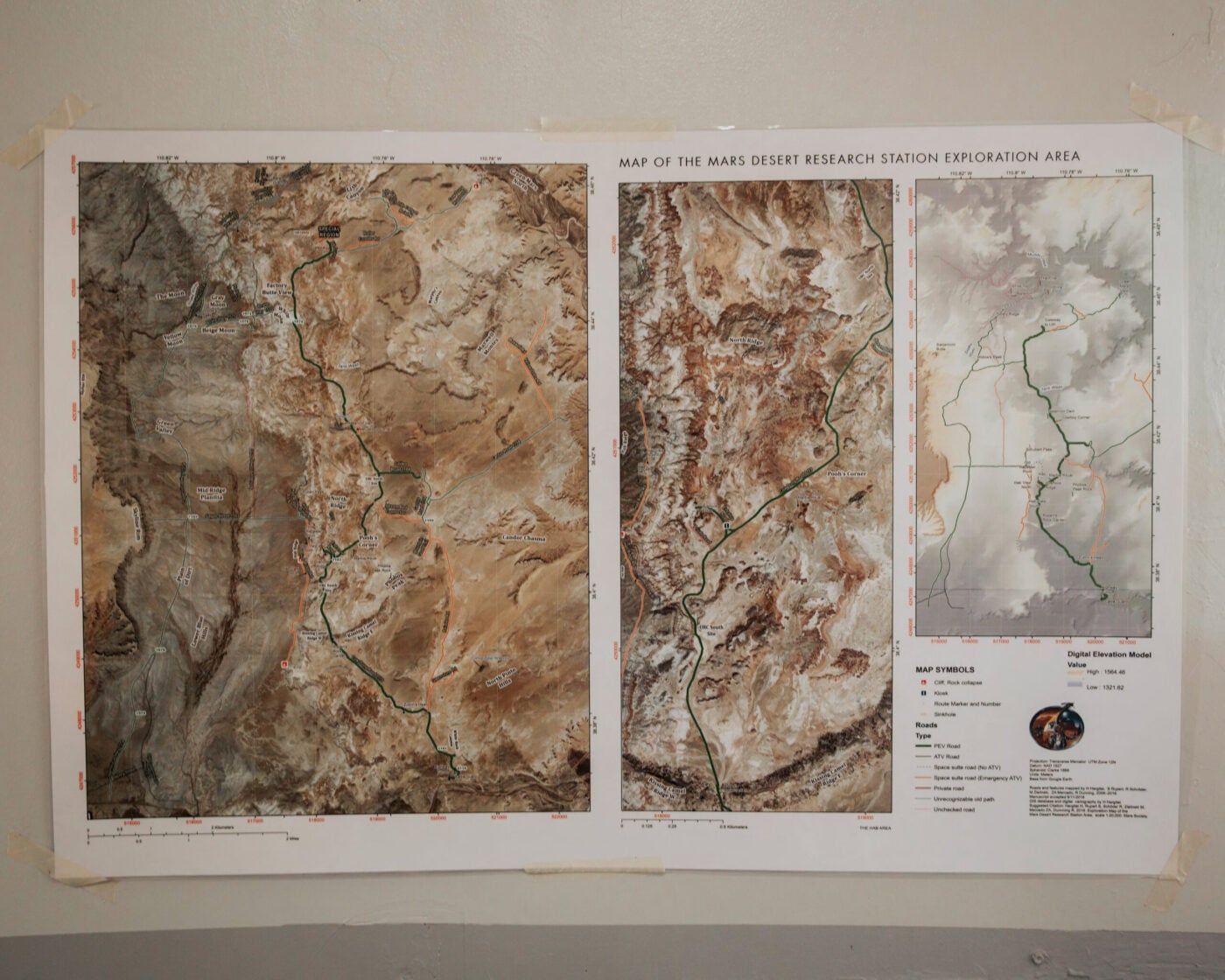
We consulted maps to plan our outings, but Dave had been to the MDRS so many times that his familiarity with the surrounding landscape made them largely superfluous. He told me that he kept returning to Utah year after year because he was retired. This didn’t seem like the whole story, but neither did it seem like the MDRS was simply a place where he could dream uninterruptedly of Mars. It was instead a kind of interstitial zone, where Dave’s memories of simulations past could mingle with his fantastical hopes for the future. They all waited here, each year, for him to return and pick them back up.
When Dave was growing up in southern Florida, he developed a “wonder over mechanical things.” He took apart clocks, cassettes, radios, televisions, filling his room with mechanical debris in the process. He joined the Air Force at nineteen and eventually became an electrical engineer. His sense of amazement with regard to the future seemed to be fixed in the Eighties and Nineties, when “electronics were getting quite good, but it wasn’t overwhelming.” One afternoon, he gave the crew a presentation on the evolution of electronics, laying out a row of transistors descending in size and culminating in a delicate, shiny integrated circuit. He liked that this small piece of equipment was capable of turning real-world inputs into digital messages. On another day, he played us a recording of “Sunrise for Olympus Mons,” one of the Mars-themed pieces he had composed for synthesizer. It was dissonant and strange, like Frank Zappa reared exclusively on low-bit sci-fi imagery. “In the beginning, you’ll hear two different creatures,” he told us. “One sort of sounds like a flock of crickets, and yet others sound like very low bass, like a didgeridoo. And as the sun starts coming out, they’re seeking refuge from it . . . ” He trailed off. “The rest of it, you just have to use your imagination.”
Dave’s research project had always seemed a little vague. As far as I understood it, he aimed to test “mobility on Mars” by attempting to travel far out into the desert in search of an ill-defined “object.” At breakfast one morning, he finally explained what he meant: in 2021, he was standing at the nearby Moon Overlook when he spotted a tower of rock in the distance. When he showed me and Michael a photo he had taken of it, we could only gape. Erupting from the ground was a slightly pixelated but undeniably phallic geological formation. “I’m not quite obsessed with it, but I am highly interested,” Dave said.
We began talking about the monolith every day, and one afternoon, Dave and I went out on an EVA to try to find it. After wriggling into our suits, we stepped into the cramped air lock, where we always had to wait an awkward, ritualistic five minutes for the fake depressurization to complete. Sometimes, Koi would play synthwave on her phone and pipe it in through the suits’ radio systems; more often and more obviously, we’d play Also sprach Zarathustra. A handwritten list of commandments was posted on the door: check suit charge; kick ass (slowly); no peeing in the suits.
Once Dave and I had fully decompressed, the two of us stumbled down the wooden stairs and into a rover, which we took into the red hills. The monolith was nowhere to be found, so we kept driving until we reached the Green Overlook, where the edge of the plateau dropped almost vertically into a distant river valley. I was developing a fondness for Dave; he seemed somewhat unaware of his charisma and surprised that I took interest in his pursuits. He had a hard time believing in the sincerity of my compliments about his music, and it wasn’t clear to him why I wanted to hear about his dreams after he told me about one involving blood seeping out of the MDRS’s external generator.
Dave was cagey about his personal life, but he was also disarmingly candid at times, telling us we were the best crew he’d ever had, that this was his favorite mission in his favorite place, or that he was lucky to be here at a time when many of his friends were “in the ground.” Up on the Green Overlook, I could tell that he didn’t want to spend all his time talking, especially out here surrounded by the landscape he loved so much. After a few minutes of idle discussion about the mission, he and I parted ways and paused, a good distance away from each other, to stare out at the valley in silence.
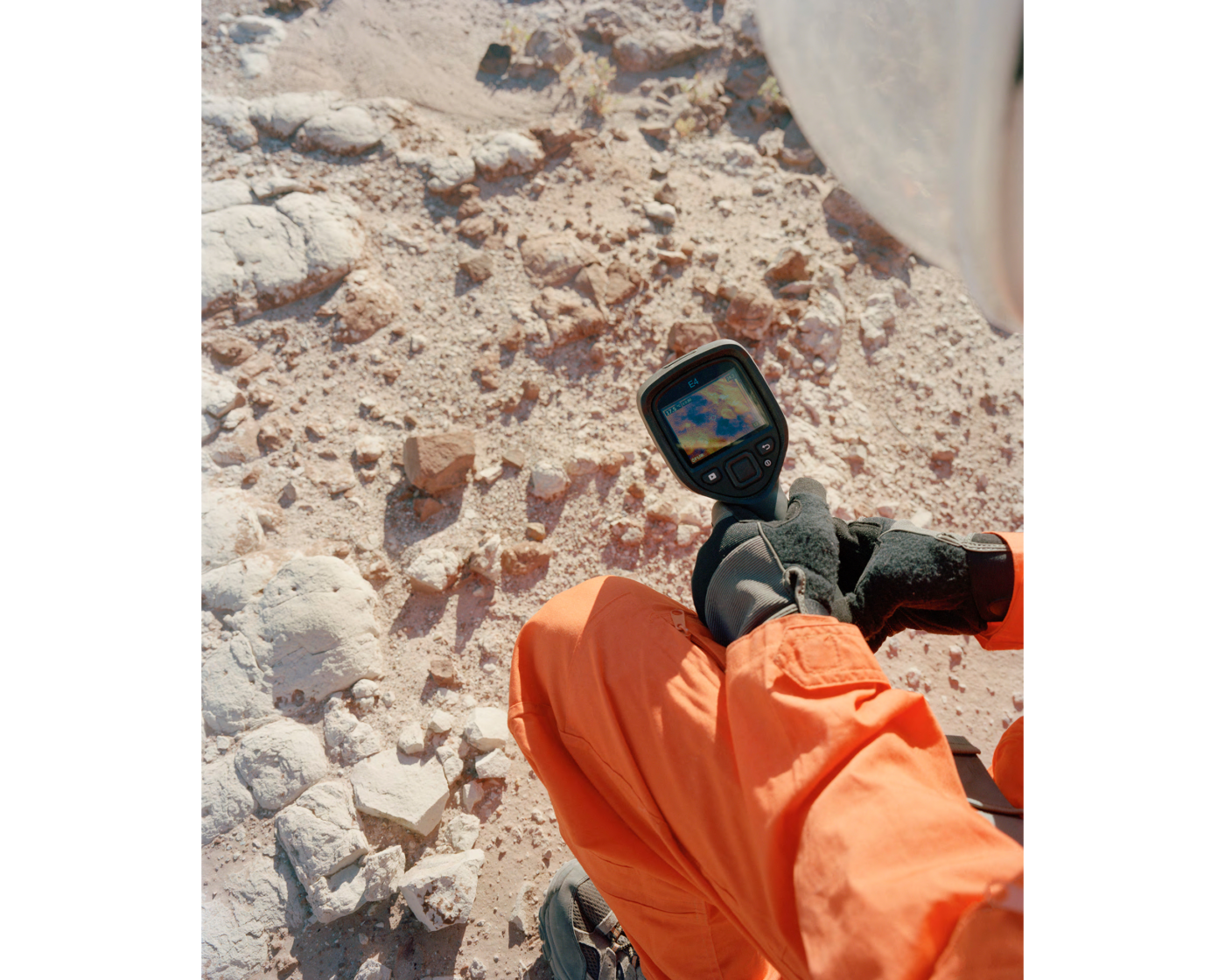
At such moments, I was thankful for our radio systems—long-range walkie-talkies that were linked to headsets in our helmets. They cut us off from the world, muffling the sound of the breeze and amplifying that of our own breath. They emphasized the loneliness of our enterprise, making concrete our isolation not only from the outside world, but from one another. But when we decided to say something, it was absolute.
After a few minutes of silence, Dave pressed the button on his radio. “Does this scenery make you think about things, or do you just stare out at it in awe?”
I waited a few seconds before answering. “I think the latter,” I said.
“Exactly.”
One afternoon, when I was out on an EVA with Michael and neither of us had much to do other than clomp through the cacti, I asked him why he thought we weren’t spending much time talking about the Big Questions. Namely: Why go in the first place? Were we really so sure it would be a good idea? What would be the worst consequence of not going? Michael agreed that pressure-testing our justifications for interplanetary travel would be a good use of our downtime. He and Koi had dedicated their lives to leaving Earth, after all.
From then on, Michael began helping me nudge conversations in more reflective directions. Most of the time, we’d end up in nerdy discussions about the Apollo missions of yore or the respective merits of America’s platoon of private space companies. But one evening, while we ate pizzas dressed in pesto made from greenhouse basil and grated Kraft Parmesan, Dave offered up a thought experiment.
“How about this,” he said. “Should there be romantic couples on a Mars mission?” He looked around the table mischievously.
“I feel like on the first trip, you don’t consider it,” Michael said. “But after that, you have to, well . . . ”
“Colonize Mars!” Koi said. Everyone laughed.
We turned from there to a few familiar topics. First, which nations everyone thought would win the Martian space race, and which they hoped would not: “No Russians, no Chinese, no North Koreans,” Dave suggested, while Tim offered India as a contender and Koi advocated for international collaboration. Tim then began to reflect on why he thought that a military-style hierarchy would be the ideal structure for a crew. And what, I wondered, would happen if a crew managed to survive the trip but immediately lost their minds from the isolation and barrenness of their new home? “Well, that’s their problem,” Dave said.
I asked my crewmates whether there was anything else humanity could accomplish that would make them reconsider their prioritization of Mars, given how many people thought of it as a distraction from earthly crises.
“Reversing climate change,” Michael said. That would be a more efficient way of saving mankind than decamping to Mars. But even this line of thinking led him back toward the red planet. If we could somehow summon the strength and political will to repair the damage caused by fossil fuels, he wondered, why wouldn’t we then turn our attention to interplanetary travel?
“Our oceans haven’t been thoroughly explored?” Koi offered.
Dave thought that nothing could ever supplant the dream. “I don’t see any replacement for it, anything that is of equal importance,” he said. “I think we need to get off this rock sooner or later. It could be destroyed in seconds.”
It was hard for me to believe that any of my crewmates thought of Mars as a mere refuge for the survivors of an apocalypse. Nor did they seem to be adherents of Musk’s brand of techno-nihilism, preferring a frozen world of Tesla Bots to a salvaged Earth. Throughout the mission, they had gestured at how the idea of Mars could inspire humanity—to greater scientific discoveries, to the next stage of our innate need to explore, to a sense of unity and common purpose. But as soon as Michael so much as murmured the word “utopia,” Dave dismissed it. “It would demonstrate a more ideal society,” he said plainly, “but that will take a long time, and by then, we would have changed, too. It will mostly be about survival for a while. That’s not utopia yet.”
I got the sense that what motivated my crewmates was, above all, a conviction that Mars would transform us, no matter what kind of society would eventually take hold there. This belief was rooted in cynicism about the prospects of radical change ever happening on Earth, but they held out hope that if such change could happen on Mars, it would somehow trickle back down to the rest of us. The Martian dream posited that the future, which felt prematurely foreclosed, could open back up, and that the entropic path our species seemed to be on could still change course for the better. Maybe this was why it was difficult to talk about what we would find once we got there.
One day, while the boys were on an EVA, Koi and I sat in the Hab’s upper deck. It was one of the first times we’d ever been alone together, despite being the only two women in the group. She had mentioned a few bits about her upbringing before, but that afternoon, she began to detail for me a painful childhood in which she felt limited by her parents in nearly every aspect of her life. While Koi had been interested in space from the moment she learned about Saturn’s rings in elementary school, she never thought it could be a part of her life beyond her imagination.
Just before the pandemic, while she was attending nursing school at her parents’ insistence, Koi thought about the ways that her own existence contrasted with the multidisciplinary lives of Mae C. Jemison and Jonny Kim, the two astronauts she most admired. As society reopened, she decided to become an astronaut herself, which, to her, meant that she had to leave her family behind. She packed her belongings in secret, not sleeping for four straight days, out of fear that her parents would discover her plan. She waited until they were out of the house, at which point her best friend picked her up and took her to a new apartment; eventually, she won a restraining order against her father. “They always told me the world was unsafe, that they needed to protect me,” she told me. “Protect me from what? The universe?” I told Koi that this certainly cleared up some questions I had about her desire to go to Mars. She nodded. “Realizing I didn’t have a family to return to gave me that push.”
Listening to her, I felt that however naïve some people might find her ambitions, Koi possessed a rare, visceral sense of possibility, and the courage to completely change her life overnight. She already knew what it felt like to leap into a new world.
“How would you feel if we never go?” I asked her.
This made Koi pause. She looked down at the table and slightly shook her head. “It’s inevitable to me,” she said. “I’ve never thought of that question.”
Two weeks wasn’t long enough for my mushrooms to grow. I’d often check on them in the triple-digit-temperature greenhouse, where they seemed to be petrifying inside their cardboard box. Nor was it long enough for us to make much of a dent in the stock of dehydrated vegetables, though we did nearly finish the can of onions. It wasn’t even long enough for debilitating impasses or conflict to emerge, since everyone knew that soon enough we’d be driving back through Hanksville and boarding planes in Grand Junction.
But two weeks was just long enough to peer over the edge of forever. I got bored, and I wondered if everyone else had, too. At one point, Michael and I put Tiny Diamond in the rock scanner just to see what would happen. (It captured only chunks of his hair, but perfectly rendered his plastic butt cheeks.) We talked about our childhoods; the evolution of the NASA logo; bidets versus toilet paper; the sidelining of Apu on The Simpsons; CRISPR; marijuana; J. D. Vance’s audience with the late pope. We spent days capturing increasingly sharp images of Dave’s monolith with Koi’s drone, which delighted him without completely satisfying his curiosity. (For the sake of keeping him occupied, this seemed like a good thing.) Sometimes, the simulation glitched, usually on account of aliens. From the Science Dome’s windows, I saw one of them doing a TikTok dance in front of the MDRS sign. Another day, I drove past two who were sitting in an ATV, drinking Coors Lights. They pointed at me and laughed.
Back on Earth, things had been changing while we were away. On April 22, Musk told Tesla investors that he was going to be spending less time on DOGE, which, at the time, seemed like a good sign for Mars advocates. Musk’s hard-right turn had been a turnoff for many of them, but now, with NASA largely spared the worst of the cuts, they could all unite behind Trump’s nominee to lead the agency: Jared Isaacman, a more palatable billionaire who also happened to be a commercial astronaut. Here was a space-expansionist bigwig who could convert Musk’s energy and connections into results, without all the shitposting. During his confirmation hearing, just days before our mission began, Isaacman affirmed his desire to “prioritize sending American astronauts to Mars.” It seemed as though Trump’s tossed-off goal for a Mars mission before 2030 might not be so unrealistic.
In this environment, we suddenly seemed to be doing something vaguely urgent. Everyone grew a little more nervous about the impending CNBC visit; we spent much of our time discussing what everyone would say in their interviews. Koi decided that she was going to stick to facts about NASA’s contribution to medical technology, and Michael had arranged to demonstrate his rock-scanning project during an EVA. Tim called dibs on explaining the freeze-dried food; I would do my interview in the greenhouse and gesture at the dying tomato plants. Dave agreed to act as tour guide, but he seemed a little worried about it. On the EVA that he and I went on the day before the filming, he said almost nothing.
The next morning, we cleaned the Hab in preparation for the shoot. A freelance cameraman named Lucas was driving down from his home in Boise to capture everything. Once we heard his car crunching up the driveway, we gathered downstairs, our space suits on, and waited for Steinhour to bring him to the air lock. It was the final few seconds of our isolation, but there wasn’t much time to celebrate. Once we were done filming, we’d officially return to Earth and head to Hanksville for dinner at Duke’s Slickrock Grill.
Magdalena Petrova, the CNBC host, interviewed us remotely via Lucas’s phone. The questions were largely softballs. Since I didn’t have much to teach her in the way of soil or mushroom sciences, she asked me mostly about the isolation. How could we survive such loneliness? Wasn’t it tough? I told her that it really wasn’t so bad, and that, in some ways, life at the MDRS felt more social than an average day in a big city. (Later, I’d learn that none of this material had been used in the final broadcast.) When she asked Dave a similar question about the hardest parts of our mission, he had to pause. He couldn’t think of much that he found difficult about the MDRS; the five-minute wait in the air lock was usually pretty boring. At one point in his interview, Tim and I overheard him explaining that humans “would still be in Africa” if they didn’t have an innate love for exploration. “This might not play well,” Tim murmured to me. (Luckily, this didn’t show up in the eventual broadcast, either.) At the end of the afternoon, after a demonstrative EVA, Steinhour radioed in from his trailer: “Are you guys ready to go back to Earth?”
We drove the Chevy back into town. We hadn’t been in the desert long enough for Hanksville to feel overwhelming, but the pleasures of Duke’s were immense. The interior was filled with cardboard cutouts of John Wayne; the menu of beers and burgers was long. Halfway through our meal, I looked over at Dave. He had been nearly silent the whole time, but he looked blissfully happy—the mission he commanded had, by almost all measures, been a success. And we still mostly liked one another. He took a sip of stout, turned to me, and giggled.
Sitting across from me was Steinhour, a newer recruit to the Mars Society. When he wasn’t holed up in the trailer near the Hab, he lived in St. George, Utah, where he worked as a substitute teacher at a community college. He had served on pit crews for race cars in the past. “Helping rich people go around in circles did not make the world a better place,” he had told us. “My personal interest is really in self-contained, self-sufficient colonies, communities, and ecovillages—that sort of thing.” At Duke’s, I realized that you could argue that Steinhour had been even more isolated than the rest of us for the past two weeks, even if he had the freedom to go into town once in a while. I also got the sense that he wasn’t as straightforwardly starry-eyed about Mars as the crews that cycled through the MDRS were. Now, with the simulation behind us, he leaned across the table. “Do you guys want to hear my hot take?” he asked.
He laid out a common space-expansionist talking point: for every dollar spent by NASA, the economy supposedly reaps seven more dollars in benefits over time. Some economists’ estimates are far higher. This idea was supposed to be the kind of thing that could convince even the most unromantic skeptics that space exploration was not only spiritually fulfilling, but economically advantageous. The problem, Steinhour continued, was that this statistic ignored the fact that each dollar spent on national parks turns into ten, or even more when spent on climate-change mitigation or public education. If these numbers were accurate, then why spend federal dollars on NASA instead of, well, anything else?
His challenge didn’t go very far. My crewmates seemed surprised to get this kind of pushback from within the Mars Society. Koi explained how the Space Shuttle’s fuel pumps had led to heart pumps for children; Tim, on the other hand, conceded that the value of interplanetary travel would always be inseparable from its romance. Dave stayed quiet. When no more impassioned defenses followed, Steinhour backed down. He warmly thanked everyone for letting him prod, and we finished our burgers.
Later, I asked Steinhour why he raised his objection in the first place. He knew the place was never going to get a rocket off the ground, and he still loved the MDRS and the strange, intelligent people he met through it. Even so, he seemed eager to encourage crews to think about everything that lay beyond the edge of the simulation. The pro-Mars camp knows how to cling to its talking points, but fear of failure—of anything that could sow doubt and lead to further slashed budgets and broken promises—prevents the development of self-critique or ideological reconsideration. Steinhour thought that sort of tunnel vision only hindered the quest for Mars, leaving plenty of room for billionaires to step in where groups like the Mars Society floundered. “It’s almost like the space race now is between post-capitalist robber barons and a very small, spread-out contingent of people who are more inclusive and altruistic in their motivations,” he told me.
Steinhour thought that the robber barons had a good chance of winning that race and then spreading their spirit of destruction and nihilism throughout the galaxy. In which case, he thought, it might be better if life on Earth were vanquished by an asteroid before that could happen. He seemed to be saying this because and not in spite of his proximity to the simulation. When you spend your life watching a bunch of astronaut hopefuls putter around in the dirt, you begin to understand the extent of the disparity between their reality and their dreams, and just how easily those dreams can be hijacked by someone else.
A few weeks after we returned to Earth, Trump withdrew Jared Isaacman’s nomination as the administrator of NASA, supposedly because of his past donations to Democratic politicians. Musk, who had just announced his departure from DOGE, launched into a tirade against the One Big Beautiful Bill on X, claiming that information about Trump was in the Epstein files and demanding his impeachment. Meanwhile, Trump’s proposed 2026 budget had been released; it called for a 24 percent cut to NASA’s funding, which, adjusted for inflation, would bring it to its lowest level since 1961. Congress would reject the cut eight months later, and Isaacman was ultimately confirmed after Trump renominated him, but more ruin soon followed. In February of this year, Musk announced that SpaceX was pivoting away from Mars to focus on building a “self-growing city on the Moon,” presumably to maximize his chances of securing more government contracts, despite having called lunar travel “a distraction” a year earlier. Steinhour’s low-pressure prodding, it turned out, was a mere prelude to the reality check that was to come.
Less than a month after our mission, CNBC aired two segments about the MDRS: one wove some of our footage into a bigger report on the state of Mars travel; the other focused specifically on the simulation itself. The network posted the videos to YouTube, where they ended up with a combined four hundred thousand views and hundreds of comments, which were largely negative:
This looks miserable and cheap. Just go interview prisoners if you want to better understand the effects of long-term confinement.
Uh, I’m not a scientist, but I do possess a decent degree of common sense and I can tell all you guys: you’re not going to mars, much less living on mars.
This entire video was f’ing hilarious. Nothing that they’re “researching” has any value or has not already been figured out. Yeah let’s go in the desert with consumer grade radios and discover they’re range-limited. Let’s fly a consumer drone that definitely would not operate the same in mars’ atmosphere, like what are you guys even talking about 🤣
Koi replied to this last comment with her reflexive formality. “Had you taken a closer look, you’d see our research spans bioastronautics, engineering, geology, and psychology,” she wrote. “But we understand some prefer to comment from the sidelines rather than actually contribute to innovative research.”
One comment even prompted Dave to respond. It read: “Hypsters with overalls and oversized patches playing astronaut. The ‘commander’ is ready for the cheech & chong movie lol.” Dave replied from an account whose five videos—each with no more than two hundred views—included a recording of one of his compositions and a clip on repairing malfunctioning car turn signals:
Yeah, that old guy is a joke with all those patches playing astronaut. But did you know many aero-space college students and professionals as well have missions there for projects related to their college major or job and a few have gone on to become NASA astronauts? I guess that “Commander” has nothing better to do in his retirement. Maybe he should be testing a wheel chair or an IV dispensing system there. I wonder what you will do in retirement? I think all those patches would be from previous missions and maybe he has the experience to lead new crews in simulation. You know, I used to be younger, but now I am that same guy.
I felt a rush of defensiveness. It was so easy to laugh at our mission, the shitty radios and Amazon space suits. But none of the people who did so understood that Dave and the rest of the crew were right about some things. They were right that humanity seemed weighed down by past and present disappointments. And they were right that it was worth living life as if those disappointments might someday fade. This was not a wholly utopian idea, but my crewmates lived with a strong, personal, even embarrassing utopian impulse nonetheless—the kind of wishing that exists so rarely in the spray of everyday life that it’s usually considered childish when it’s not ignored altogether. To doubt the value of that impulse felt not only depressing, but maybe even more nihilistic than abandoning Earth.
The next time I talked to Dave, he was parked in his RV in Utah’s Valley of the Gods, some one hundred and fifty miles from the MDRS. He was spending his days flying his model airplanes and making music, though he had taken a few days off from his hobbies, he said, for “total relaxation.”
“I’m out in the middle of nowhere—a beautiful desert,” he told me. “I’ve hardly moved from this one location. I stayed for several days, but I knew the heat was coming. Then I remembered there was a tree I saw another camper under a few years ago. So I walked over here. There’s a green riverbed going by, there are bushes and a few trees, and I parked under a big juniper. In the afternoon, there are birds and bats. In the evening, lizards and tadpoles.”
“You have a little oasis to yourself,” I said.
“I do. It’s so wonderful.”
Dave had already locked down his place on an MDRS mission the following year. He complained that there couldn’t possibly be another crew as good as ours and that, since he hadn’t met any of them yet, it was easy to imagine the worst.
In the meantime, he didn’t really want to go home. He was stressed about answering emails and tending to his earthly responsibilities. For now, he was trying to put it all out of his mind.
“We can always worry more, but it probably won’t help,” he told me. “I try to worry less. Some people use the phrase ‘everything works out for the best.’ Well, I think it does a lot of the time, but you have to drive it that way, right? And even if you drive it that way, it doesn’t always work out for the best. Things just work out.”
We hung up so that he could go make a sandwich for lunch. Dave had enjoyed one of the two beers in his RV’s mini fridge already, but that meant there was one left. He happily wondered when, sometime in the future, he would finish it.