
Researchers have developed an intelligent monitoring pipe that they say could help prevent pipeline displacements and building collapses.
The soil settlement three-dimensional trajectory pipe sensor (SST-3D) combines optical sensing with machine learning algorithms to monitor and predict 3D soil settlement.
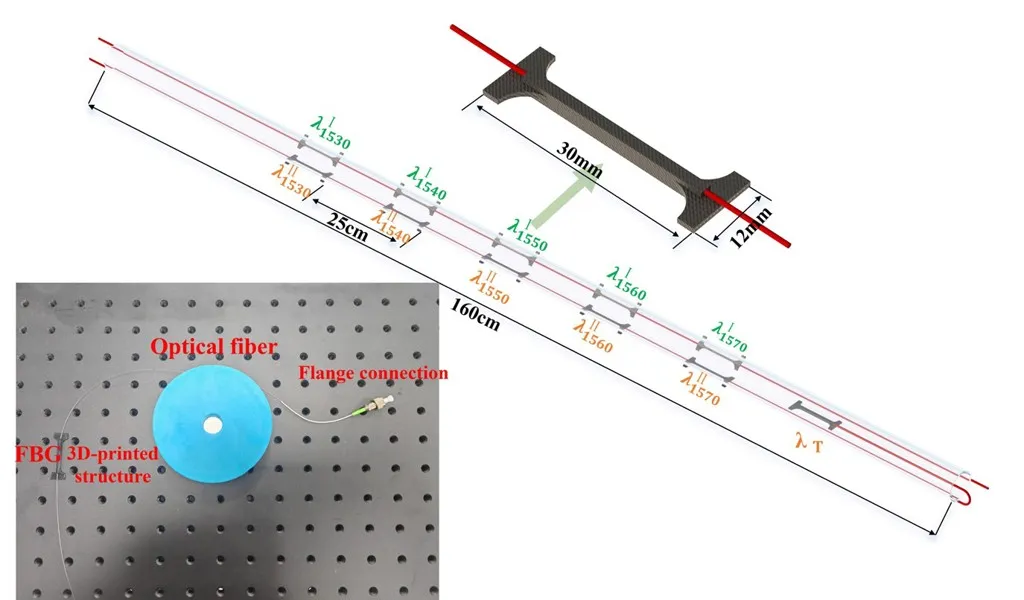
Researchers at Shanxi University in China created the tool by fitting a PVC pipe with 3D-printed protective structures and special fibre optic strands with tiny mirrors, known as fibre Bragg gratings (FBG), that function as ultra-sensitive strain gauges.
FBGs are extremely sensitive to tiny deformations caused by soil extrusion and settlement. They are also immune to electromagnetic interference and robust in harsh environments such as soil.
“Instead of a single grating, we used two sets of five-point grating arrays attached to the pipe at a 45° cross angle, plus an independent temperature compensation grating to eliminate the influence of temperature fluctuations,” said Dandan Sun, the research team leader. “This makes strain measurement more accurate and enables the capture of multi-directional deformation signals.”
When the soil moves or squeezes the pipe, these fibres stretch or bend, causing a small shift in the light passing through them. By measuring this light shift, the system can calculate exactly how much the ground is moving and in which direction.
Researchers first conducted indoor air trials to test the sensor’s performance. These showed that it was sensitive and accurate enough to detect very small movements and tell exactly where and how the ground was moving.
Subsequent laboratory-based soil burial tests using loess soil, which is found in various regions around the world and is particularly challenging for today’s soil settlement methods. They showed that the soil doesn’t just sink smoothly but goes through four distinct stages during drainage, including initial rapid response, relative stability, pre-collapse dynamic stage, and post-collapse sustained response.
Researchers used the ‘Random Forest’ machine learning model to analyse the sensor data. It learned to recognise the four stages with 95.65% accuracy and could predict exactly how much water had been drained – a measure of how much the ground had sunk – with a relative error of only 4.02%.
“Soil settlement directly endangers the safety of engineering structures like buildings, bridges, pipelines and slopes,” said Sun.
“Our device overcomes the problems of traditional soil monitoring by providing precision 3D measurements and capturing dynamic changes using a simple structure that can be directly buried in soil.”
The research, which was published in the scientific journal Optics Express, concluded that with more development the system could help provide early warnings of risks from soil settlement. This, in turn, could prevent pipeline displacement, accidents from building cracks and structure collapse.
“One application of this technology could be in old urban communities, which are often built on soft or unstable soil,” said Sun.
“By monitoring the 3D settlement trajectory of a building’s foundation in real time and predicting, in advance, whether it will enter a dangerous stage, problems could be fixed before they become dangerous.
“The method could also be useful for landslide detection and monitoring the structural health of bridges as well as railway or highway subgrade settlement in challenging environments.”