
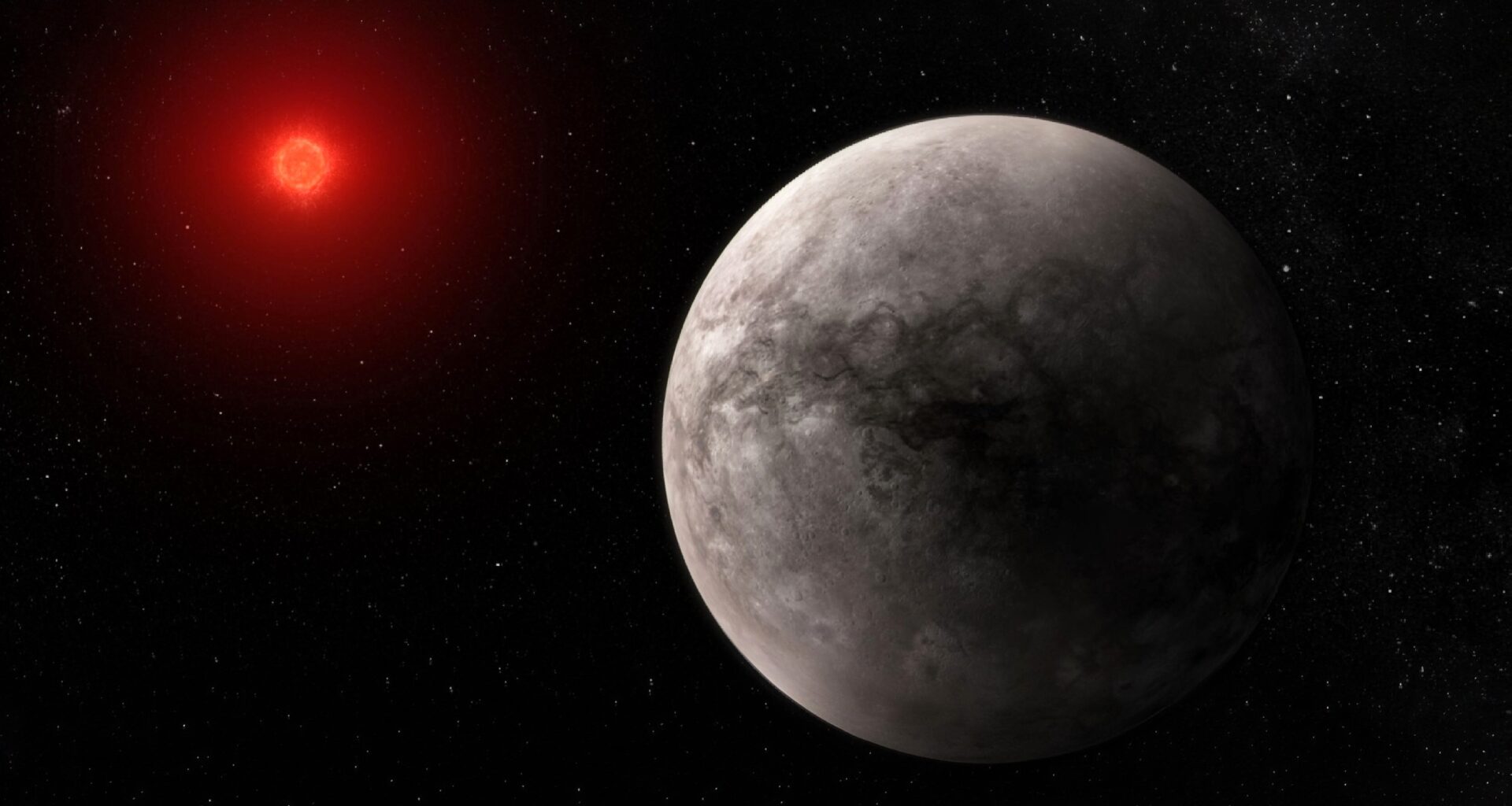
Researchers have found that two Earth-size planets orbiting the nearby red dwarf star TRAPPIST-1 carry such extreme day-night heat contrasts that both worlds are likely bare rock.
The result sharply narrows where astronomers can still hope to find lasting atmospheres around the most common stars in the galaxy.
Heat without air

On the two innermost planets of TRAPPIST-1, one hemisphere remains in constant daylight while the other stays in permanent darkness, creating sharply divided climates on the same world.
Reading the planets’ heat over nearly 60 straight hours, a team at the University of Geneva (UNIGE) documented the first climate maps of the Earth-size rocky worlds.
The researchers found warmth pooling almost entirely on the star-facing side. That leaves the night hemispheres with almost no detectable heat, a split of more than 900 degrees Fahrenheit between the two sides.
Such an uneven pattern leaves little room for anything thicker than a tenuous atmosphere and sets up the harder question of why these worlds lost so much in the first place.
Clues in the darkness
Nighttime carried the strongest clue, because a planet with air should leak stored warmth into darkness.
Those thermal phase curves, changes in a planet’s heat signal over an orbit, reveal whether winds move energy around.
Here, the dark hemispheres stayed so faint that heat barely moved, which is what an airless surface does when daylight shuts off.
That simple signal let astronomers test atmosphere ideas directly instead of guessing from one snapshot of a sunlit hemisphere.
The planets are tidally locked
Trouble starts with the star itself, because nearby red dwarfs can blast their closest planets with damaging radiation for long stretches.
Orbiting so close also leaves these worlds tidally locked, keeping one face toward the star at all times, while the other stays dark.
Without an atmosphere, the daylight side keeps absorbing energy while the night side loses it quickly as infrared heat escapes.
Such worlds can look temperate on paper yet still be punishing on the ground, especially near the inner edge.
A system worth watching
The seven-planet TRAPPIST-1 system has fascinated astronomers since 2017 because several worlds orbit where liquid water could, in principle, exist.
Since the planets circle the same cool star, researchers can compare them almost side by side and watch how distance changes the outcome.
“The TRAPPIST-1 system is incredible! Seven planets, some with masses similar to Earth’s, orbit the same star,” said Emeline Bolmont, associate professor in the Department of Astronomy at UNIGE and director of the Centre for Life in the Universe.
By focusing first on the two closest worlds, TRAPPIST-1b (Planet b) and TRAPPIST-1c (Planet c), the team chose the places where stellar exposure should be strongest.
What planet b shows
Planet b gave the cleanest answer, with a dayside above 390 degrees Fahrenheit, a nightside with almost no glow, and no clear offset.
Earlier eclipse observations had already hinted that planet b reradiates starlight almost entirely from its dayside.
Models that spread heat efficiently failed against the new curve, while airless explanations matched both the timing and the brightness.
That mix makes a substantial atmosphere on planet b look highly unlikely, even before scientists argue over its surface composition.
Why planet c resists
Planet c also looked starkly split, with a dayside near 210 degrees Fahrenheit but a signal too weak to settle everything.
A 2023 measurement had already ruled out a thick carbon dioxide atmosphere on planet c.
One remaining possibility is a very thin, oxygen-rich atmosphere that moves only a modest amount of heat before the planet cools again.
Until sharper data arrive, a more reflective bare surface and a tenuous atmosphere both remain in play.
The role of exposed rock
Surface models added another layer, because the brightness of an airless world depends strongly on what its exposed rock reflects and emits.
Another line of modeling favored ultramafic rock, dark rock rich in iron and magnesium, for planet b’s most likely surface.
Moderate radiation damage could darken other materials too and blur that conclusion by a wide margin.
Because of that uncertainty, the result says more about the absence of air than the exact rock type.
Targets in the search for alien life
Life questions now center on the outer worlds, not the two planets that orbit closest to their star.
Mercury offers a useful reminder here, because one rocky world can lose its atmosphere while nearby neighbors keep theirs.
Even so, the inner pair show what fierce radiation and close orbits can do during a planetary system’s early history.
That matters for every red dwarf survey, since these stars are abundant and their planets are common targets in the search for life.
Webb keeps watching
The James Webb Space Telescope is already turning to planet e, a farther-out world that sits inside the system’s habitable zone.
Future observations should test whether distance alone helps a planet hold on to gas, water, and milder temperatures.
Meanwhile, these inner planets have become a reference case for reading other rocky worlds around faint, active stars.
Each new measurement will sharpen the line between planets that merely resemble Earth in size and those that can keep Earth-like conditions.
What changes now
The new picture is stark: on the closest two worlds, permanent day and permanent night are not softened by a thick atmosphere.
That does not end the hunt here, but it tells astronomers where hope fades fastest and where it still survives.
The study is published in the journal Nature Astronomy.
Image Credit: European Space Agency
—–
Like what you read? Subscribe to our newsletter for engaging articles, exclusive content, and the latest updates.
Check us out on EarthSnap, a free app brought to you by Eric Ralls and Earth.com.
—–