
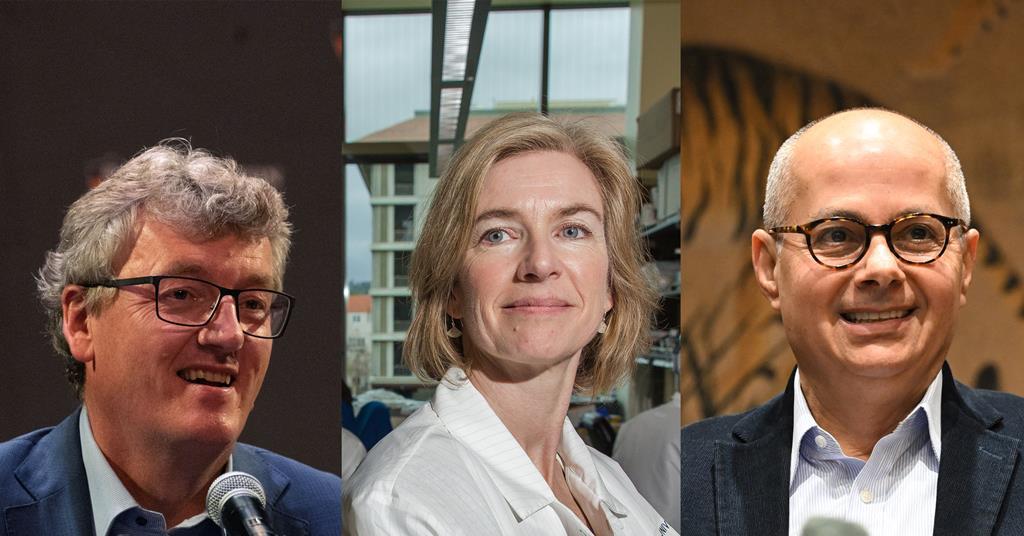
At the recent spring meeting of the American Chemical Society (ACS) three Nobel laureates met at a roundtable and shared their stories about the obstacles they overcame to become scientific superstars. Participating were biochemist Jennifer Doudna, who won the award in 2020 for developing Crispr–Cas9 genome editing; organocatalysis pioneer David MacMillan, who shared the prize in 2021 for discovering asymmetric organocatalysis; and Omar Yaghi, who is known as the father of reticular chemistry and won last year’s award for co-developing metal–organic frameworks (MOFs).
A failure that yielded success
Yaghi told a story about being asked to perform what should have been a simple de-coordination reaction in graduate school but one that took him about a year of failures before succeeding. And during this time, even though he loved chemistry and couldn’t imagine his future without it, Yaghi said be doubted whether it was the right path for him. ‘I questioned whether passion was sufficient,’ Yaghi recounted.
At the end of that year he succeeded, but the material decomposed as he took it to the lab’s nuclear magnetic resonance instrument. ‘This beautiful orange solid turned into a brown gunk, and I asked one of the postdocs, “What do I do with this?” And this postdoc said, “Throw it away, it’s ugly”. And I didn’t because that was my whole year of work,’ Yaghi recalled. After working up the reaction it crystalised the next day. ‘That was the beauty I was expecting,’ he told the audience. ‘So, I would say that if you feel things are desperate, success may very well be right around the corner.’
Doudna talked about taking chemistry at Pomona College in California, having come out of a public high school in Hawaii where no advanced chemistry courses were offered. She suddenly found herself in a class with lots of students who had taken such courses and earned college credits for chemistry before graduating high school. ‘I was really underwater compared to a lot of my classmates and I struggled, and I asked myself whether I was cut out to be a chemist,’ Doudna stated. She recalled her parents urging her to give it another semester before abandoning chemistry. So Doudna took organic chemistry and absolutely loved it. ‘It felt like solving puzzles,’ she said. ‘The challenge was: how do I build this molecule?’ Doudna continued. ‘And it was not easy, but it was definitely really fun, and I realised this is what I wanted to do.’
MacMillan discussed growing up in a small steel-working town in Scotland, noting that nobody from his high school had ever attended university until his older brother did. ‘That was very controversial. My mum and dad thought he was just lazy and trying to avoid the steelworks; it was probably true,’ MacMillan said. But once his brother earned an undergraduate physics degree, he landed a job that paid more money than his father had earned after 30 years of working in the steelworks. ‘It was at that moment that my mum and dad came to see me and said, “You’re going to university”,’ MacMillan recalled.
So, he said his path was chosen for him, and he followed the formula of studying physics at university. However, MacMillan recalls not enjoying or excelling at the subject and trying hard to leave university by interviewing for multiple jobs. ‘But I was so terrible at interviewing that I couldn’t find any jobs,’ he recounted. His only path forward seemed to be pursuing another field at university and that’s when MacMillan started reading organic chemistry textbooks. ‘That was the moment when suddenly I saw my path forward and also found the first thing that really spoke to me,’ he recalled.
A moment that set the trajectory for a Nobel prize
MacMillan recounted how he pursued a postdoc at Harvard with the synthetic organic chemist Dave Evans in 1996, during which he learned about asymmetric catalysis. There, he spent eight hours a day with his arms in a glovebox working with air-sensitive materials. During the more than two years that this continued, MacMillan sought better ways to do this work. He wanted an alternative to spending hour upon hour working with these precious metal systems, and said that was the real driver behind his work to democratise chemistry by allowing reactions to be performed on a standard lab bench using organic catalysts.
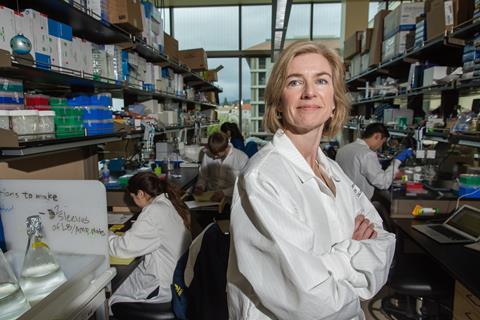
Doudna told the audience that she went on to pursue a PhD at Harvard in 1985 without knowing much about biochemistry, except for an undergraduate project she worked on studying how bacteria interact with each other using small molecule signalling. ‘I thought that was very cool and I was very excited to work on that during my PhD,’ she recalled. But nobody at Harvard was pursuing that topic, so she started investigating other areas. Through a conversation with a classmate Doudna learned about the work of chemical biologist Jack Szostak, who at the time was studying how DNA recombined in cells.
Captivated by the topic, she went to talk with Szostak, who eventually shared the physiology or medicine Nobel in 2009 for discovering how chromosomes are protected by telomeres and the enzyme telomerase. He told her his lab’s focus was switching to the RNA world hypothesis. ‘“What’s that?” I asked,’ Doudna recalled. ‘He said, “Well, it’s the theory that life on our planet evolved from RNA molecules that were self-replicating, so RNA could be both genetic material and a catalyst copying genetic information.”’ She thought that sounded fascinating and joined his lab. ‘You can see that really set the path for everything I did after that,’ Doudna said.
Yaghi noted that as a visiting scholar at Nanjing University in China in 1989, he met a promising undergraduate student [named Hailian Li] whom he later recruited as his graduate student when he was an assistant professor at Arizona State University. ‘He was fascinated by making crystals and made this beautiful crystal that looked like diamond – sharp edges, sharp corners, clear and so on,’ Yaghi stated. But when he removed it from the mother liquor, the part of a solution that remains after a substance has crystallised or precipitated out, the crystal turned into a white powder. ‘He said, “This is very uninteresting, it’s not stable.” And I said, “Put it back – don’t take it out of the mother liquor, analyse it with the mother liquor there so the crystal doesn’t lose its form”,’ Yaghi recounted. After examining the crystal structure, ‘we both looked at each other and thought we had done something really significant’, he stated. That turned out to be the landmark material that the Nobel Committee cited for the award he shared with Susumu Kitagawa and Richard Robson for the development of MOFs.
Advice for a young scientist
Doudna insisted that what’s most important in science is discovering people whose work is exciting and fires you up. ‘Finding that connection has always been the catalyst for projects that I have started, or people who I have worked with,’ she said. ‘You can call it “good chemistry”,’ Doudna continued, ‘where people get together, hit it off, and realise they have a common interest and the complementary expertise to achieve more together than they ever could alone.’
Yaghi also emphasised the value of partnering with fellow researchers who you like and trust, arguing that such collaborations won’t be fruitful otherwise. ‘They will be privy to a lot of information from your group,’ he said. ‘You will have many discussions about great ideas that you don’t want to necessarily be published and out there without proper attribution.’ He also stressed that mentors can come in all forms.
‘After we first discovered MOFs when I was at Arizona State, a CEO of a major chemical company came to my lab and I was showing him this stuff like a kid in a candy shop,’ Yaghi recalled. ‘And he looked at me and he asked, “What are they good for?” And I thought, I’m a scholar, we do this to advance the frontiers of knowledge.’ The CEO warned Yaghi that he could be an excellent professor but never a great professor unless he applied this work to society. ‘That was a very important lesson for me,’ Yaghi told the audience. ‘He pushed me towards taking these materials into applications, and since that time my team has always aimed to solve societal problems with these materials.’
MacMillan was clear that when selecting a mentor one should consider the broader research team. ‘You are going to spend time with your mentor, your adviser, but you’re also going to spend an enormous amount of time with your research group,’ he stated. ‘And so, if you find people to work with whose values, thought processes and interests align with yours then you will find an environment in which you will thrive.’
These quotes have been edited for clarity and brevity.