
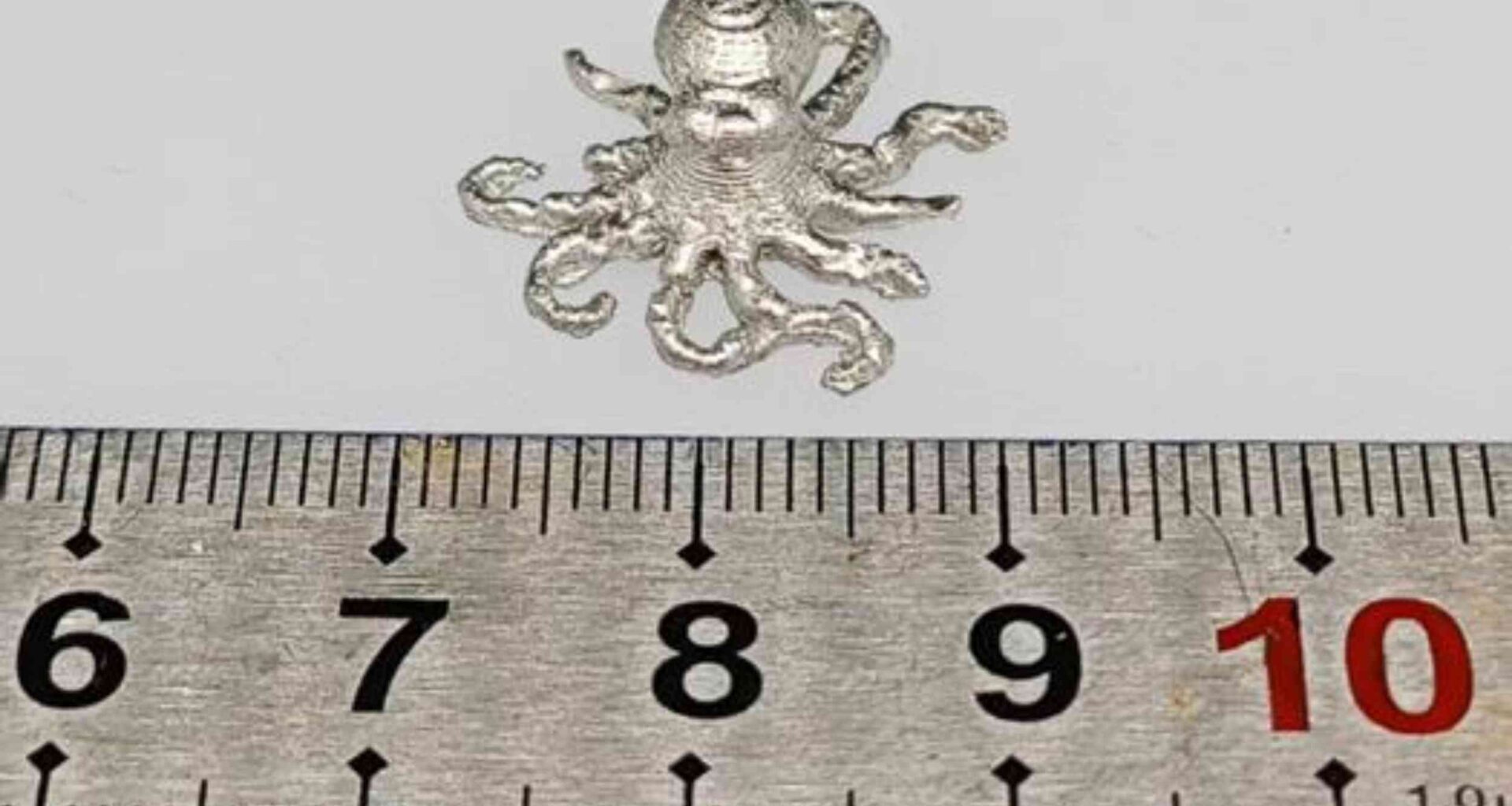
Researchers have demonstrated that a metal mixture can react and harden at room temperature into a solid as strong as conventional alloys, without the need for high energy heating.
That finding replaces heat-heavy manufacturing with a low-energy process that can rebuild damaged metal without furnaces.
Proof in copper

Inside the test piece, a hole about 0.7 inches wide had stripped the metal of most of its load-bearing strength.
Working from that failure, Yong He at Zhejiang University (ZJU) and colleagues pressed a reactive paste into the cavity.
At ZJU, he and his team showed pressure locked the repair into the surrounding copper instead of leaving a weak filler.
That outcome made the material feel less like a lab trick and more like a repair route worth taking seriously.
A chemical cure
Rather than melting everything together, the recipe started with copper powder and a gallium-indium liquid that stayed fluid in the air.
Sodium hydroxide acted as a catalyst, a substance that speeds a reaction, helping gallium wet the copper and move across its surface.
Once atoms began crossing that boundary, new copper-gallium compounds formed in place and the slurry hardened without outside heating.
That is why the team called it a “concrete-type alloy,” a name that fit because mixing triggered the cure instead of a furnace.
Pressure closes pores
One problem appeared quickly, because the reaction also produced hydrogen that could get trapped as tiny pores.
To fix that, the team used cold isostatic pressing, a method that squeezes equally from all sides, after the alloy had set.
After pressing, porosity fell to 4.83%, and the material became about 10% denser than the printed version.
Less empty space meant fewer weak spots, setting up the jump in stiffness and hardness that came next.
Strength climbs fast
Before pressing, the material already behaved like a structural metal, with nanohardness near 1.2 GPa and stiffness near 120 GPa.
After pressing, nanohardness, resistance to a tiny point pushing inward, rose to five GPa, while stiffness reached 150 GPa.
Pressure also raised stiffness sharply, showing the same material became tougher after defects were squeezed down.
Those values help explain why the repaired regions outperformed ordinary copper at the surface instead of merely filling space.
Holding off corrosion
Strength alone would not be enough, because repair metals also fail when water, salt, or reactive chemicals attack them.
Corrosion tests showed the new alloy formed a more stable passive film, a thin protective surface layer, than copper alloys.
Its resistance stayed strongest in acidic and alkaline solutions, although salty conditions still accelerated corrosion for both materials.
That balance matters for real repairs, since factory equipment sees messy environments long before it reaches a test machine.
The team then mixed in carbon fibers and MXene, a layered carbide sheet, to push the repair further.
Carbon fibers helped stop cracks from spreading, while MXene reacted more actively at the interface and bonded more tightly.
That difference showed up in testing, where MXene-reinforced surfaces reached 10 GPa and showed more even pore distribution.
A cleaner internal layout meant the added phase improved the whole repaired zone, not just the outer skin.
Broken parts recover
In full workpieces, the repaired cylinders deformed much like undamaged ones instead of collapsing in an uneven squeeze.
Small-scale tests showed the repaired region reached about two GPa at the surface, compared with 0.5 GPa in the standard region.
Microscopy still found pores, but they were shallow enough that the overall compression behavior stayed close to normal.
That mix of strength and forgiveness matters, because industrial repairs rarely happen on perfectly clean, flawless metal.
Why heat dominated
Traditional alloy making usually depends on furnaces or laser systems that spend huge energy just breaking old metal bonds.
An earlier paper from the same ZJU group had already shown room-temperature alloy printing, but strength remained the central challenge.
This newer study answered that problem by combining chemical curing with pressure and reinforcement instead of relying on heat alone.
That mix could matter most where fuel is limited, repair windows are short, or hot processing would damage nearby parts.
Limits still matter
Even so, the process is not finished, because trapped gas and leftover sodium chemistry can still complicate performance.
Researchers said better venting during pressing should cut those defects further, especially before the material fully hardens.
Future tests also need vacuum, low-temperature, and high-pressure conditions if the alloy is going to leave the lab.
Those gaps do not erase the result, but they set the line between a clever material and a dependable one.
Where this leads
Room-temperature metal repair looked unrealistic until chemistry, pressure, and reinforcement worked together here as one manufacturing system.
If scaling and durability hold up, factories, field crews, and even off-world builders could patch structural metals with far less heat.
The study is published in the International Journal of Extreme Manufactur
—–
Like what you read? Subscribe to our newsletter for engaging articles, exclusive content, and the latest updates.
Check us out on EarthSnap, a free app brought to you by Eric Ralls and Earth.com.
—–