
Gravity, as most people understand it, is the familiar force that pulls a falling apple toward Earth. But for astronomers and theoretical physicists, it is also a vexing invisible architect that guides the shape and evolution of the largest cosmic structures across the universe.
For decades, puzzling observations of unusually fast-moving galaxies have forced cosmologists like the University of Pennsylvania’s Patricio A. Gallardo to revisit the fundamentals of physics, exploring, for example, whether the laws of gravity as described by Isaac Newton and Albert Einstein truly apply everywhere.
“Astrophysics has been plagued by a massive discrepancy in the cosmic ledger,” says Gallardo. “When we look at how stars orbit within galaxies or how galaxies move within galaxy clusters, some appear to be traveling way too fast for the amount of visible matter they contain.”
This mismatch forces a choice between two radical conclusions, he explains. Either the universe contains concentrations of massive invisible “dark matter” that provide extra gravitational pull or “the fundamental equations for gravity need to be modified.”
Now, using observations from the Atacama Cosmology Telescope (ACT), a roughly three-to four-storey-tall telescope developed largely by Penn researchers led by Mark Devlin, Gallardo and collaborators have tested gravity across galaxy clusters separated by hundreds of millions of light-years—the largest-scale probe of gravity to date.
Their findings, published in Physical Review Letters, show that gravity’s strength weakens with distance almost exactly as predicted by the equations developed by Newton and later incorporated into Einstein’s theory of general relativity.
“It is remarkable that the law of the inverse of the squares—proposed by Newton in the 17th century and then incorporated by Einstein’s theory of general relativity—is still holding its ground in the 21st century,” says Gallardo.
The confirmation that gravity behaves as predicted by the established theory over vast, extragalactic distances reinforces a fundamental pillar of modern science, Gallardo explains: the standard model of cosmology. By showing that fundamental theories of gravity do not break down on the largest scales, the data effectively closes the door on a group of theories such as Modified Newtonian Dynamics (MOND), that attempt to explain cosmic motions by modifying the laws of gravity.
When Newton proposed the inverse square relation, which states that gravity weakens in proportion to the square of the distance between objects, he was primarily concerned with describing the movements of objects in the Solar System. This same principle has now been tested on masses and distances that were “inconceivable in Newton’s day,” Gallardo says.
Understanding the universe’s ‘speed limits’
The universe’s galaxies—of which there are more than 200 billion—don’t move the way gravity alone says they should.
Following Newtonian logic, stars farther from a galaxy’s center should orbit more slowly. Instead, astronomers see the opposite. The outermost regions move far faster than visible matter can account for. The same mismatch appears in galaxy clusters, where entire galaxies move too quickly for their mass.
“That is the central puzzle,” Gallardo explains. “Either gravity behaves differently on very large scales, or the universe contains additional matter that we cannot directly see.”
Testing gravity across the cosmos
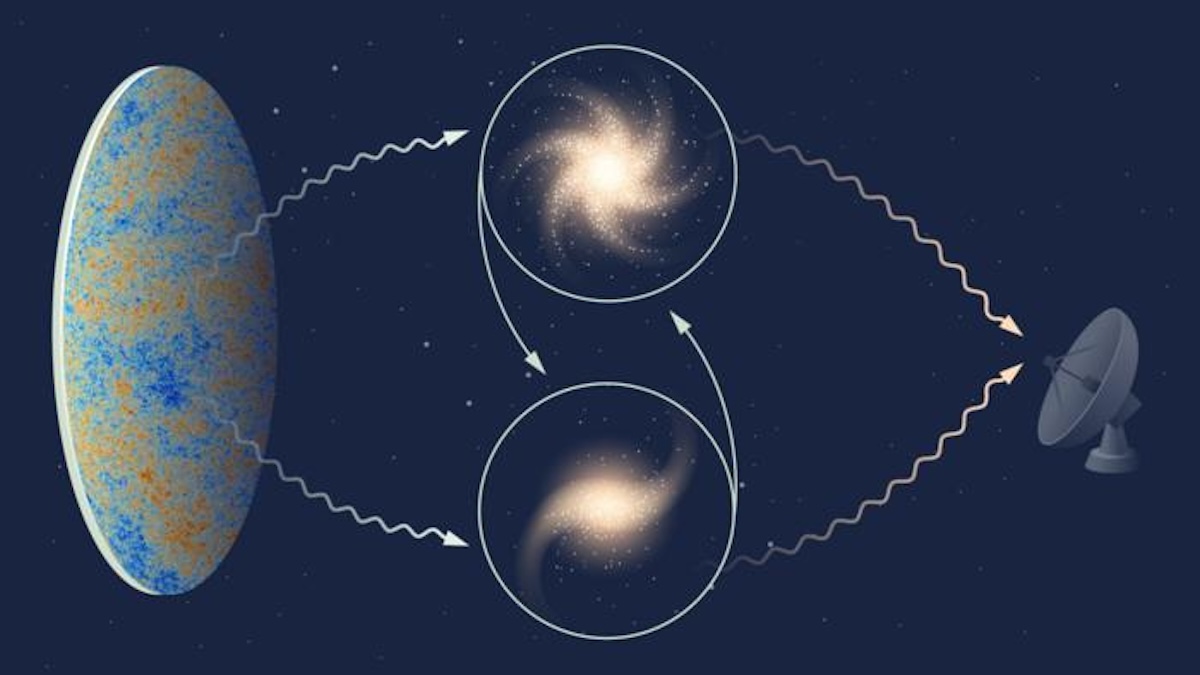
To test this, the researchers turned to ACT’s observations of a light released about 380,000 years after the Big Bang that has been traveling across the universe ever since, known as the cosmic microwave background.
As this ancient light passes through massive galaxy clusters, it is subtly altered by their motion, leaving faint imprints that astronomers can detect. By reading these distortions and measuring these motions across hundreds of thousands of clusters separated by tens of millions of light-years, the researchers determined how strongly gravity pulls on the largest structures in the cosmos. If modified gravity theories such as MOND were correct, the measurements would reveal a flatter gravitational fall-off.
Instead, the results landed almost exactly where both Newton’s and Einstein’s theories agree.
Because that prediction holds, the missing mass problem cannot be explained by changing gravity itself, strengthening the case that an unseen component—dark matter—must be providing the extra pull.
The dark matter mystery
Understanding what dark matter actually is remains one of the biggest challenges in modern physics.
“This study strengthens the evidence that the universe contains a component of dark matter,” says Gallardo. “But we still do not know what that component is made of.”
Future observations of the CMB and larger galaxy surveys will allow physicists and astronomers to test gravity even more precisely.
“With so many unanswered questions, gravity remains one of the most fascinating areas of research. It’s a naturally attractive field,” Gallardo chuckles.