
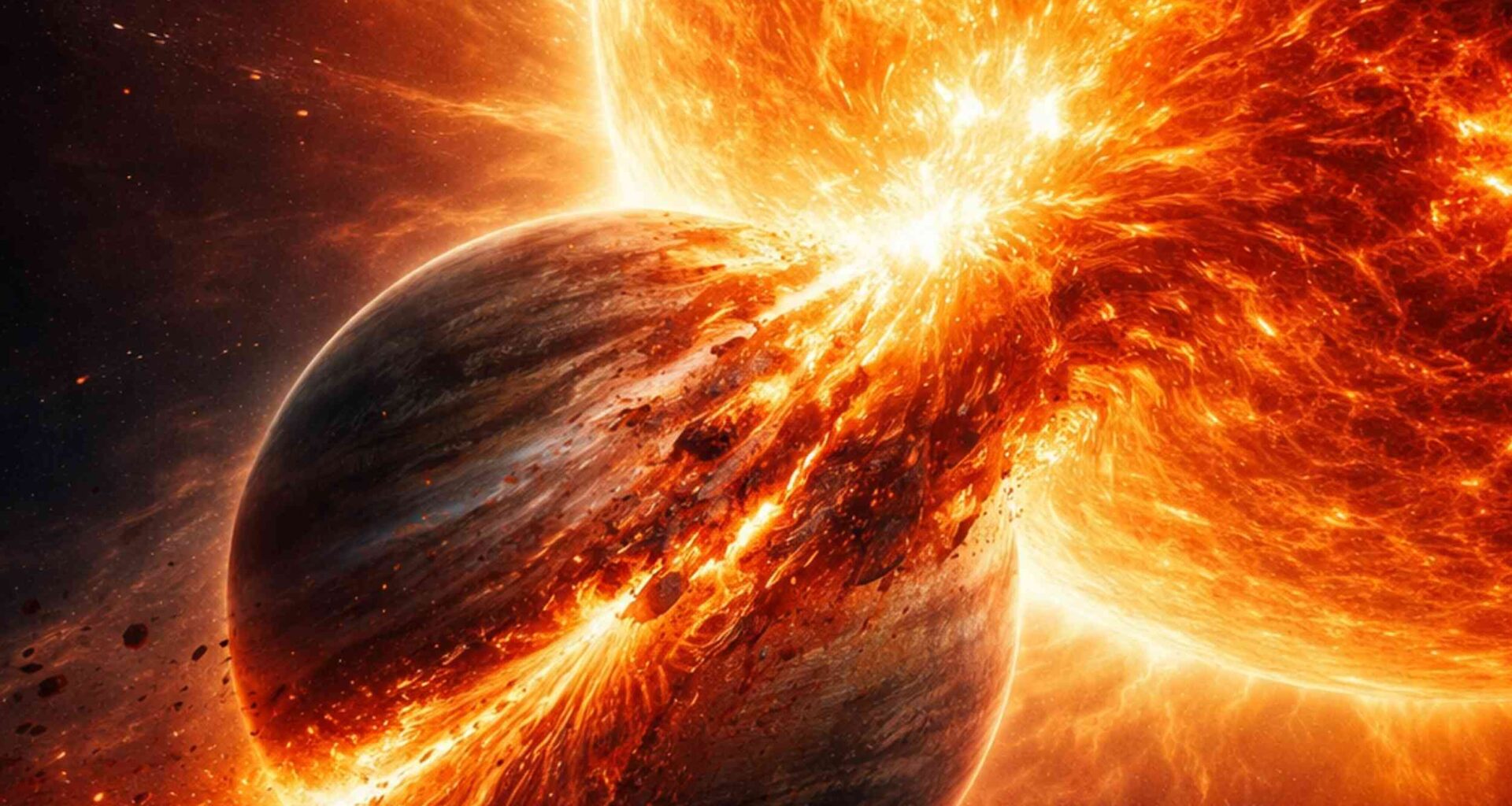
A new study has found that close-orbiting giant planets nearly vanish as stars expand into red giants, dropping to just 0.11% around the most evolved stars.
That collapse reveals a widespread process in which aging stars pull nearby planets inward and destroy them rather than simply hiding them from view.
The missing worlds

Across 456,941 aging stars observed by the Transiting Exoplanet Survey Satellite, TESS, the missing planets showed up as an absence, not a flash.
Reading those patterns, Dr. Edward Bryant at University College London (UCL) found that the nearest giant planets were disappearing fastest.
Rather than fading evenly, the count fell hardest once the stars had cooled and expanded enough to count as red giants.
That trend pointed away from chance and toward a physical process that steadily clears close orbits as stars swell.
Why planets fall
As a star grows, a tidal interaction, a mutual pull that drains orbital energy, grips an orbiting giant planet ever harder.
With each lap around the star, the planet loses a little speed and drops into a tighter path.
Long before the star reaches its biggest size, that inward drift can tear a planet apart or dump it into the star.
“We expected to see this effect but we were still surprised by just how efficient these stars seem to be at engulfing their close planets,” said Dr. Bryant.
Hunting faint dips
NASA’s TESS watched for repeated dimmings in starlight as planets crossed in front of their stars.
Because swollen stars are large, the transits can last a long time and look broader than usual.
The team therefore tailored its search to short-period giant planets that circled in 12 days or less.
That focus kept the study on the worlds most exposed to the growing pull of an aging star.
Sifting real worlds
More than 15,000 likely signals eventually shrank to 130 surviving planets or planet candidates, including 33 not reported before.
Some apparent dips came from eclipsing star pairs or from light leaking in from nearby stars.
To sort possible planets from look-alikes, the researchers checked whether signals repeated cleanly, matched each star, and stayed centered on the target.
That caution matters because a false planet can easily distort the population picture the study was built to measure.
Rates that plunge
Overall, just 0.28% of the surveyed stars held close giant planets once the team corrected for missed detections.
Among the less evolved stars, the rate was 0.35%, which looked much like comparable stars before swelling began. By the time stars reached early red giant status, the figure had dropped to 0.11%.
Those numbers turned a long-argued idea into a measurable population effect, not just a story built from individual systems.
The shortest orbits
The sharpest losses appeared among planets that whipped around their stars in less than about six days.
At those distances, the gravitational tug works faster, because a nearby planet raises stronger tides on the star.
Farther out, giant planets still looked reduced, but the drop was smaller and harder to separate from random scatter.
That period dependence is one reason the team argues the planets are being dragged inward, not merely overlooked.
Our distant future
Our own Sun is expected to remain stable for about five billion more years before becoming a red giant.
Unlike the giant planets in this survey, Earth sits much farther out and was not the kind of world studied here.
Even so, the paper followed only the first one or two million years of this swollen stage.
That leaves room for Earth to avoid being swallowed while still becoming utterly hostile to life long before then.
What remains uncertain
Many of the objects are still candidates, which means astronomers know their size but not yet what they weigh.
Using radial velocity, the back-and-forth motion seen in starlight, astronomers can confirm real planets and measure their pull.
With brighter targets now in hand, UCL and other teams can test the picture much more directly.
“Once we have these planets’ masses, that will help us understand exactly what is causing these planets to spiral in and be destroyed,” Bryant said.
Beyond one disaster
Astronomers have already seen a dramatic engulfment when one distant star apparently swallowed a Jupiter-size planet.
What TESS adds here is scale, showing that quieter destruction seems to happen across many systems, not only as a rare outburst.
Population studies like this matter because they reveal what single spectacular events cannot, namely how common the damage becomes.
That wider view turns dying planetary systems from isolated curiosities into a visible part of how ordinary stars age.
Planetary systems do not simply coast into old age, because swelling stars keep rewriting the nearest orbits.
Better mass measurements should now show which giants still have time left and which are already falling in.
The study is published in Monthly Notices of the Royal Astronomical Society.
—–
Like what you read? Subscribe to our newsletter for engaging articles, exclusive content, and the latest updates.
Check us out on EarthSnap, a free app brought to you by Eric Ralls and Earth.com.
—–