
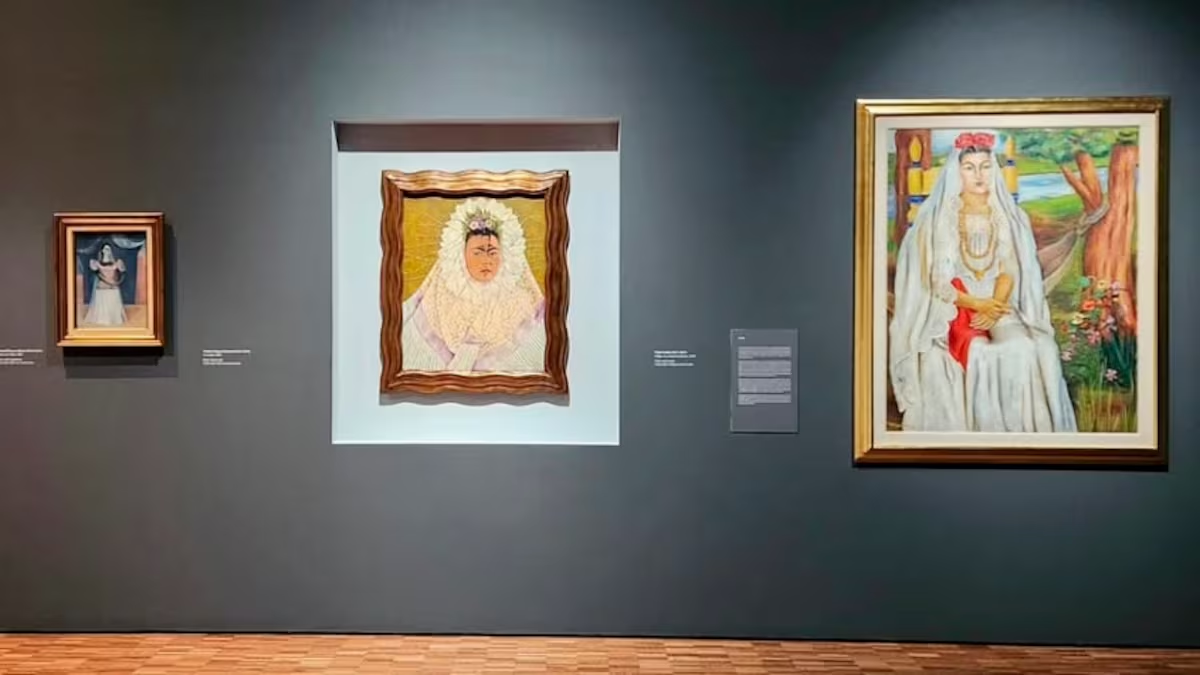
The tragedy can be summed up in a few figures: there are 150 Frida Kahlo paintings in the world, and only four of them are part of Mexico’s public heritage. There are seven in total within the country, if privately owned works are included. That imbalance — in a body of work that is already tiny — partly explains the outrage of Mexico’s art community, which is observing with a mixture of astonishment, doubt, and anger as the elusive Gelman collection — which includes at least 18 Kahlo works — is slated to be moved to Spain.
The Gelman collection has been managed by Spain’s Banco Santander since January of this year. It is yet another unexpected twist in the long history of murky episodes following the death of the original owners, Jacques and Natasha Gelman. Several professionals point out that the role of the Mexican authorities responsible for protecting cultural heritage has been insufficient and lacking in transparency.
The bank will manage 160 works out of the more than 300 that make up the collection, which is one of the most important in Mexico. Little is known about the rest, apart from the fact that a handful were sold at auction a year and a half ago. The collection includes not only works by Frida Kahlo, but also pieces by other leading figures of modern Mexican art: Diego Rivera, María Izquierdo, Rufino Tamayo, José Clemente Orozco, Francisco Toledo, and David Alfaro Siqueiros.
These works are subject to strict regulation because of their symbolic value and public significance. A total of 28 of the 160 pieces have been declared artistic monuments, but the Kahlo works are the ones protected by an even stricter designation. That is why they have become the rallying point for the sector, which has signed an open letter urging the Mexican government to take stronger action to safeguard them.
The type of designations these works carry — similar to those used in other countries, and which, for example, prevented the sale of a Sorolla painting outside Spain a few years ago — effectively amount to a “restriction on private property,” explains Carlos Lara, a cultural‑law specialist and one of the signatories of the letter. Because of their public significance, these works must go through specific authorization processes, for instance, to leave the country or be sold to a third party, regardless of whether they are publicly or privately owned. “That drives up the artwork’s market value, but at the same time reduces its mobility,” he notes.
Many of the murky circumstances surrounding the issue have to do precisely with the collection’s change of ownership: from executor Robert Littman, who managed it after the death of Natasha Gelman, to the Zambrano family of Monterrey — linked to the cement company Cemex — who in turn have transferred it “for the long term,” under an unknown arrangement, to Banco Santander.
It is unknown whether there is any public record of the transfer from Littman to Zambrano, and as of the publication of this report, Mexico’s National Institute of Fine Arts (INBAL) has not confirmed it to this newspaper.
The Santander Foundation — which has taken the lead in the bank’s public statements — consistently refers to the holdings as the “Santander Gelman Collection,” a choice of wording that has led professionals to suspect that the works may at some point have been used as collateral and that the Spanish bank may now hold full ownership, not merely custodianship. There is no confirmation of this, and the Zambrano family has remained silent since the announcement that the works will be exhibited at the new Faro Santander cultural center in the Spanish city of Santander, set to open in the autumn, with no specific date yet announced.
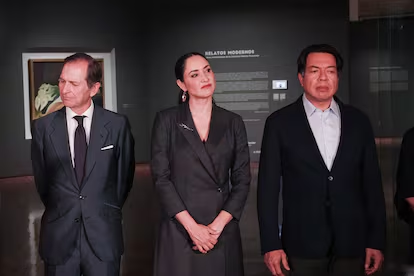 The executive director of the Santander Foundation, Francisco de Borja, Mexico’s secretary of culture, Claudia Curiel de Icaza, and Mexico’s secretary of public education, Mario Delgado Carrillo, at the exhibition at the Museum of Modern Art in Mexico City.Camila Ayala Benabib (Cuartoscuro)
“What worries us most is that the state’s role should have been to create the conditions for a collection this valuable to remain in Mexico. And not only did that not happen, but INBAL chose to sign an agreement that entirely favors a foreign financial institution,” laments María Minera, art critic and one of the main authors of the public complaint.
The community asked for the agreement to be made public, but after the authorities refused, they eventually gained access to it through a media leak. Among other things, what concerns Minera is the clause that allows Mexico’s authorization for the works to remain abroad to be extended indefinitely.
“If temporary permits can be renewed indefinitely, you effectively neutralize the purpose of the law,” she argues. “Daniel Vega [director of Faro Santander] said it again very recently. Santander has been telling the truth all along, which is: ‘We’re going to keep the collection for a very long time.’”
In response to the controversy, the Santander Foundation issued a brief written statement on April 3, assuring that it will comply “at all times” with Mexican law: “The agreement entails five years of collaboration with the current administration, a period that corresponds to an institutional framework of coordinated work, which in no way will contravene Mexican legislation. […] We reiterate that no agreement signed provides for a change of ownership, nor for the definitive transfer of the collection to any location outside Mexico.”
Vega’s latest public remarks add to earlier statements pointing to the “flexibility” of Mexican law when it comes to securing authorizations to take the works on a world tour. Those kinds of comments, repeated over recent months, have set off alarm bells across the sector. The controversy has grown to such an extent that the bank postponed the opening of the new cultural center until the autumn, so that the exhibition of 68 pieces can remain in Mexico until after this summer’s soccer World Cup.
After 20 years without being shown in the country, the works have been on view since February — and will remain so until July 19 — at the Museum of Modern Art in Mexico City. That last‑minute agreement has avoided the scenario initially feared: that the works would leave the country in the middle of the tournament, at the end of June, undermining the World Cup euphoria the government has spent months cultivating.
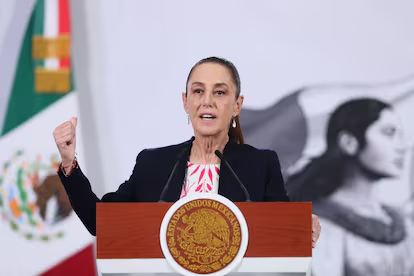 Mexican President Claudia Sheinbaum said during a press conference last Monday that the Gelman collection will return to Mexico in 2028.Mario Guzmán (EFE)
The same agreement stipulates that the works will return to Mexico every two years, with the first return scheduled for 2028. This middle‑ground solution not only fails to satisfy specialists but also raises a new concern: whether the pieces can withstand such frequent travel, especially since the Santancer Foundation also plans to exhibit them in other countries beyond Spain. The specialists have also been unable to access the technical report that a committee of experts must produce to assess the condition of the works and the feasibility of the transfers — the very assessment on which, in theory, the authorizations are based.
Mexican President Claudia Sheinbaum has pushed back against the criticism, stressing last week that the Secretary of Culture would “comply with the law and defend the country’s artistic heritage.” “How many times do we have to say that the Ministry of Culture is complying?” she added, irritated by the attention the issue has drawn in international outlets such as The Guardian and The New York Times.
For the artistic community, however, the frustration goes beyond the handling of a collection whose original owners wanted it to remain together and in the country — only to see it broken apart far from Mexico. What troubles them is what the situation reveals. It raises, in the words of curator and art historian Cuauhtémoc Medina, who also signed the letter, “the question of to what extent the protection framework the Mexican state has for modern heritage is of any real use.”
“The Mexican law, in very clear terms, has declared all cultural objects created before 1824 to be property of the nation and placed them under a very strict protection regime,” the specialist explains. In other words, all works predating the country’s first federal Constitution are considered “original property.” Modern art does not fall under that category, which makes its protection legally more ambiguous and less effective.
According to Medina, the only real way to counter an artistic diaspora of this scale is for the state to purchase works — a task for which the authorities have been unwilling to allocate funds. The priority in the previous administration, and in the current one, has been the repatriation of pre‑Hispanic pieces scattered around the world, not the recovery of modern heritage.
Former INBAL director Gerardo Estrada acknowledged in an interview with the newspaper Milenio that the Mexican government had the opportunity to buy the Gelman collection at the start of the century, shortly after Natasha Gelman’s death, but “did not have the resources.” “At the time, it was estimated to be worth between $200 and 300 million. It was a purchase that required government intervention — a state decision — but it didn’t happen,” he said.
Since then, the collection’s value has multiplied, even as the holdings have continued to fragment, with little clarity about how, when, or under whose authorization — given the collection’s rare public appearances and the complete silence of the key actors who control it.
The Mexican state’s only — and modest — victory came a couple of years ago, when it managed to halt the auction of two works by María Izquierdo in New York, an event from which another 30 pieces, lacking official designation, were not spared. The sense of powerlessness felt then now resonates even more strongly with the reappearance of 160 works in the hands of a foreign bank. Little is known about the steps taken by public authorities. Even less is known about the private agreements reached between the current owners and the powerful Spanish bank.
Sign up for our weekly newsletter to get more English-language news coverage from EL PAÍS USA Edition