
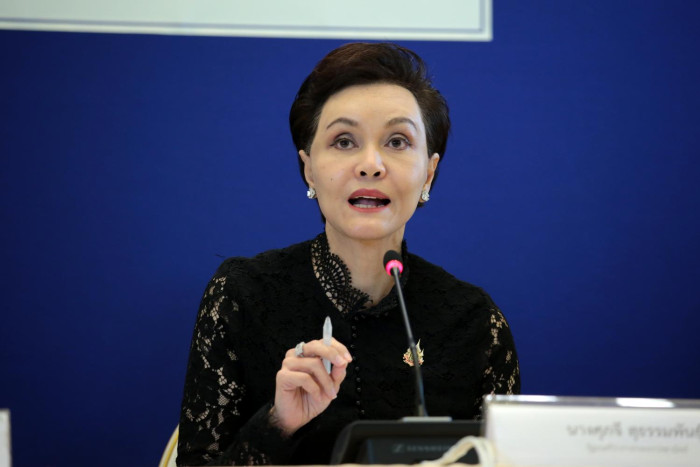
Commerce Minister Suphajee Suthumpun is seeking outside advice, wiming to integrate expertise from across sectors to support more well-rounded policymaking that addresses the needs of both the public and businesses.
As the festive haze of Songkran dissipates, Thailand has entered a far more sobering phase — one defined not by celebration but by tightening household budgets, rising fuel costs and growing unease over economic stability.
The post-holiday economic landscape is shaping up to be particularly unforgiving. During Songkran, consumer spending typically surges, driven by travel, retail and tourism. This year was no exception, with bustling streets and packed transport hubs briefly masking deeper structural concerns.
However, such seasonal boosts are temporary. As normality returns, so too does the reality of strained household finances — exacerbated by global forces beyond the country’s control.
At the centre of these pressures is the volatile situation in the Middle East, whose instability continues to reverberate across global energy markets. Persistent geopolitical tensions have kept oil prices elevated, feeding directly into domestic fuel costs.
For a country heavily reliant on imported energy, this translates into sustained upward pressure on inflation, particularly in transport and logistics, the source said.
The knock-on effects are already being felt. Higher fuel prices increase the cost of goods distribution, pushing up retail prices and eroding purchasing power. For ordinary Thais, this means less disposable income and more cautious spending. Early indicators suggest that post-Songkran consumption may dip more sharply than usual, as households recalibrate their budgets in response to rising living costs.
This contraction in consumer activity presents a serious challenge for the Anutin administration, which has yet to demonstrate its ability to manage economic turbulence. The government had hoped to rely on short-term stimulus measures and public spending initiatives to sustain momentum, but such efforts risk being overwhelmed by external shocks, the source said.
Compounding the issue is a growing perception problem. Public confidence in the government’s economic stewardship appears to be weakening, with criticism mounting over what many see as reactive rather than proactive policymaking.
While authorities have acknowledged the impact of global energy prices, critics argue there has been insufficient urgency in implementing mitigating measures, such as targeted subsidies or structural reforms to reduce energy dependence.
The political implications are significant. Popularity, already on a downward trajectory, could erode further if economic conditions worsen in the coming months.
In Thailand’s highly competitive political landscape, where public sentiment can shift rapidly, sustained dissatisfaction over cost-of-living pressures has the potential to reshape voter attitudes and embolden opposition forces.
Moreover, the government faces a narrowing window in which to deliver tangible results.
This urgency may explain why Deputy Prime Minister and Commerce Minister Suphajee Suthumpun has held discussions with leading experts in economics and trade, as well as former ambassadors to Austria, Germany and India, and a former Thai trade representative to the European Union, as part of efforts to establish an advisory team and appoint Thailand Trade Representatives (TTR), says government spokeswoman Rachada Dhnadirek.
Ms Suphajee aims to integrate expertise from across sectors to support more well-rounded policymaking that addresses the needs of both the public and businesses.
The discussions covered a broad range of issues, including macroeconomics, international trade, legal frameworks and business development, with a view to mitigating the impact of current economic conditions and preparing for future volatility.
She has also outlined proactive long-term strategies to strengthen Thailand’s competitiveness amid shifting global supply chains and evolving trade geopolitics.
The proposed advisory team includes prominent figures such as former tourism and sports minister Weerasak Kowsurat; Kobsak Pootrakool of Bangkok Bank; Piti Srisangnam of the Asean Foundation; capital market expert Nat Leuangnaramit; Yanyong Thaicharoen of the SCB Economic Intelligence Centre; Arm Tungnirun of Chulalongkorn University’s Institute of Asian Studies; Pipat Luengnaruemitchai of Kiatnakin Phatra Financial Group; Phusit Ratanakul Sereroengrit of Asian Sea Corp; and Anan Lapsuksatit of K Agro-Innovate Institute.
In addition, former ambassadors Nongnuch Petchratan (Austria and Germany) and Chutintorn Gongsakdi (India), along with former Thai trade representative to the EU Veerapong Prapa, are being approached to serve as Thailand Trade Representatives.
Regarding Mr Veerapong — currently deputy leader of the opposition Democrat Party — consultations have been held with party leader Abhisit Vejjajiva. Both sides agree the role is a professional position that could benefit the country, particularly in advancing negotiations on the Thailand–EU Free Trade Agreement, an area in which Mr Veerapong has prior experience.
Analysts suggest the next three to six months will be crucial in determining whether the administration can stabilise the situation or become mired in crisis management. Failure to act decisively could cement a narrative of economic mismanagement that may prove difficult to reverse ahead of future elections.
Tourism, often cited as a pillar of economic recovery, may not provide the buffer it once did, the source said. While international arrivals have been recovering, the sector remains vulnerable to global uncertainties and fluctuating travel demand.
Moreover, tourism-driven growth does not always translate into broad-based economic relief, particularly for lower-income households most affected by inflation.
Small and medium-sized enterprises (SMEs), which form the backbone of the economy, are also under strain. Rising operational costs — driven by fuel, raw materials and wages — are squeezing profit margins and limiting expansion. Many businesses that benefited from Songkran-related demand now face a more subdued outlook, amid concerns over declining foot traffic and weaker consumer spending.
In this context, policy responses will be critical. Economists are calling for a multi-pronged approach, combining short-term relief with longer-term structural adjustments. These could include targeted energy subsidies, incentives for renewable energy adoption and measures to boost domestic consumption without exacerbating fiscal pressures.
However, such policies come with trade-offs. Expanding subsidies could strain public finances, while structural reforms require time and political capital — both of which may be in short supply. The government must therefore strike a delicate balance between immediate relief and sustainable economic management.
Communication will also be key. Clear and consistent messaging on economic policy can help restore public confidence and manage expectations. Conversely, mixed signals or perceived indecision could further undermine trust and heighten political risks.
Ultimately, the post-Songkran period may serve as a defining test for the Anutin government, the source concluded.
The convergence of external shocks and domestic vulnerabilities has created a challenging environment that demands decisive leadership. Whether the administration can rise to the occasion remains to be seen.
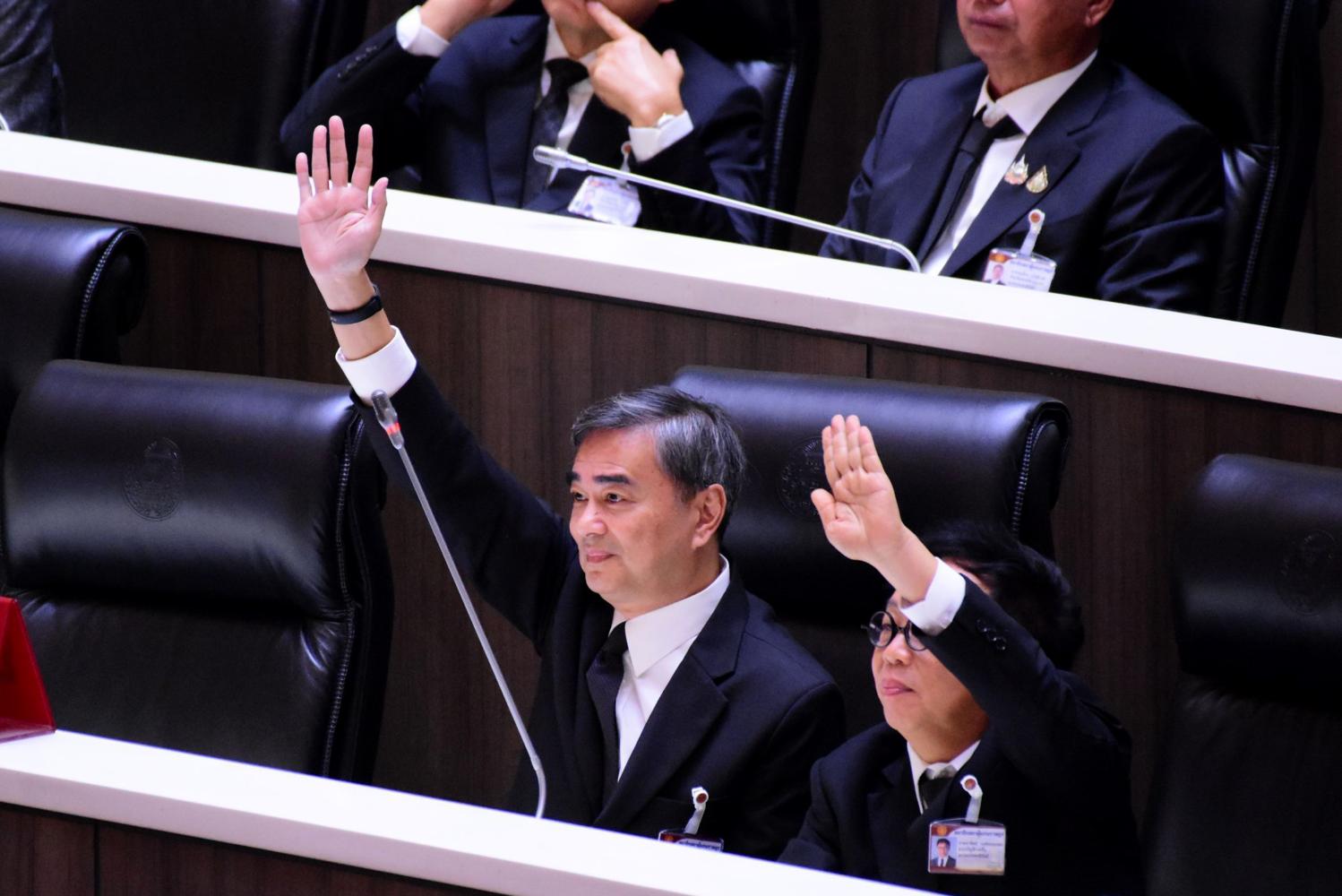
Abhisit: Impressive performance
Democrats off to a good start
Democrat Party leader Abhisit Vejjajiva’s performance in the government policy statement debate in parliament has returned him to the spotlight and revived prospects of the party staging a comeback at the next election, according to political observers.
During the April 9–10 debate, Mr Abhisit, making his first appearance after a lengthy hiatus, pulled no punches in criticising the policies outlined by the Bhumjaithai Party-led government.
He opened by raising concerns over the government’s plan to press ahead with the Land Bridge project, a trillion-baht infrastructure scheme linking the Gulf of Thailand and the Andaman Sea.
He questioned why such a significant project — with far-reaching implications for communities, the environment and national security — was not clearly set out in the government’s policy statement to parliament.
The policy had not been submitted to the Election Commission (EC) during the campaign.
Despite this, Transport Minister Phiphat Ratchakitprakarn has indicated the project will proceed, with bidding expected between 2026 and 2027 and initial operations targeted for 2028 to 2030.
Mr Abhisit described the policy statement as lacking direction and substantive measures, particularly at a time when the country is grappling with rising energy costs and mounting economic pressure.
He pointed to the absence of clear plans to ensure adequate energy supplies and to manage rising production costs in both the industrial and agricultural sectors. Key goods such as fertilisers and industrial materials — closely tied to energy prices — have become more expensive, yet the government has failed to respond effectively.
“The government is burning through 40 billion baht taken from oil consumers, who will ultimately pay higher prices in the future, without putting in place any measures to cope,” he said. “And now it is trying to fix the problem by invoking laws on shortages, which has only added to the confusion.
“The heart of this government is not with the people,” he said. “You once said no one is better than the people, but now you suggest that the public is responsible for hoarding fuel. You should identify the real actors [behind the shortages] and take action.”
In his concluding remarks, the Democrat leader urged the cabinet to honour its oath of office to improve people’s livelihoods, strengthen democracy and preserve national stability.
He warned that if the government treats the public merely as a means to power, democracy as a formality, and national security and ethics as political tools, it will fail in its pledge and risk a public backlash over unmet expectations.
Yuttaporn Issarachai, a political scientist at Sukhothai Thammathirat Open University, said Mr Abhisit had not lost his edge, noting his performance stood out for its focus and precision. The Democrat leader’s approach contrasted with that of People’s Party leader Natthaphong Ruengpanyawut.
Rather than scrutinising the government’s agenda, the opposition leader focused his criticism on coalition partner Pheu Thai Party, accusing it of joining the government without meaningful bargaining power with the leading party.
Mr Abhisit’s opening criticism of the Land Bridge project was a strategic move, given strong opposition to the scheme in the South, which remains a core support base for the Democrat Party. His closing remarks highlighted the government’s handling of the energy crisis, an issue of immediate concern to the public.
“This was a more effective approach than focusing on political attacks that are not directly related to the policy statement,” Mr Yuttaporn said.
Mr Abhisit delivered a strong performance despite being away from the parliamentary spotlight for several years, positioning him once again as a credible opposition figure. The Democrat Party, once dominant in Bangkok and the South, has seen its influence decline since the 2014 coup.
Mr Abhisit stepped back from politics after the party secured 52 seats in the 2019 election. In 2023, its tally fell further to 25 seats. He returned to the party’s helm to help rebuild support ahead of this year’s polls. While the Democrats won 22 seats this time, the 3.6 million party-list votes they received suggest the party has stabilised and may yet regain its former strength.
Mr Yuttaporn said the political landscape may also create an opening for Mr Abhisit — who served as prime minister from 2008 to 2011 — to return to the top post after the next election. He pointed to uncertainty over the government’s ability to deliver its policies, as well as the weakening positions of other major parties.
The People’s Party faces pressure over its stance on Section 112, or the lese-majeste law, while Pheu Thai’s role in the coalition has limited its ability to rebuild political strength. “Mr Abhisit’s role in opposition today will pave the way for his possible return [to the premiership],” he said.