
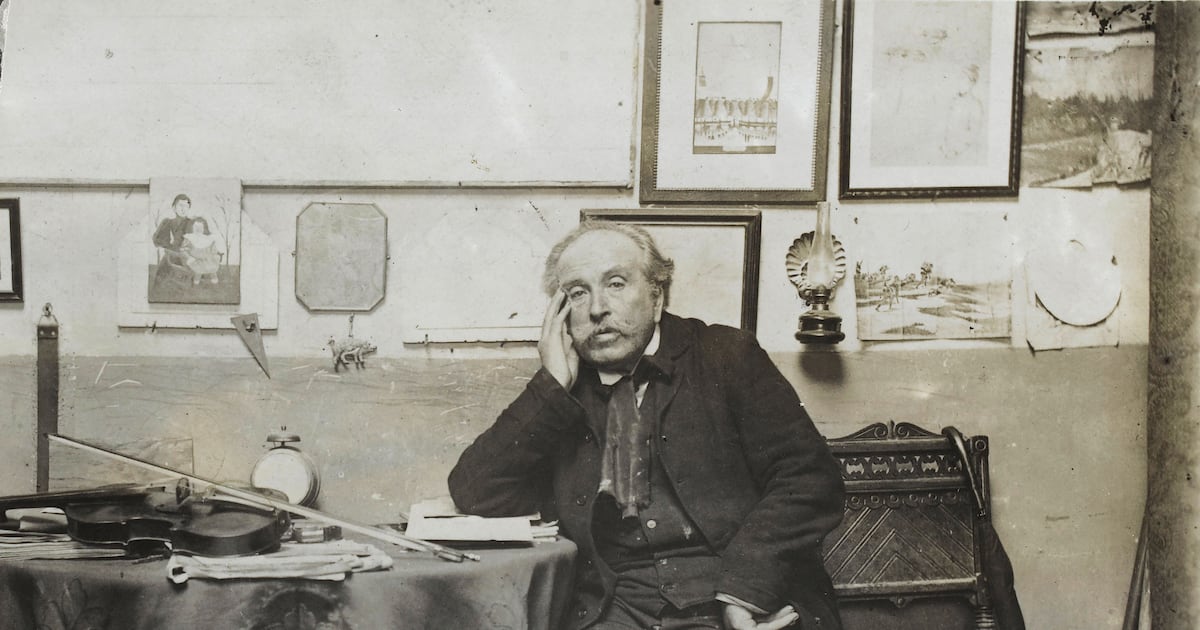
Henri Rousseau gave up his day job as a low-ranking collector of tax on wine unloaded from boats on the Seine, in Paris, in 1893, when he was 49. He wanted to devote himself full-time to his passion for painting, which he had taken up eight years earlier.
Rousseau exhibited at the Salon des Indépendants, the annual exhibition where entry was open to all, without selection by a jury. His early works were mocked, but over two decades his entries became a main focus of the salon. In 1910, the last year of Rousseau’s life, he showed The Dream, a painting of a naked woman reclining, like Manet’s Olympia, in the jungle. “No one is laughing any more,” the poet and art critic Guillaume Apollinaire wrote. “All are unanimous. They admire him.”
Rousseau’s large canvas entitled War created a sensation at the Salon des Indépendants in 1894. The artist had served briefly with a French infantry regiment, but he never saw battle. He had, however, seen bodies lined up on the streets of Paris during the Franco-Prussian War of 1870, which transformed him into a pacifist.
War shows a crazed horsewoman posed side-saddle above her steed, brandishing a sword and smoking torch as the black horse gallops across a field of rubble and cadavers. Crows drink blood from severed limbs. Clouds appear tinged by blood. “War passes through, terrifying, leaving everywhere despair, tears and ruin,” Rousseau wrote in his description.
Today, as wars rage in the Middle East, Ukraine and elsewhere, Rousseau’s painting remains a terrifying pictorial statement on the horror of humans slaughtering their own species, rivalled only by Picasso’s Guernica.
In his other great allegorical painting — entitled Foreign Representatives Salute the Republic in a Sign of Peace — Marianne, the symbol of France, holds an olive branch above the man who was president at the time, Armand Fallières, and officials from Europe, Asia and Africa. Critics assumed the painting alluded to the second Hague peace conference. Rousseau wanted to sell it to the state, but it was instead bought by the art dealer Ambroise Vollard, who sold it to Picasso.
Both works, along with more than 50 others by the artist, are on show at Henri Rousseau: The Ambition of Painting, an exhibition that runs at the Orangerie, in Paris, until July.
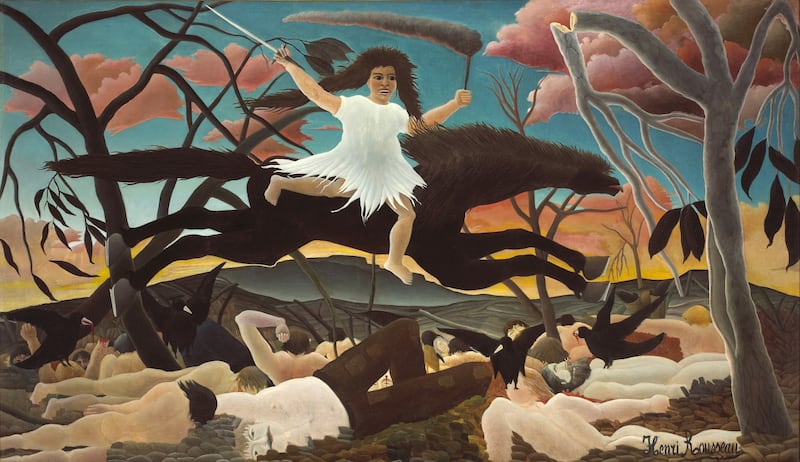 Henri Rousseau: War. Photograph: Patrice Schmidt/Musée d’Orsay
 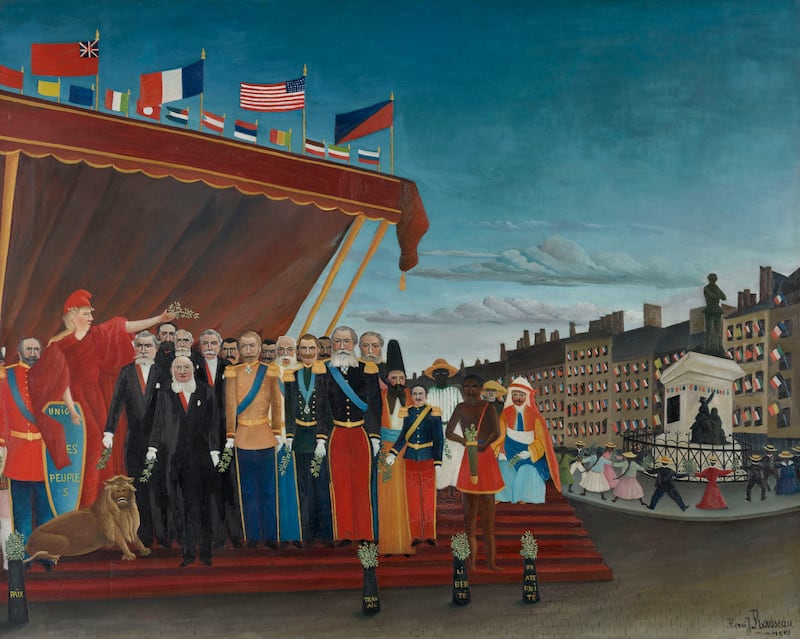 Henri Rousseau: Representatives of Foreign Powers Salute the Republic in a Sign of Peace. Photograph: Adrienne Didierjean/Musée National Picasso-Paris
Rousseau was long known in France as “le douanier”, or the customs officer, the name given to him by young painters and writers who adopted him as a sort of ageing mascot. He was not in fact a customs officer but a subaltern clerk.
“We called him Henri Rousseau [in the name of the exhibition] to give him the status of a painter and artist rather than a lowly clerk who painted in his spare time,” explains Juliette Degennes, a curator at the Orangerie and one of three commissioners of the exhibition, which was five years in the making.
Over a quarter-century Rousseau produced about 250 canvases, of which 100 were lost. The Barnes Foundation, in Philadelphia, which showed the exhibition before it moved to Paris, possesses 18 of Rousseau’s paintings, the single largest collection. The Orangerie has the second-largest collection, with 11.
[ Recreating my old cycling commute shows how Paris won the car warsOpens in new window ]
These paintings all passed through the hands of Paul Guillaume, the art dealer whose personal collection is the heart of the Orangerie. Guillaume sold many paintings to Dr Alfred Barnes, an American chemist and businessman, who decreed in his will that his paintings could not travel abroad. That was overturned in court in 2023, enabling the foundation to lend significant paintings to this exhibition.
Rousseau did not mind being called a naive or primitive painter, names he associated with sincerity and honesty. The same labels were applied to his contemporary Paul Cézanne.
Although Rousseau called himself a realist painter, he had no regard for accuracy in proportion, perspective or visual description. In the charming 1890 painting Myself, Portrait-Landscape, Rousseau painted himself as a giant, dwarfing tiny passersby on a quay of the Seine. The bird in Snake Charmer, from 1907, looks like a cross between a duck and a heron.
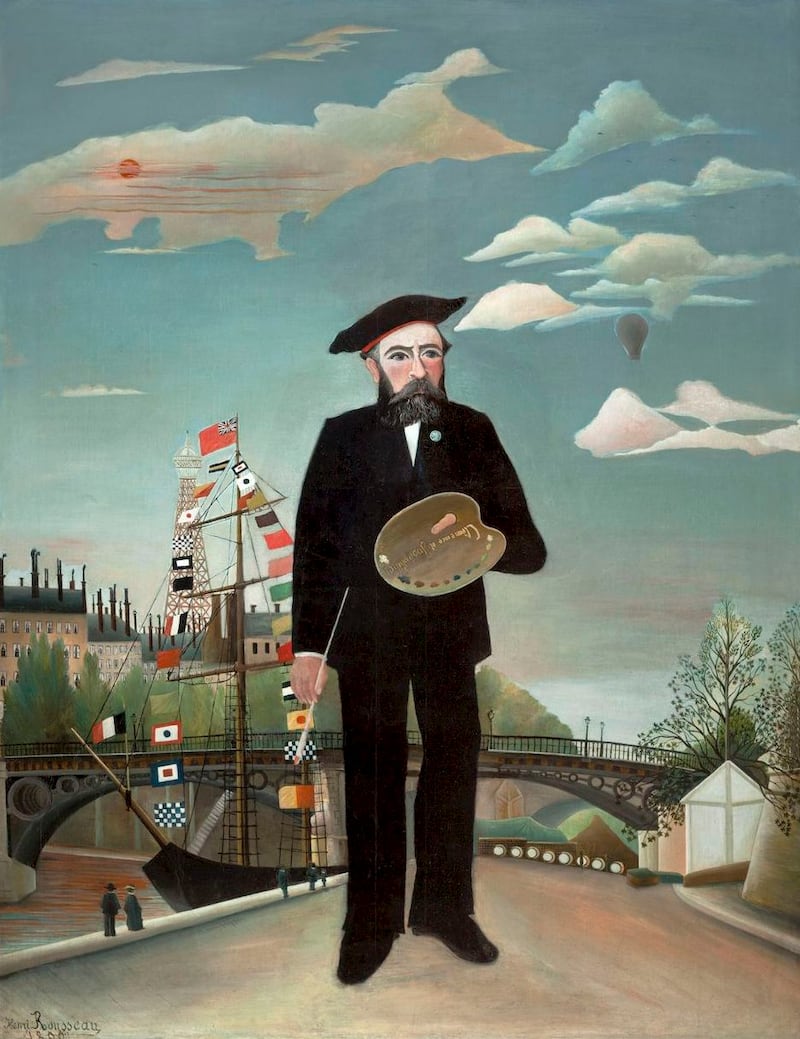 Henri Rousseau: Myself, Portrait-Landscape. Photograph: Musée de l’Orangerie/National Gallery Prague
 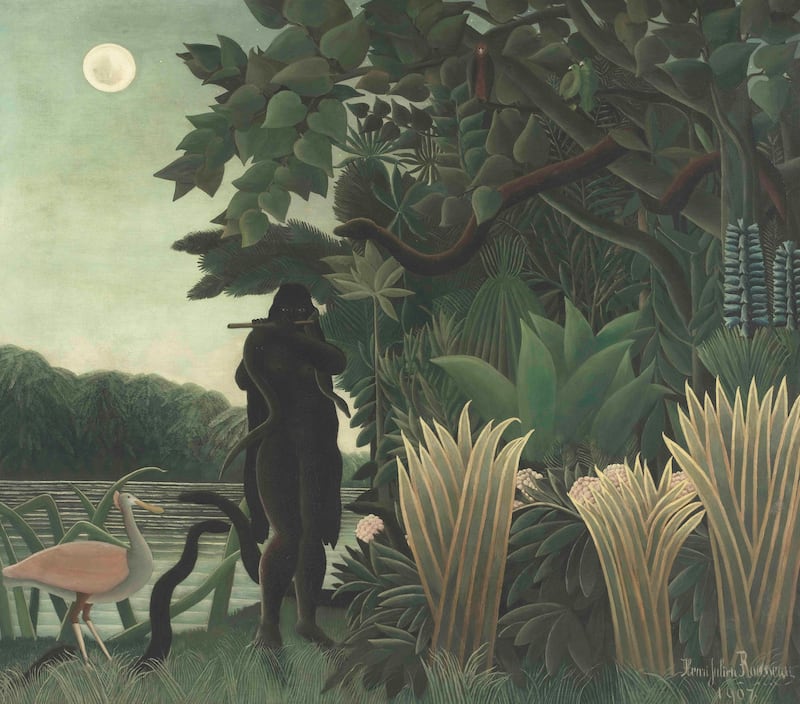 Henri Rousseau: Snake Charmer. Photograph: Patrice Schmidt/Musée d’Orsay
In the same self-portrait one could almost miss the Eiffel Tower, partially obscured by rigging on a boat, and the hot-air balloon in the clouds. “The Eiffel Tower was only a year old then, and it was still very criticised,” says Degennes, the curator. “Despite his naive style, Rousseau embraced a certain modernity.”
Rousseau enthusiastically included contemporary details such as telegraph polls, dirigibles and metal bridges in his paintings. In 1908 he marked the first flight of the Wright brothers by painting a biplane overhead in a landscape.
Apollinaire’s poems read like Rousseau’s paintings translated into words. In his landmark poem Zone, Apollinaire placed angels, figures from the Old Testament and Greek antiquity “floating around the first aeroplane”.
Similarly, Rousseau’s Carnival Evening, the hauntingly beautiful painting of Pierrot and Columbine walking through a woodland in moonlight, is like a precursor to Apollinaire’s poem and Picasso’s painting, both entitled Saltimbanques.
Carnival Evening was one of four paintings shown in Rousseau’s initial entry at the Salon des Indépendants. It exudes a sense of mystery, poetry and silence, qualities found in many of his works.
In the self-portrait, which belongs to the National Gallery of Prague, Rousseau wears a painter’s beret and holds a paintbrush in one hand and a palette in the other. On the palette he wrote the names of his wives. His first, Clémence, died in 1888, probably of tuberculosis. All but one of their six children died in infancy. He married Joséphine, a widow, in 1899.
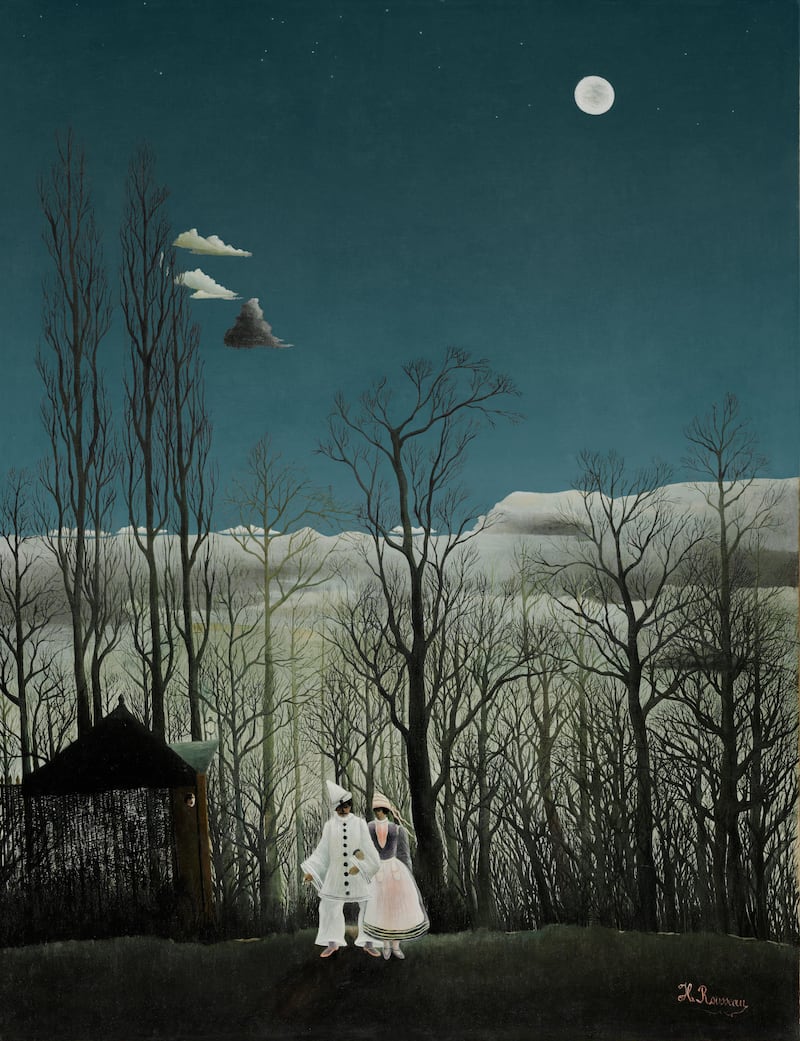 Henri Rousseau: Carnival Evening. Photograph: Musée de l’Orangerie/Philadelphia Museum of Art
 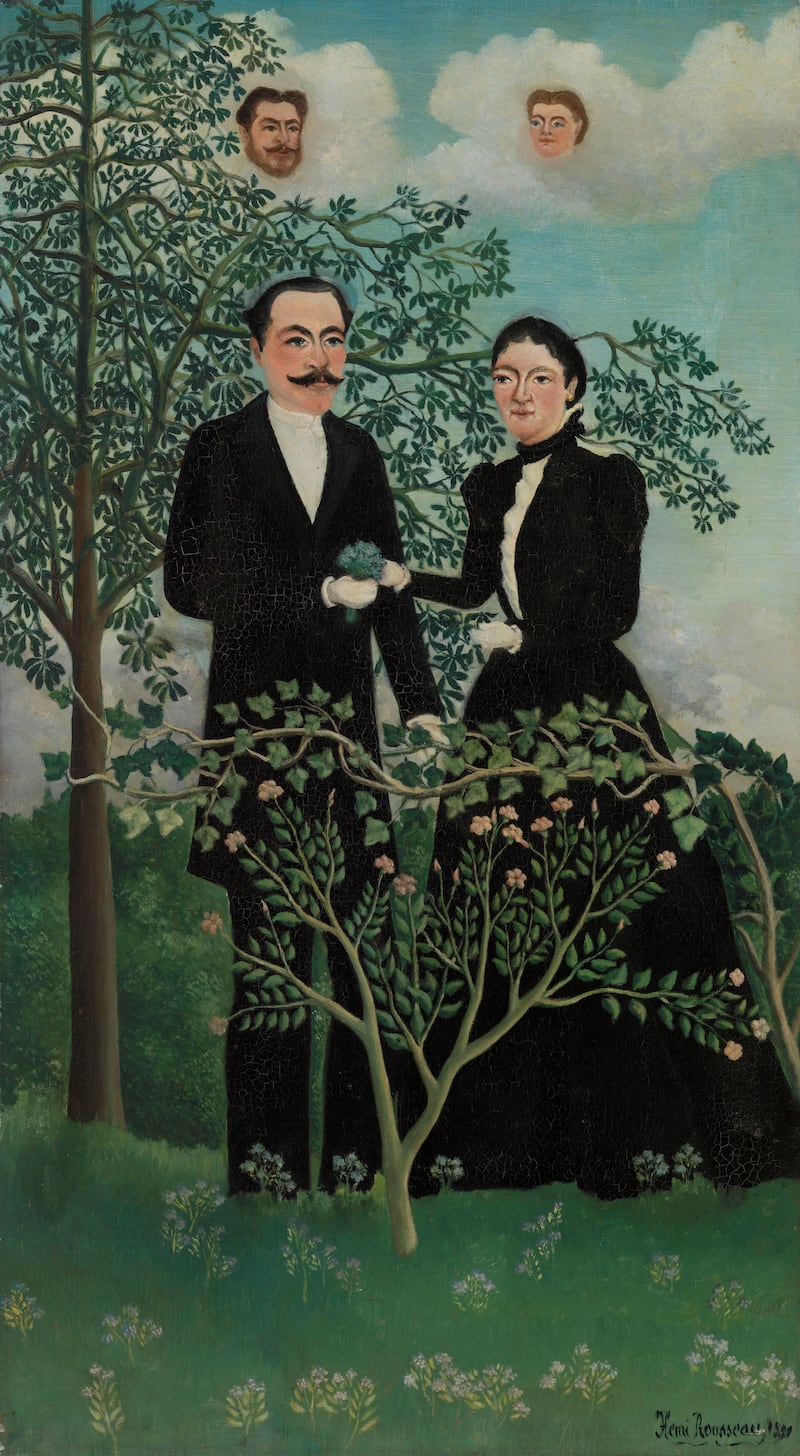 Henri Rousseau: Past and Present. Photograph: Musée de l’Orangerie/Barnes Foundation
In Past and Present, Rousseau painted himself and Joséphine, both middle-aged, as young people in a spring garden. He believed in spirits and added the faces of their late spouses in little clouds above their heads. “Both separated from those they loved / Both make new unions / Remaining faithful to their memory,” he inscribed on the original frame.
Rousseau is best known for more than two dozen large paintings of luxuriant tropical jungles inhabited by savage felines, comical monkeys and the occasional human. He knew Gauguin in the 1890s and was influenced by Gauguin’s idyllic paintings of the south Pacific. Rousseau let people believe he had participated in France’s 1860s expedition to Mexico, a rumour seemingly confirmed by Apollinaire in a poetic tribute cataloguing “the Aztec landscape / Forests of mangoes and pineapple / Monkeys spilling blood from watermelons / And the blond emperor who was shot over there”.
But in 1910 Rousseau told a journalist he had never left France. He studied tropical plants in the botanical gardens and wild animals in the natural history museum.
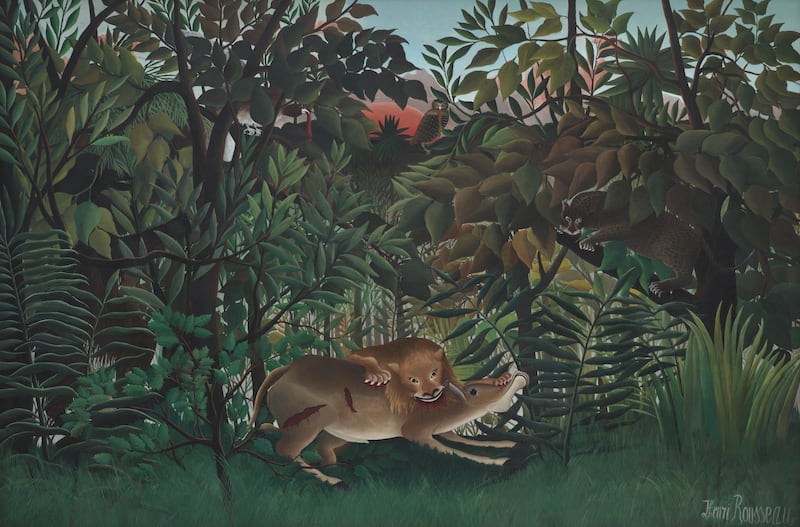 Henri Rousseau: The Lion, Being Hungry, Throws Himself on the Antelope. Photograph: Musée de l’Orangerie/Robert Bayer/Riehen/Basel, Beyeler Collection
The Lion, Being Hungry, Throws Himself on the Antelope was the largest painting completed by Rousseau, measuring just over two by three metres. Close examination reveals three other clawed creatures – a green-eyed leopard, an owl and a bird of prey – hidden in the foliage. The painting was shown at the Salon d’Automne, or Autumn Salon, in 1905, alongside works by Henri Matisse and André Derain.
The penultimate room of the Orangerie exhibition holds three strange canvases considered masterpieces by the curators. Their ambiguity might induce fantasy or fear. “I long ago stopped trying to solve the mystery of these paintings,” says Nancy Ireson, a curator at the Barnes Foundation and one of the other commissioners of the exhibition. “One just has to accept it.”
In Bad Surprise, one of the Barnes Foundation paintings, a nude woman with knee-length hair stands in a forest at twilight. She looks heavenwards and raises her hands as if in surrender. A tiny spark and puff of smoke at the end of the barrel of the hunter’s rifle indicate that he has fired at the bear.
We don’t know if the animal is wounded. The hunter looks at the woman, perhaps with lust. Is she more threatened by the bear or by the hunter? The scene is at the same time comical and unsettling.
In the Louvre’s Snake Charmer, a black woman plays a flute in the jungle, surrounded by undulating snakes. Are the snakes under the woman’s spell, or will they harm her?
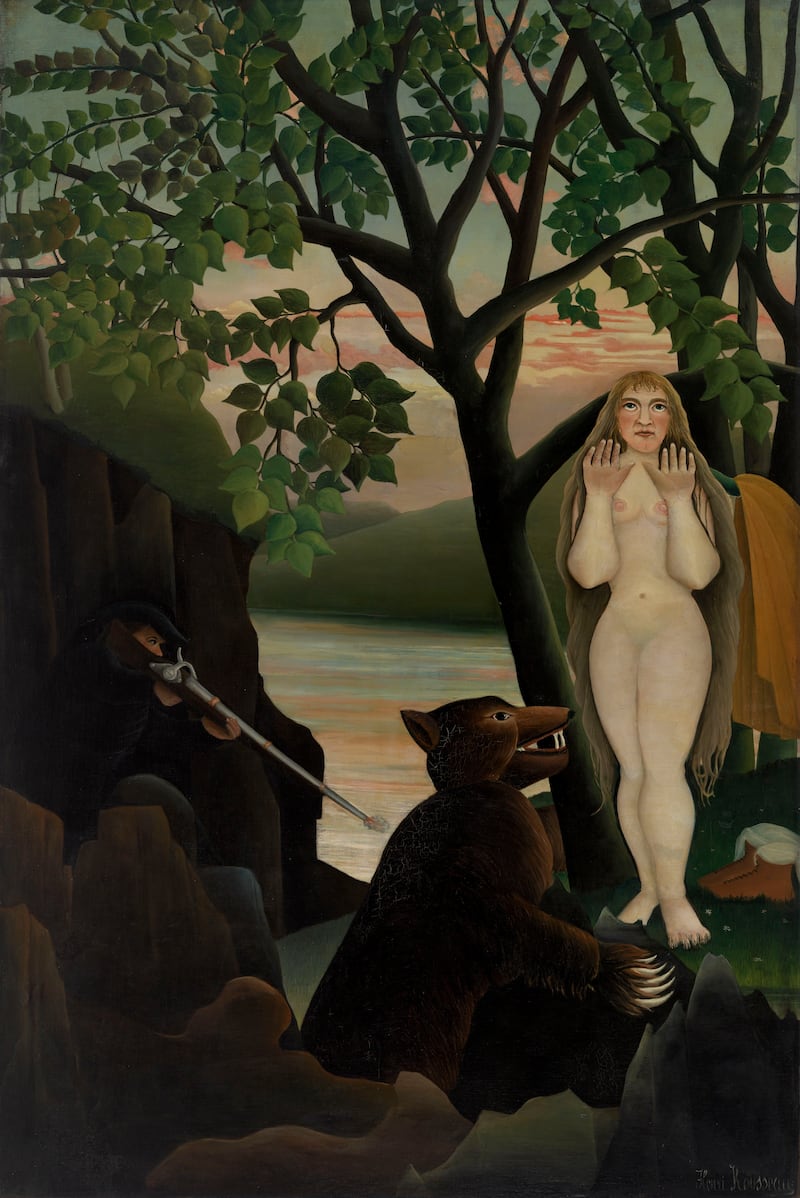 Henri Rousseau: Bad Surprise. Photograph: Musée de l’Orangerie/Barnes Foundation
 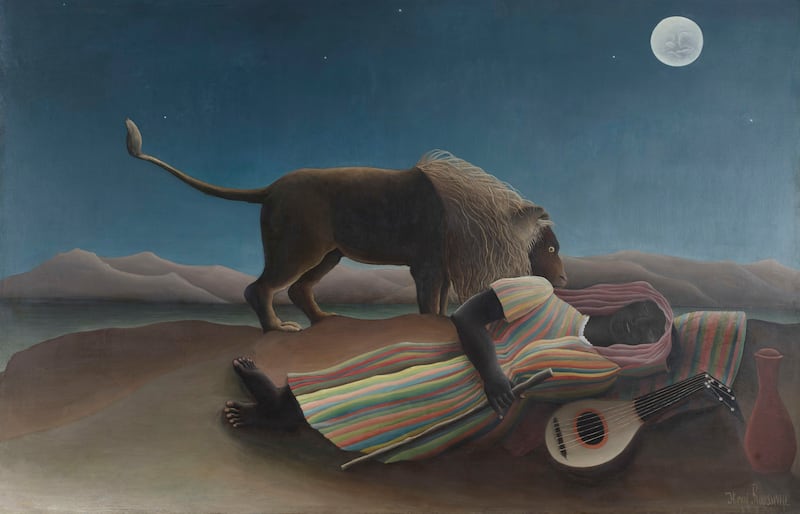 Henri Rousseau: Sleeping Gypsy. Photograph: Musée de l’Orangerie/Museum of Modern Art, New York/Scala, Florence
The Sleeping Gypsy, from the Museum of Modern Art in New York, is the signature painting for the exhibition. It had not been seen in Paris for 42 years. In 1897 Rousseau described the painting as featuring a wandering, mandolin-playing black woman “lying down with a jug of drinking water beside her, overwhelmed with fatigue and in deep sleep. A lion passes by chance, sniffs her odour and does not devour her. There is a moonlight effect, very poetic”.
Rousseau could barely make ends meet. He sold canvases, or swapped them for food or services, to the petty bourgeois among whom he lived. Three of his best paintings belonged to a cleaning lady, a laundry woman and a baker. Rousseau swapped a portrait of the grocer Junier and his family in their carriage for provisions. He painted many small landscapes and still-lifes because he could do them quickly and sell them cheaply to Parisians of modest means.
In 1907, after Rousseau made an amateurish attempt at bank fraud, he was arrested and thrown in prison. His lawyer showed a painting of monkeys in the jungle at the artist’s trial, arguing that a man who could make such a naive painting could not possibly be dishonest. Rousseau received a suspended sentence.
Rousseau admired conformist artists who painted in the style known as academicism, chief among them Jean-Léon Gérôme. He repeatedly entered competitions to paint murals in the town halls of Paris suburbs, without success. He wrote pleading letters to high-ranking officials.
“I am waiting, now, for the good fortune of finding a rich and generous person with a noble heart who would like to make me happy by acquiring my works,” he wrote to the minister for fine arts in 1884.
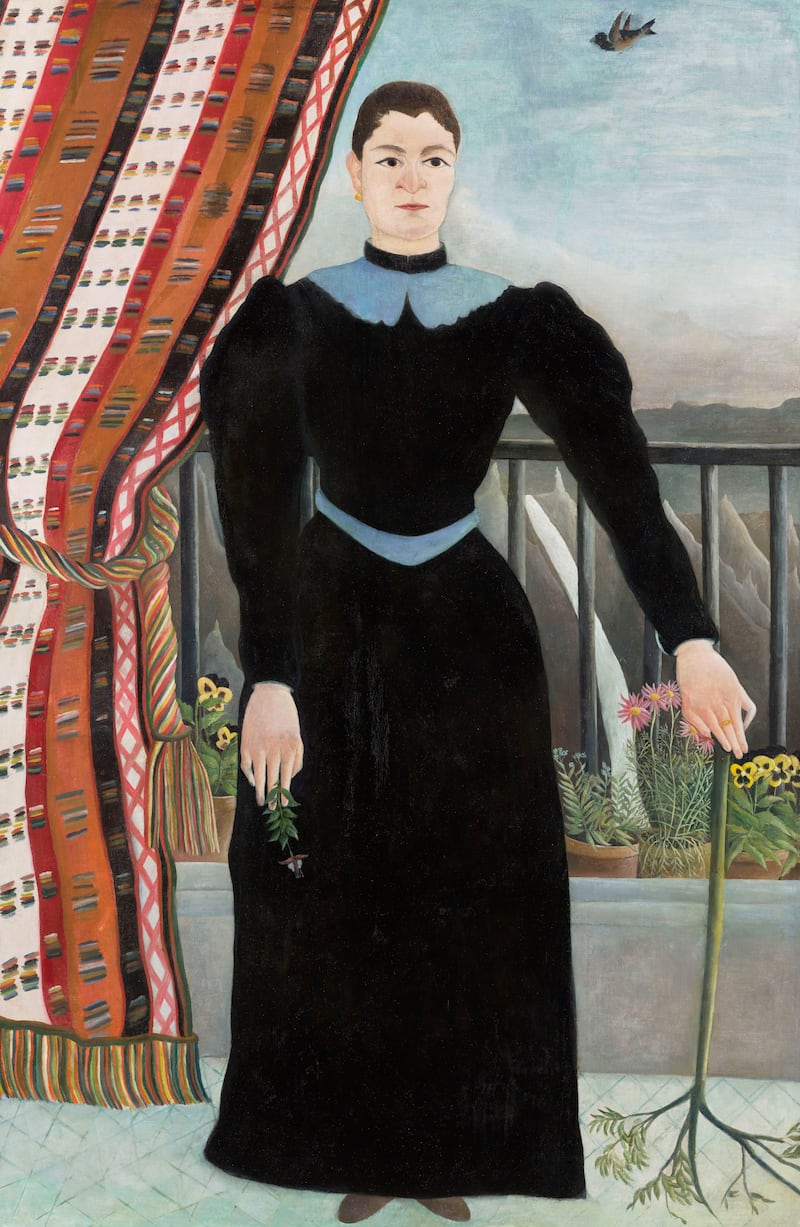 Henri Rousseau: Portrait of a Woman. Photograph: Adrienne Didierjean/Musée National Picasso-Paris
Recognition eventually came not from officialdom but from young, avant-garde writers and painters, including Apollinaire and Picasso, who like Rousseau were struggling to make a living. In 1908 Picasso purchased Rousseau’s Portrait of a Woman from a junk dealer in Montmartre. Picasso called it “one of the most truthful French psychological portraits” and organised a banquet in his studio in the Bâteau Lavoir artists’ colony, in Montmartre.
The banquet was attended by the US collectors Gertrude Stein and her brother Leo, Picasso’s fellow cubist Georges Braque, the painters Robert and Sonia Delaunay, the poet Max Jacob, Wassily Kandinsky, the first abstract painter, and his partner, Gabriele Münter. Kandinsky bought two paintings by Rousseau and endeared him to the Blaue Reiter, or Blue Rider, artistic movement in Germany.
Rousseau was 64 years old. Picasso was 27. One can imagine the ageing painter’s emotion at being so raucously feted. Apollinaire recited a long poem in his honour, ending with the stanza, “We have come together to celebrate your glory / These wines that Picasso pours in your honour / Let us drink then; it is time / Shouting in unison, ‘Vive! Vive Rousseau!’”
In 1909 Ambroise Vollard, the art dealer, bought 1,000 francs worth of paintings from Rousseau, enabling him to purchase a studio in Montparnasse. But Rousseau died the following year, from a gangrenous leg injury. The hospital registry recorded that he was an alcoholic. He was buried in a pauper’s grave.
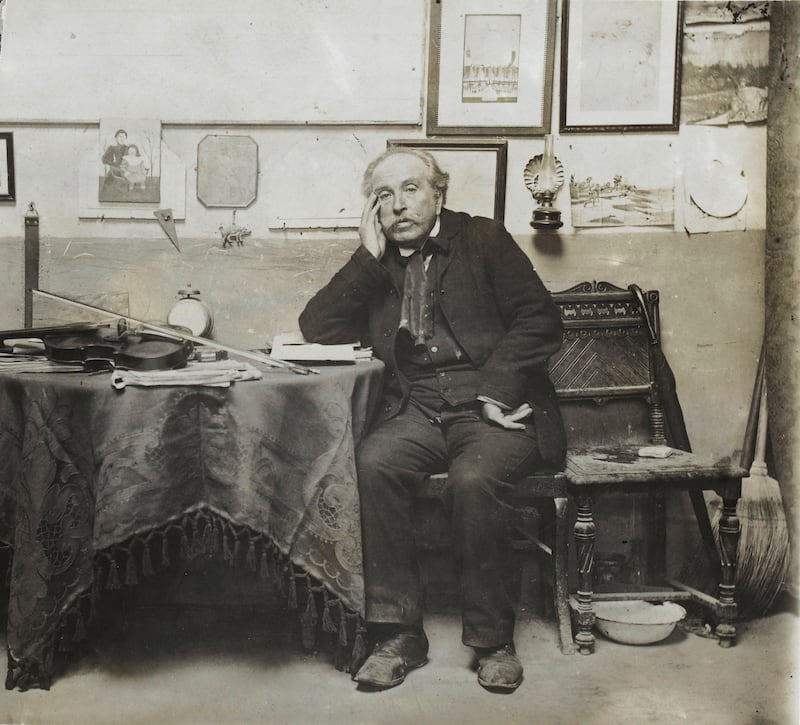 Henri Rousseau: the artist in the 1900s, the final decade of his life. Photograph: Fine Art/Heritage via Getty
Eighteen months later Rousseau’s young friends purchased a plot for him. Constantin Brancusi engraved Apollinaire’s poem on the tombstone: “We salute you / Gentle Rousseau hear us / Delaunay, his wife, Monsieur Queval and me / Let our baggage pass through the gates of heaven duty free / We will bring you paint brushes, colours and canvas”
Prices fetched by Rousseau’s work rose exponentially in the 1920s. Sleeping Gypsy, which had been jeered in 1897, made newspaper headlines by selling at auction for 525,000 francs in 1926, a year after the couturier Jacques Doucet willed Snake Charmer to the Louvre. In 2023 Rousseau’s Flamingoes sold for $37.5 million at Christie’s in New York, putting him in a league with Renoir, Picasso and Matisse.
More than a century after his death, Rousseau’s paintings still have the power to enchant and mystify. Christopher Green, professor emeritus at Courtauld Institute of Art, in London, and the third commissioner of the exhibition, credits Rousseau with changing the very definition of art.
“He created interest in the untaught, which is still there, and very strongly – interest in something that isn’t sophisticated and is obviously not establishment art.”
Henri Rousseau: A Painter’s Ambition is at the Orangerie, in Paris, until July 20th