
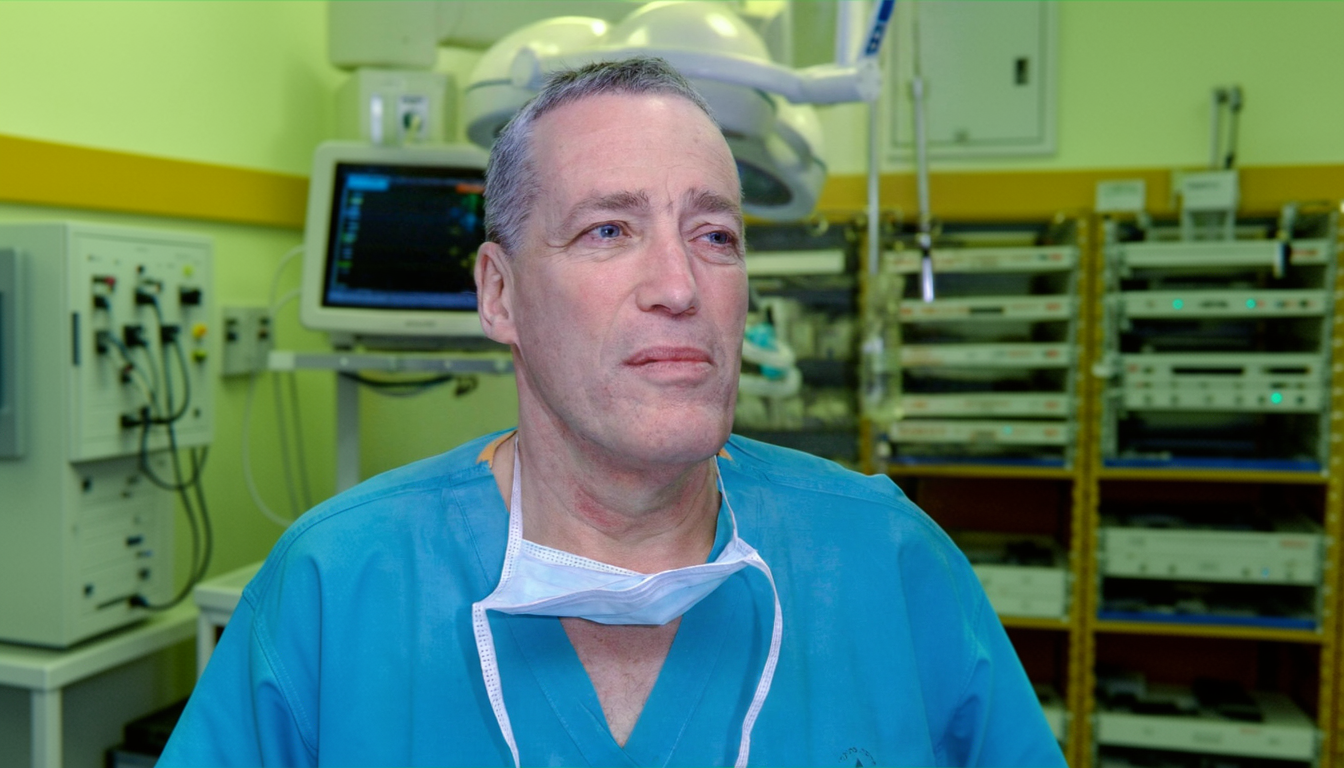
Rivkind is being recognized for founding Israel’s first trauma center, shaping the national trauma system, and saving thousands of lives.
Prof. Avraham “Avi” Rivkind, head of the Department of General Surgery and the Trauma Unit at Hadassah Medical Center in Ein Kerem, has long described his work as a “mission.”
Now, the man who founded Israel’s first trauma unit will be honored with the 2026 Israel Prize for Lifetime Achievement. He is being recognized for founding that trauma center, shaping the national trauma system, and saving thousands of lives.
Rivkind is a “pioneer in developing new medical approaches and tools for saving lives that have become an integral part of the State of Israel’s reality,” the committee said in its announcement.
The Israel Prize is awarded to individuals whose contributions in the realms of culture, education, medicine, science, and society have had a lasting impact on the country. This year, the awards ceremony was prerecorded and will be shown on April 22, Israel Independence Day. The awardees also meet with President Isaac Herzog and Prime Minister Benjamin Netanyahu.
Rivkind graduated from the Hadassah-Hebrew University School of Medicine in 1977 and completed his general surgery residency there. He told The Media Line that he decided to become a surgeon during his residency after a young woman came to the hospital.
She had been beaten by her husband. She first came in complaining of abdominal pain and was sent home. Two days later, she returned, but amid the many patients in the emergency room, she was not seen. The next morning, she was dead. It turned out that she had a lacerated spleen, and her death was preventable.
Rivkind said the team discussed the case and concluded that something was wrong with their behavior. Although he was not involved in the incident, he never forgot it.
We decided we needed to change something, and that’s how I suggested that we look around and find the best trauma units in the world
“We decided we need to change something, and that’s how I suggested that we look around and find the best trauma units in the world,” Rivkind said, and he wanted to see if Israel could emulate them. They looked to the Shock Trauma Unit at the University of Maryland Medical Center.
“Now we can compete with them,” Rivkind said.
The first such trauma room was opened at Hadassah, and similar systems soon spread across the country. Rivkind traveled from the north to the south, helping hospitals establish comparable units. At the time, he could never have envisioned the first and second intifadas, but these rooms became essential during those violent years.
“People were always there,” Rivkind recalled in a phone interview. “I used to say how lucky we were that we had opened these centers to treat the severely injured patients. We opened the trauma centers for road accidents. We did not talk about terror attacks and bus explosions.”
We opened the trauma centers for road accidents. We did not talk about terror attacks and bus explosions.
Alongside building the system, Rivkind also helped shape its guiding protocol. The approach is to do what can be done immediately at the scene and then transfer the patient quickly. The principle, he said, is “right patient, right time, right hospital.” This protocol remains in use to this day.
Today, trauma patients are received directly into the right place in the Trauma Unit. They do not have to wait; the staff is ready for them.
“You are working in order to prevent mortality, to save lives, and to treat life-threatening injuries first,” Rivkind explained, noting that later, other issues the patient is experiencing can be addressed, or they can be transferred to another unit or hospital.
“When the patient is alive, we then discuss what else we have to do,” he said. “Unfortunately, we have gained a lot of experience with this in Israel. The world looks to us.”
Unfortunately, we have gained a lot of experience with this in Israel. The world looks to us.
According to Rivkind, the Israel Defense Forces reduced the mortality rate of injured soldiers by around 50% through these protocols.
Rivkind said that when he received the call from Education Minister Yoav Kisch, he was at work. His staff asked him to take the call, but he assumed it was just another routine conversation. He was surprised to hear that he had been awarded the prize.
The committee, however, described him as an ideal recipient. It said that the doctor “embodies the values of the sanctity of life, love of humanity and the land, and high-quality, equitable public medicine,” stated the Committee.
Rivkind agrees with that characterization. He said he became a doctor to “fight against the death of people,” and specifically, “I have a commitment to this nation and these people.” As the only son of Holocaust survivors, he said he often thinks about the six million Jews who were killed and wants to ensure that no one dies if they can be saved.
“I will always do what I can,” he said, adding that doctors are saving lives and “saving a life is really meaningful.”
I will always do what I can. Saving a life is really meaningful.
For Rivkind, the work never stops. He can be woken up early in the morning or late at night, but he said he never gets tired of doing his job. Being a trauma surgeon, he said, “runs in my blood.” What drives him, he explained, is seeing families reunited.
“It’s a feeling I cannot express,” he told The Media Line.
He recalled, for example, seeing a patient arrive and lose a leg, and then seeing that same patient later walking in rehabilitation. A year or two later, the patient sends photos, married and with children.
“It’s unbelievable,” Rivkind said. “It is filling you up.”
Those moments, he said, are what stay with him. He shared another story from about 30 years ago, during a period when two buses were bombed week after week on Sundays. It was the number 18 bus. A young woman was severely injured in one of those explosions. She suffered blast injuries and was bleeding heavily.
She had serious damage from the blast wave. She was intubated, and her condition was critical.
“We did everything we could,” Rivkind recalled. “At that time, we used a treatment that was still very new, Recombinant factor VIIa, which had only been approved by the FDA for hemophilia. We gave it to her without formal approval, only with the consent of her parents, hoping it would help stop the bleeding. She survived.”
Rivkind remembered that her mother later came in and asked if she could eat. The young woman had problems with her esophagus.
“I went out and bought ice cream. I gave it to her, just to see if she could swallow,” Rivkind recalled with a smile. “You should have seen the look on her face, and on her mother’s face. It is something I will never forget.”
He added, “There are so many stories. Truly, so many.”
Today, in the aftermath of October 7, the country is dealing with many more injured patients. Many have lost limbs or are coping with post-traumatic stress disorder and other long-term effects. When asked how this will impact Israel in the long term, Rivkind focused on the lives that were saved.
People want to help them. It becomes a shared responsibility, and we deal with it together.
“They were in a war. We saved their lives. But saving a life sometimes comes with consequences. People lose a leg, an arm, sometimes both legs,” Rivkind said. “Still, they live with it. They accept it. Even the patients themselves understand this reality. They are not pushed out of society. Society accepts them without hesitation. People want to help them. It becomes a shared responsibility, and we deal with it together.”