
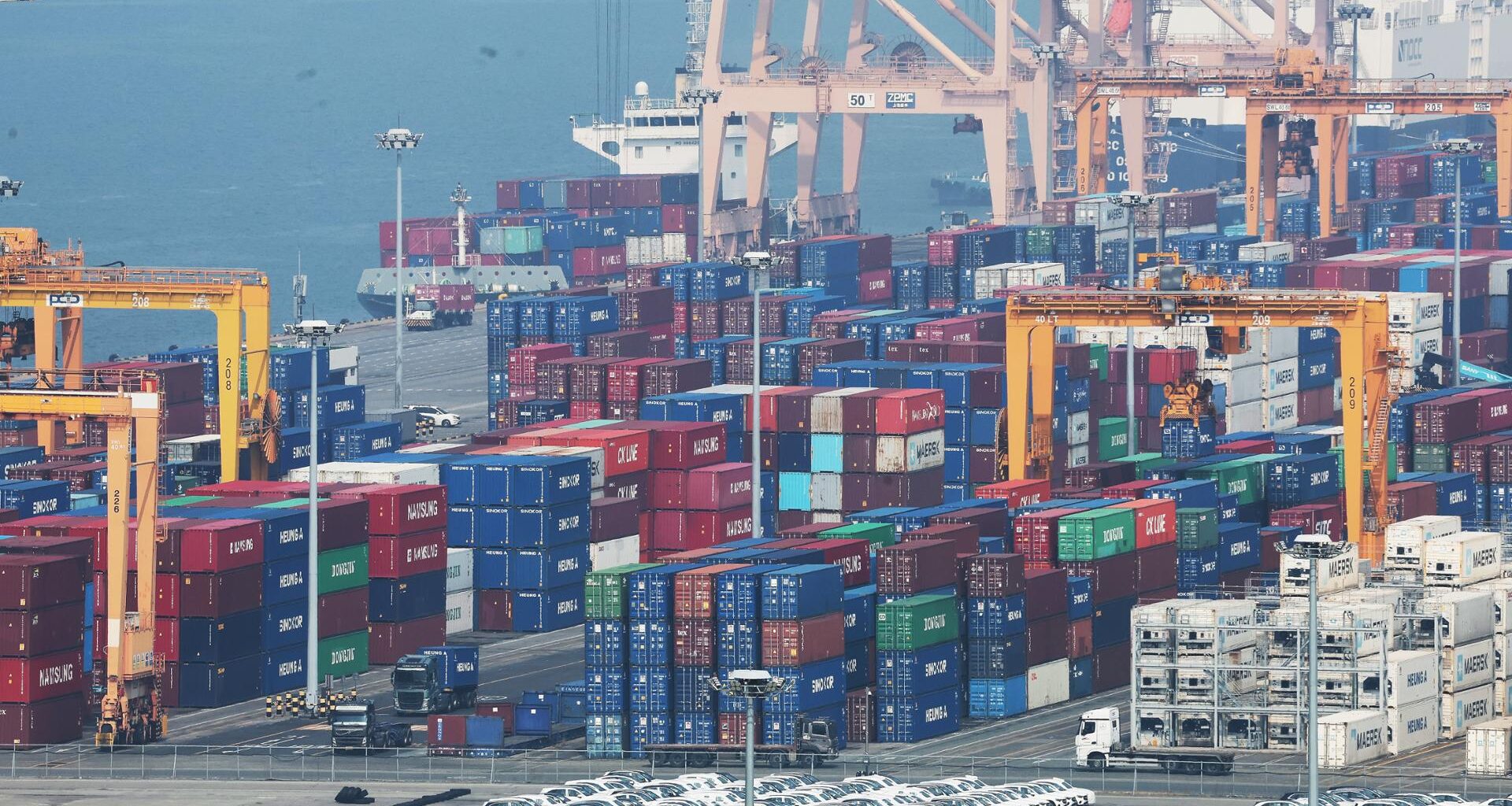
Containers bound for export are stacked at a port in Pyeongtaek, Gyeonggi Province, April 1. Yonhap
Korea’s real gross domestic product (GDP) per capita is expected to trail Taiwan’s by more than $10,000 within five years, according to the International Monetary Fund (IMF).
Having lost its lead over Taiwan for the first time in 22 years last year, Korea is likely to see the gap widen each year, reducing the chances of a reversal.
According to officials of the Bank of Korea and other financial authorities Sunday, the IMF estimated Korea’s GDP per capita at $37,412 this year, up 3.3 percent from $36,227 a year earlier, in its World Economic Outlook released Wednesday.
The global lender expects the country to surpass the $40,000 mark in 2028, reaching $40,695. It had initially projected this milestone for 2029 in its April 2025 report, but brought the timeline forward by one year in its October update and maintained that view in the latest report.
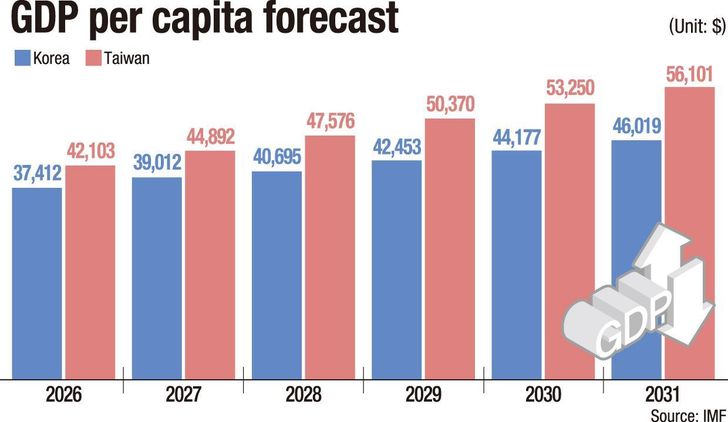
Taiwan is expected to reach the threshold sooner. Its GDP per capita is projected to rise 6.6 percent, from $39,489 last year to $42,103 this year, allowing it to exceed $40,000 ahead of Korea.
Taiwan is also set to maintain strong growth momentum, with GDP per capita projected to surpass $50,000 by 2029.
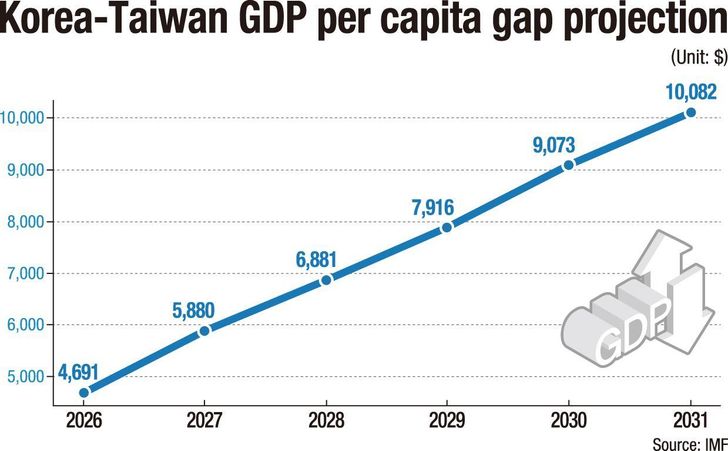
Accordingly, the gap between Korea and Taiwan is estimated to widen steadily, from $4,691 in 2026 to $5,880 in 2027, $6,881 in 2028, $7,916 in 2029 and $9,073 in 2030.
By 2031, Taiwan’s GDP per capita is forecast at $56,101, compared with Korea’s $46,019, pushing the gap beyond $10,000 to $10,082.
In global rankings, Taiwan is expected to climb from 32nd to 30th place, while Korea is projected to slip from 40th to 41st.
Taiwan’s rapid growth is being driven by the global semiconductor supercycle.
Data from the Korea Center for International Finance (KCIF) show that major global investment banks projected Taiwan’s economic growth at an average of 7.1 percent this year as of the end of March, despite geopolitical tensions in the Middle East. Korea, by comparison, is expected to grow in the upper 1 percent range.
KCIF researchers Kim Mi-seung and Lee Chi-hoon attributed Taiwan’s outperformance to strong AI demand, which has reinforced its dominance in the foundry sector. Rising semiconductor exports have fueled facility investment and expanded production capacity, supporting growth.
In a report, they suggested the gap would take time to narrow. “Taiwan’s strength lies in its fully integrated semiconductor ecosystem, enabling a swift response to surging AI demand. Korea, by contrast, still faces challenges in diversifying supply chains and expanding its industrial base,” the report reads.
They warned that Korea’s export structure is becoming increasingly imbalanced, with more than 60 percent of semiconductor shipments concentrated in memory, particularly DRAM.
Park Jung-woo, an economist at Nomura Securities, underscored that Korea must expand its semiconductor and AI ecosystems to sustain growth.
“Financial investment should be strengthened to support the tech sector. Scaling up funding through specialized financial intermediaries focused on venture capital will be key to efficiently channeling capital,” he said.