
Alex Dering | Photo Editor
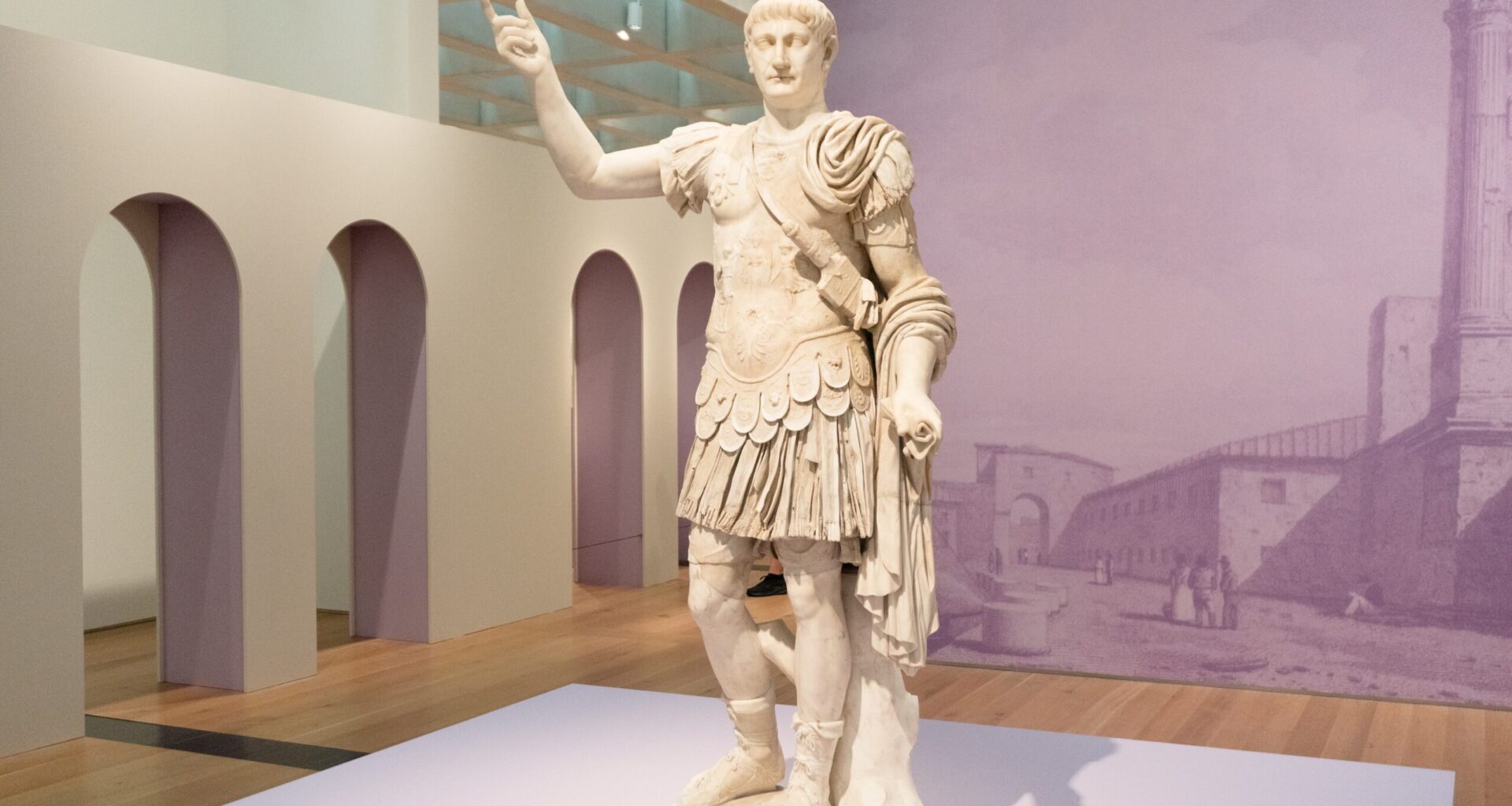
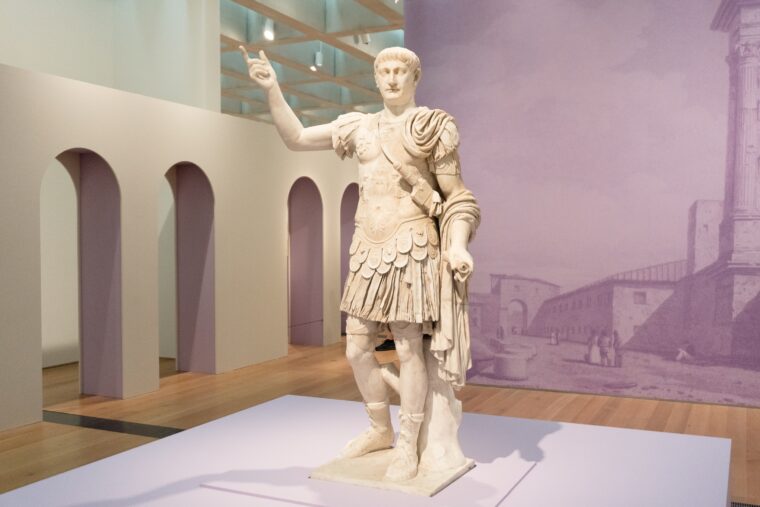
The 7-foot-tall, 2,000-year-old statue of the Roman emperor Trajan, taken from Minturno, is quite an imposing sight. Once, this full-body statue would have been painted in vivid reds, deep purples, bright blues, and other rich hues, but now the pure white cracked marble is unadorned. Though worn with age, lines visible where the statue has been pieced together and sections replaced, the intricate carvings of Minerva and Pallas are clearly visible on Trajan’s cuirass, each individual tassel visible on his skirt, each fold of his paludamentum clearly defined as it drapes over his shoulder and wraps around his left arm.
Appropriately, this statue of Trajan is the first thing viewers see as they enter the Saint Louis Art Museum’s (SLAM) new exhibition, “Ancient Splendor: Roman Art in the Time of Trajan,” which displays various artifacts from Trajan’s reign.
The exhibition follows a carefully crafted loop, designed to guide viewers through the experience in a way that emphasizes the themes of the exhibition and the history behind it. According to Hannah Segrave, an associate curator at SLAM who curated the show, the exhibition is separated into three sections: The first two rooms focus on Trajan and the imperial household, the next few rooms explore the households of everyday Romans during Trajan’s reign, and the final section of the show delves into the public sphere of Roman life, from theater to gladiators, food to shipping, and Roman baths to religious practices.
“Ancient Splendor” is a traveling exhibition and is being shown in only two museums in the US; before making its way to SLAM, the exhibition was shown in The Museum of Fine Arts, Houston in Houston.
The show has been in the works for several years and is a unique exhibition because of the way it came to be. Rather than being organized solely by SLAM, the show was put together by an organization called StArt that specializes in arranging shows on Italian art to send to foreign institutions. The chief curator of “Ancient Splendor” was Lucrezia Ungaro, the now-retired director of the the Museum of Imperial Fora in the Trajan’s Markets.
“She’s really the great expert in Trajan Studies and has worked in Rome and Naples and in these surrounding areas on Trajanic and ancient projects for her whole career. And so, really, it’s thanks to her great expertise and her career of building up these relationships with these very prestigious institutions, that they agreed to be a part of this project,” Segrave said.
Segrave, who started working at SLAM just before the museum took on the exhibition, worked closely with Ungaro on shaping the exhibition, particularly in making it accessible to a St. Louis audience.
“Italians already have such a baseline of knowledge about the ancient Roman world, and we knew that most people in St. Louis might not even know some of the basics,” Segrave said.
Segrave’s main goal in the exhibition was to engage the St. Louis audience in a way that is less serious and dramatic than the way that many Americans tend to view the ancient Romans. She also wants to reflect stories that are easily overlooked: the lives of women and enslaved people and the different aspects of class and labor. She also explained that the exhibition was designed to involve as many senses as possible to further immerse visitors in the art and artifacts.
As part of this immersion, there are several “scent stations” scattered throughout the exhibition. Recent research has revealed that Roman sculptures would not only have been painted in the past, they also were often scented. SLAM wanted to embrace this feature of the original works, but obviously could not scent the sculptures themselves. Instead, they came up with scent stations, places where museumgoers can smell the fragrances that likely would have been on the statue originally while they gaze at the statue itself. In one room, there is also a soundbath, specially commissioned from British artist and musician Chris Cundy.
“He takes ASMR recordings of the actual ancient Roman baths in Bath, in England, and manipulates them and turns them into these musical compositions. … He made this one specifically for us, so this is its world premiere,” Segrave said.
Finally, the last room of the exhibit contains a 3D-printed one-to-one scale replica of a small segment of the Column of Trajan that visitors can touch and interact with directly. The actual Column of Trajan, which is around 120 feet tall, memorializes the Dacian Wars and Trajan’s reign more generally, but since the actual column couldn’t be brought to SLAM, the museum instead made an interactive segment of it.
Trajan ruled the Roman empire from 98 C.E. to 117 C.E. as part of the Nerva-Antonine dynasty, and during his reign, the Roman empire reached its greatest size, enclosing over three million square miles. He invested heavily in the arts and architecture of Rome alongside its military and supported social programs and various building projects, thus earning himself the title of one of the “Five Good Emperors.” Due to his investment in the arts, many sculptures, buildings, and other artifacts remain from his time, many of which are gathered and displayed in Rome.
While four of the sculptures and many of the coins in “Ancient Splendor” come from SLAM, most of the works come from four major Italian institutions: The National Roman Museum, the Archaeological Park and Museums of Ostia Antica, the National Archaeological Museum of Naples, and the Vatican Museums. For many of these pieces, this is the first time they have left Italy.
“It was pretty fun to be able to add the things that we have here in St. Louis into dialogue with their ancient companions,” Segrave said.
Museumgoers start the exhibition with the imperial family, the statue of the emperor Trajan their first view as they walk in. To the side of Trajan is a lineup of imperial busts, featuring Trajan’s sister Marciana, his niece Sabina, and his successor, Hadrian, who married Sabina. Each sculpture reflects a particular message, based on what ideals the imperial family wanted to portray to their people at the time. To some modern art historians, however, the bust of Sabina is the most interesting, as it remarkably retains visible traces of its original pigment.
“Romans really loved this kind of technicolor world. Bright colors, lots of colors. So much of our idea of ancient Rome as being these grand white marble statues is wrapped up in 18th-century values … but really, the Romans loved crazy colors everywhere,” Segrave said.
The next segment of the museum continues on with the introduction to Trajan and his family. On the left side of the room stand two colossal busts of Trajan and his wife, Plotina, while on the right, a collection of tiny coins are on display.
“We have this really fun thing about scale,” Segrave said. “These massive, literally colossal, oversized busts of the deceased and deified emperor and empress versus the tiniest scale that we have in the coins.”
Most of these coins are actually from SLAM’s archives, and according to Segrave, this is the first time many of these coins have been displayed.
The focus of the exhibition then shifts from the imperial household to the overall sphere of domestic life, concentrating particularly on the Roman household as an extension of public duty. The room centers around a segment of mosaic taken from the doorstep of a house in Rome, the setup mimicking the function of the impluvium (atrium) in the traditional Roman house. The design of a Roman house centers around a central open courtyard, so the rectangular mosaic in the center of the floor, illuminated from above as though light is coming through, mirrors this design. The rest of the art is laid out against the walls, surrounding the central mosaic, allowing people to walk around the mosaic as if it was actually an open courtyard.
The Roman household continues on, with a space focused on the convivium, a social ritual focused on dining and general merriment. According to Segrave, the tone of the convivium matched a fresco of a satyr — a follower of Bacchus, god of wine, revelry, and occasionally, madness — shown in the exhibition.
“But, of course, it’s a Roman home, it wasn’t this private space. It was a space for negotium. … This is where you did your duty, your daily business,” Segrave explained. The following room in the show demonstrates the Roman solution to this desire for otium (leisure).
To the Romans, otium mostly took place in one of two locations — the baths or the gardens. The otium space created by SLAM embraces both. The room itself features tiles, fountains, and other paraphernalia of the Roman baths, but the space itself is equally carefully crafted. The layout of the entire exhibition was designed to have the otium space set in a very specific room: one that overlooks both SLAM’s gardens and the original Cass Gilbert building, which is modeled after the Roman Baths of Caracalla.
“We’ve kind of brought a little bit of Rome and St. Louis into contact with each other,” Segrave said.
The otium space is also where Cundy’s soundbath is located. The presence of the soundbath, combined with the gardens outside, blends seamlessly with the ancient remnants of the Roman baths. The combined elements transport museumgoers into an incredible world where the past melds with the present, and one can almost imagine they themselves are standing in the Roman baths of several thousand years ago.
The next room focuses on Roman women, a group whose power and influence were often overlooked. According to Segrave, one reason behind Trajan’s success was credited to his wife, Plotina. She was highly educated, very influential, and was the one who pushed for the social welfare initiatives that were put in place during Trajan’s time.
“She is so influential, she [even] changes laws. It really speaks to this kind of unprecedented moment that at the turn of the 2nd century, when women could have real — oftentimes invisible, but real — power, to shape the public and private social networks, interactions, and in the case of the imperial woman, even laws,” Segrave said.
The last few rooms of the exhibition focus on Roman daily life. The first room is focused on religion, and Segrave pointed out a particular piece of interest along the back wall: a fresco from a community burial site, this one actually bought by a group of freedmen — people who had been enslaved, but upon being freed had become full Roman citizens.
“So little of what survives comes from lower social classes, because the material culture of their lives were things that were much more fleeting — wood and textiles and things like this, and there was a big fire problem in Rome. Everything was just burning constantly,” Segrave explained.
This funerary urn is unique, then, because it is a surviving remnant depicting the lives of the common people.
“It is not quite as elaborate as something like this marvelously carved cinerary urn for the ashes of one wealthy individual, but there’s still this attempt to really honor this communal space for everyone,” Segrave said.
The second-to-last room is split in half, separated by a large statue of the emperor Caligula. Segrave commented that the room embraces the Roman phrase “panem et circenses,” coined by the Roman poet Juvenal in the first century C.E., which means “bread and circuses.” Juvenal meant it as a critique of the Roman people, claiming that all a leader needed to do to curry favor from the people was to give them bread and circuses, which he used to mean more generally, food and entertainment.
“The first half celebrates the circuses, with all of the games that we know and love: the gladiator games that were so popular and made these superstars, but those also went hand in hand with theatrical performances,” Segrave explained. “But, of course, the most important games were the chariot races in Rome, which occurred at the Circus Maximus. Trajan understood how important this space was — he actually enlarged and modernized the Circus Maximus so that it became the largest stadium in antiquity.”
The latter half of the room celebrates the panem, or bread, of bread and circuses. It contains artifacts that represent and explain the process of transporting goods in and out of Rome, particularly grain, and also artifacts used for milling and weighing grain to be portioned out to the people for making bread.
The final room in the exhibition contains the 3D-printed one-to-one scale replica of a piece of the Column of Trajan, as mentioned earlier. However, there is another element to this room, one designed to further bring the St. Louis community into conversation with the Roman Empire. Visitors can draw small designs to add to a communal “column” on the wall of this final room.
“Since Trajan’s column tells the story of the Dacian War, and really tells a collective history of ancient Rome, our visitors are making their own scenes to tell a kind of collective history of St. Louis together,” Segrave said.
The exhibition has also been paired with another small exhibition, called “Visions of Antiquity,” which explores portrayals of ancient Rome by artists in later centuries. “Ancient Splendor: Roman Art in the Time of Trajan” is open through Aug. 16, 2026. Tickets are free every Friday.