
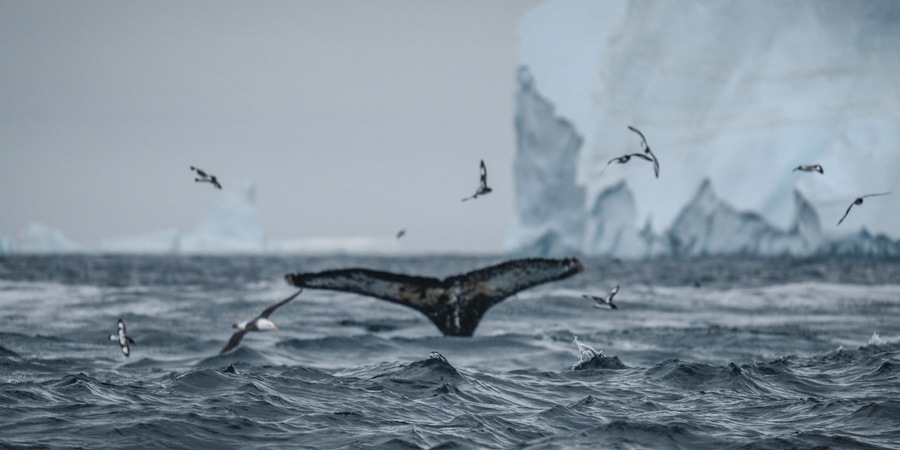
Krill are a keystone species in the Southern Ocean, converting energy captured by phytoplankton into a food source that sustains whales, penguins, seals, and countless other species. When krill populations decline, the entire Antarctic ecosystem is destabilized. Scientific evidence suggests that krill densities around the Antarctic Peninsula — where much of the fishing occurs — may have declined by as much as 80% since the 1970s.
The Sea Shepherd vessel Allankay has just returned from Antarctica, facilitating the work of an independent team of scientists, studying the impact of the krill fishery on whale populations.
Last year, a key conservation measure requiring krill fishing activity to be distributed across a wider geographic area — in order to reduce the risk of localized depletion — was not renewed. As a result, fishing effort has become increasingly concentrated in biodiversity hotspots, accelerating exploitation and intensifying pressure on Antarctic wildlife.
Earlier this month, the Antarctic fur seal was listed as Endangered by the International Union for Conservation of Nature (IUCN), the global authority on extinction risk. Their survival depends on Antarctic krill.
This combination of evidence gathered at sea and sustained advocacy on land is now beginning to shift market forces.
The announcement by Rossmann follows on decisions made by dm and Holland & Barrett, a leading health and wellness retailer in the United Kingdom, that pioneered what has become a movement of retailers exiting the krill space. The company also introduced the Antarctic Krill Pledge together with Sea Shepherd Global — a co-authored call to action encouraging retailers to end sales of all krill-based products.