
Hamas’s Psychological Warfare Against Local Militias and Collaborators in the Gaza StripDownload Since the events…
Since the events of October 7, 2023, Hamas has confronted a formidable domestic challenge: the emergence of local militias and collaborators within Gaza who contest its hegemony and challenge its status as the leading “resistance” force. In response, Hamas has launched a multi-faceted campaign that transcends conventional military action, employing sophisticated psychological and cognitive operations. By leveraging local tribal structures, Hamas seeks to delegitimize its rivals, subvert their narratives, and consolidate its territorial control. This paper examines how Hamas frames the issue of “collaborators” and analyses the psychological mechanisms used to suppress this phenomenon.
The protracted Israeli military campaign in Gaza, which has resulted in the elimination of much of Hamas’s senior political and military leadership over two and a half years, has notably weakened the organization’s grip on the enclave. This power vacuum led to the rise of armed militias seeking to displace Hamas from key positions of influence. Israel largely supports these entities to destabilize Hamas from within, foster a viable governing alternative, prevent the consolidation of anti-Israel armed factions, and gather field intelligence while reducing the need for direct military intervention. On June 5, 2025, Israel officially acknowledged for the first time that it was arming the “People’s Forces” militia, led by Yasser Abu Shabab in Rafah, as part of these efforts.[1]
Currently, four primary militias operate in the Gaza Strip (listed chronologically by their emergence):
The “People’s Forces” Militia (Est. July 2024): Operates primarily in eastern Rafah. Founded by Yasser Abu Shabab and currently led by Ghassan al-Duhayni following Abu Shabab’s assassination
Shouki Abu Nazira’s Militia (Est. November 2024): Active mainly in eastern Deir al-Balah.
Rami Helles’s Militia (Est. May 2025): Centered in eastern Gaza City.
The al-Astal Militia (Est. July 2025): Operates in northern Gaza.
The “People’s Forces of Beit Lahia” (Est. September 2025): Led by Ashraf Muhammad Mahmoud al-Mansi, this group coordinates closely with the “People’s Forces.”
To contextualize Hamas’s psychological operations, this analysis employs the concept of Political Framing. As theorized by Robert Entman, framing involves selecting specific aspects of a perceived reality and making them more salient to promote a particular problem definition, causal interpretation, and moral evaluation.[2] In the Gazan context, Hamas utilizes ‘diagnostic framing’ to identify local militias not as indigenous political actors, but as existential threats to the social fabric. By categorizing these groups through the prism of ‘treason’ and ‘collaboration,’ Hamas constructs a binary moral universe. This strategic communication serves a dual purpose: it justifies the use of extreme violence (such as public executions) as a form of social purification, while simultaneously delegitimizing any potential governing alternative to its rule.
Hamas’s psychological warfare apparatus operates across various digital platforms, primarily leveraging Telegram due to its high level of encryption, lack of regulatory enforcement, and guaranteed anonymity, as well as its user-friendly interface for disseminating audiovisual content. Furthermore, content from Hamas’s Telegram channels frequently migrates to broader social media networks and traditional media outlets, thereby achieving significantly greater exposure. Beyond Telegram, Hamas utilizes WhatsApp, Instagram, TikTok, Facebook, and X (formerly Twitter), alongside web domains that are not necessarily officially affiliated with the movement, such as the Palestinian Information Center (palinfo.com). Within the framework of its psychological operations, Hamas employs aesthetically designed banners to frame political and military messaging, cultivate an image of governance and stability, and exert cognitive influence over both domestic adversaries and the Gazan public.
Hamas’s strategic campaigns target four primary audiences: First, the Palestinian population in the Gaza Strip and the West Bank, with the objective of projecting a ‘victory narrative’ and deterring internal subversion and rival factions. Second, the Muslim world, aiming to consolidate Hamas’s image as a vanguard of Islamic resistance against Israel, thereby mobilizing popular pressure on regional decision-makers to adopt more confrontational policies toward the State of Israel. Third, Western public opinion seeks to portray Hamas as a movement combatting oppression, social injustice, and colonialist schemes, while highlighting Israeli subversion to isolate Israel in the international arena. Fourth, the Israeli public, intending to project a facade of triumph despite Hamas’s military inferiority, and to sow demoralization and fear within the civilian population.
In March 2024, five months after the outbreak of the war between Israel and Hamas in Gaza, the latter established the Sahm (Arrow) unit. Its primary objectives were to enforce authority over the local population, regulate market prices, prosecute thieves, and execute individuals accused of collaborating with Israel. Subsequently, in June 2025, Hamas formed an additional unit named Rad‘a (Deterrence), which serves as the enforcement arm of the ‘Resistance Security’ in the Gaza Strip, specifically focusing on neutralizing Israeli collaborators.
Following the implementation of the ceasefire agreement between Hamas and Israel on October 10, 2025, the organization intensified its efforts to address this challenge, moving beyond kinetic measures such as assassinations and executions to include sophisticated psychological warfare. The following sections outline the prominent themes in Hamas’s campaign against local militias, as derived from a thematic analysis of its three primary Telegram channels: Rad‘a, al-Hares, and Imsak Amil:
Outlining the “Archetype of the Gazan Traitor”: This theme emphasizes a moral vacuum and a preference for materialism. For instance, Hamas cites the primary motivations for joining hostile militias as a cover for collaborating with Israel, a pursuit of material gain, and personal vendettas.[3]
Accusing Militias of Crimes Against Gazan Residents: Hamas alleges that these militias carry out criminal acts against the local population, such as burning agricultural lands with Israeli backing.[4]
The Inevitable Death of the Collaborator: According to Hamas, Israel exploits these militias for its own interests and will not come to their aid in times of distress. Members of these militias are portrayed as destined to meet their deaths at the hands of Hamas, sooner or later. For example, the death of Yasser Abu Shabab—reportedly killed by one of his own associates—is framed as definitive proof that Israel abandoned him (see image below).[5]
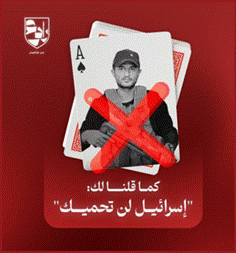


From right to left: Against the background of Yasser Abu Shabab’s photograph: “As we have told you: Israel will never protect you.”; “The inevitable fate of every traitor.”; “With our own hands, we shall reach you, collaborators.”
Increasing Fractures Within the Militias: Hamas emphasizes internal tensions and the accelerating disintegration of these groups. As an illustrative example, Hamas cited an incident involving the attempted execution of a militia member who had sought to defect.[6]
Calls for Defection and “Repentance”: As part of its efforts to encourage militia members to abandon their activities and cease cooperation, Hamas announced a designated ten-day grace period. During this window, individuals were urged to leave the militias in exchange for a formal amnesty granted by Hamas.[7]


From right to left: “Opening the door to repentance; 9 days remaining.”; “Admitting a mistake is an act of courage; there is no time to wait—two days left, and time is running out.”
Militias as Israeli Proxies: Hamas asserts that by mobilizing these groups, Israel seeks to achieve three primary objectives: reducing its own military casualties through the use of proxies for assassinations and security sweeps; gathering intelligence and expanding the IDF’s target bank; and executing high-risk security missions such as assassinations, abductions, locating Hamas weapon caches and ambush sites, clearing booby-trapped buildings, and conducting tactical security screenings.[8]
Demonstrating Hamas’s Intelligence Penetration and Counter-Recruitment Capabilities: On February 18, 2026, Hamas announced the successful exposure of a Gazan female agent recruited by an Israeli officer in February 2024. Her alleged mission was to collect intelligence and “entrap” specific individuals. According to the report, her tasks included entering tents and homes under the pretext of seeking aid in order to conduct surveillance, verify the identities of those present, and deliver miniaturized technical equipment.[9]

A banner titled “Confessions of a Collaborator, “disseminated via Hamas-affiliated Telegram channels as part of its psychological operations.”
Encouraging the Surrender of Israeli Collaborators: The Hamas-affiliated Telegram channel Imsak Amil (“Catch a Collaborator”) disseminates photographs of Gazan residents suspected of collaborating with Israel. These publications explicitly call upon local clans (Hamulas) and Gazan civilians to apprehend these individuals and hand them over to Hamas authorities

Image of a Gazan resident [face blurred by the author] disseminated via the Hamas-affiliated Telegram channel “Catch a Collaborator” (Imsak Amil).[10]
Heightening Vigilance and Awareness of Israeli Recruitment Efforts: Hamas consistently disseminates guidelines and safety protocols to Gazan residents on avoiding the disclosure of intelligence to Israel, reporting collaborators to Hamas authorities, and the secure use of mobile devices and social media. For instance, Hamas published a banner titled “What should you do if someone contacts you and asks about a resistance operative?” According to these instructions, no information regarding the location of an operative or their family should be disclosed, and the operative or their associates must be notified of the communication.[11] In another banner, Hamas provides recommendations on how to resist the “enemy’s temptations” to commit treason, such as advising against returning calls from unidentified numbers.[12]


A banner providing instructions on counteracting Israeli recruitment efforts, titled: “How Shall We Confront Attempts to Lure [Citizens] into the Mire of Treason?”; A banner warning against disclosing details regarding the locations of resistance operatives and their families to Israeli agents.
Hamas strives to present Palestinian society in Gaza as a unified front centered around the concept of “Resistance” under its leadership. Consequently, it attaches significant importance to tribes and clans (Hamulas) as mechanisms capable of ensuring order and security, and as tools for consolidating its own legitimacy. Researcher Dag Tuastad has noted that Hamas views tribalism in Gaza not merely as a threat, but as a strategic asset in building social legitimacy and preventing widespread popular opposition, despite the blockade and ongoing economic crises.[13] As early as 2008, Hamas established the “General Administration for Clan Affairs and Social Reconciliation”—an expression of its perception of clans as political and social partners rather than mere subjects. Hamas leaders, such as Ismail Haniyeh, frequently commented on the vital role of Gazan clans in maintaining national unity, standing firm against Israeli aggression, and ensuring personal security.[14] Furthermore, Hamas enjoys a degree of support among certain Bedouin tribes in Jordan, such as the al-Huwaitat tribe, driven in part by the Al-Aqsa issue and the advocacy efforts of the Muslim Brotherhood in Jordan.[15] Hamas seeks to exploit its influence and the kinship ties between certain Jordanian Bedouin tribes and clans in Gaza and the West Bank to deter clan members in the Palestinian territories from collaborating with Israel.
The following are three representative examples illustrating Hamas’s utilization of clans as tools for deterrence and for combating local militias:
On December 9, 2025, the al-Duhaini clan in Jordan and the Palestinian territories issued a statement condemning the collaboration of several of its members with Israel against Hamas. According to the announcement, following consultations among its elders, the clan decided to disavow the activities of four of its members, revoke their tribal protection, and expel them from the clan. These measures were taken in response to actions that deviated from established tribal norms—namely, leading a militant line that serves Israeli interests. The clan stated that this decision was intended not only to preserve its reputation but also to deter others from adopting similar policies.[16]

An official document issued by the al-Duhaini clan, detailing its decision to revoke tribal protection from four of its members and expel them from the clan.
In February 2024, Ala’ al-Din al-Aklouk, head of the “General Administration for Clan Affairs and Social Reconciliation,” described Ghassan al-Duhaini and his militia members as traitors and mercenaries acting against their own people in an interview with the Qatari news outlet Al-Jazeera. Al-Aklouk emphasized that their fate would be identical to that of previous collaborators who were punished for their actions. He asserted that while the Gazan public is aware of the potential for internal instability caused by such activities, these efforts are destined to fail. According to al-Aklouk, this failure is guaranteed by the tribal structure in Gaza, the resolute stance of the clans against chaos, the inherent resilience of Palestinian society, and the lack of a genuine social foundation for these militias, as evidenced by the social ostracism of their members by their own families and tribes.[17]
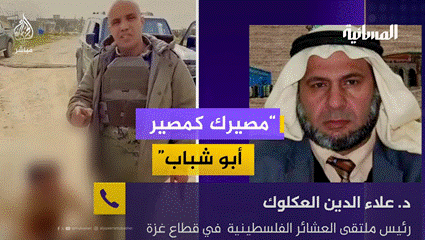
Ala’ al-Din al-Aklouk, head of the “General Administration for Clan Affairs and Social Reconciliation,” sharply criticizes the activities of Ghassan al-Duhaini’s militia in an interview with the Qatari channel Al-Jazeera.
A former Fatah intelligence officer reveals that Hamas is working to counter rogue groups opposing its authority by exerting tribal pressure on their members. According to his account, Hamas coerced the re-establishment of the “al-Astal Clan Council” in April 2026, partly to ensure the publication of statements aligned with Hamas’s interests and policies. He further noted that this trend was prominent during the tenure of Yahya Sinwar, who sought tribal assistance to legitimize his organization’s agenda.[18] In other words, Fatah supporters argue that Hamas seeks to create a false impression of authentic tribal backing, as seen in the case of the al-Astal clan, despite many of its members being armed militants who oppose Hamas.
The logo of the al-Astal Clan Council, re-established on April 7, allegedly under Hamas coercion, according to a former Fatah intelligence officer.[19]
Qatar as a Reinforcement Actor in Psychological Warfare Qatar presents itself as a neutral mediator between Israel and Hamas, emphasizing that its support is directed solely toward the Palestinian people through authorized humanitarian aid. However, it appears to be engaging in a “double game,” simultaneously hosting senior Hamas officials and facilitating the transfer of significant funds to Gaza—actions that raise questions regarding its true neutrality. Qatar’s media outlets also contribute to Hamas’s psychological warfare against Palestinian collaborators in Gaza. On February 6, 2026, the Al-Jazeera network broadcast a program praising Hamas’s success in intelligence penetration of collaborator militias. For example, the channel aired exclusive footage provided by Hamas from body cameras worn by Gazan collaborators during missions. The intended message was clear: Hamas is aware of the identities of militia members and is capable of constructing a comprehensive intelligence picture of these collaborators. Furthermore, the network portrays Israel as an opportunistic actor that exploits militia members for various missions only to abandon them once the task is completed or compromised. In one instance, a video was shown documenting a collaborator who found himself in distress on the ground and was ultimately captured by Hamas personnel without any Israeli intervention. Throughout the program, collaborators are depicted in a negative light—as individuals lured by food, cigarettes, and false promises in exchange for their services.[20]
In another broadcast, Al-Jazeera noted that Israel utilizes collaborators to operate within the “Yellow Line” (contested zones) to avoid exposing the Israeli military to risks, create a false impression of internal Palestinian conflict, and maintain its formal commitment to the ceasefire agreement.[21]
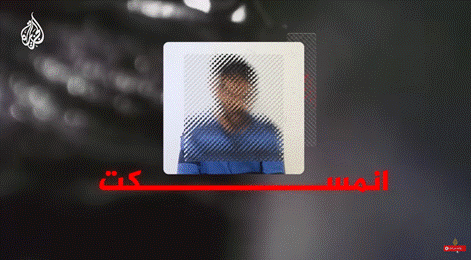
One of the alleged Gazan collaborators captured by Hamas personnel, as broadcast on the Al-Jazeera network.
Senior officials within the Palestinian Authority (PA) have leveled harsh criticism against Hamas, accusing it of causing the destruction of Gaza, sacrificing the Palestinian people to serve its own interests, and committing crimes against Gazan residents, including arbitrary extrajudicial executions. The office of PA President Mahmoud Abbas issued a strong condemnation, emphasizing that these actions constitute “a crime and a blatant violation of human rights, as well as a severe assault on the principle of the rule of law. It reflects the movement’s persistence in imposing its authority through force and terror, while our people in Gaza suffer profound agony due to war, destruction, and the blockade.”[22] Similarly, a Fatah spokesperson condemned Hamas, noting that while its efforts to enforce order and deter looters by force might have been understood prior to the ceasefire, there is now no justification for the execution of dozens of Gazans. He further accused Hamas of deepening internal divisions.[23] The PA-affiliated daily Al-Hayat al-Jadida published an editorial on October 16 comparing Hamas’s executions to those of ISIS: “Hamas militias have carried out a new massacre through ISIS-style executions, in open and blatant violation of human rights and the rule of law. Its victims are dozens of civilians from the wounded Gaza Strip […]”.[24]

The editorial of the PA-affiliated daily Al-Hayat al-Jadida, which compared Hamas to ISIS regarding its [practice of] executions.
In summary, the proliferation of local militias in the Gaza Strip represents one of the most significant threats to Hamas’s governance in the “day after” it loses its primary sovereign assets. Hamas does not rely solely on military force (via the Sahm and Rada’ units); rather, it conducts a large-scale psychological campaign aimed at the total delegitimization of its domestic rivals. By framing these militias as unprincipled entities—driven by material interests and acting as Israeli “subcontractors”—Hamas successfully maintains the narrative of “pure resistance” in contrast to “ignoble treason.”
The manipulative use of the tribal structure, alongside the pressure exerted on clans to disavow their rogue members, demonstrates Hamas’s understanding that its political survival depends on social legitimacy as much as it does on firepower. Media support from Qatar complements this strategy by fostering a perception that Hamas is always one step ahead of the collaborators. The resulting conclusion is that any alternative governing authority in Gaza will have to contend not only with Hamas’s military branches but also with a well-oiled ideological and tribal apparatus deeply rooted in Gazan society—one that denounces any attempt at cooperation with Israel as a moral and national deviation.
[1] “Former Senior ISA (Shin Bet) Official: The Abu Shabab Militia operated as a fully functional Israeli unit,” [in Hebrew], Maariv, December 6, 2025.
[2] Robert M. Entman, “Framing: Toward Clarification of a Fractured Paradigm,” Journal of Communication 43, no. 4, 1993, pp.51-58.
[3] Telegram, January 22, 2026.
[4] Telegram, April 11, 2026.
[5] Telegram, February 7, 2026.
[6] Telegram, April 4, 2026.
[7] Telegram, December 13, 2025.
[8] Telegram, January 23, 2026.
[9] Telegram, February 18, 2026.
[10] Telegram, April 12, 2026.
[11] Telegram, March 1, 2026.
[12] Telegram, March 5, 2026.
[13] Dag Tuastad, “Hamas and the Clans: from Islamisation of Tribalism to Tribalization of Islamism?”, Third World Thematics: A TWQ Journal, Volume 6, Issue 1-3, 2021, pp. 88-104.
[14] See, for example: @aljazeeramubasher, “Meeting of Ismail Haniyeh, Head of Hamas’s Political Bureau, with Clan Leaders, Notables, and Mukhtars in Gaza,” YouTube, December 26, 2017. https://www.youtube.com/watch?v=hx1S02CsE4I
[15] See: Michael Barak, “Is Jordan an Emerging Iranian Anti-Israel Attrition Front?”, ICT, October 8, 2024. https://ict.org.il/is-jordan-an-emerging-iranian-anti-israel-attrition-front/
[16] @paldf, X, January 26, 2026. https://x.com/paldf/status/2014566724822032536
[17] “Head of the Tribal Forum in Gaza Threatens al-Duhaini: Your Fate Will Be Like That of ‘Abu Shabab’,” Al-Jazeera, February 1, 2026. https://www.youtube.com/watch?v=-e-Wrjt38s8
[18] Telegram, April 9, 2026.
[19] During the establishment of the al-Astal Clan Council, representatives from 26 out of 30 clan branches were approved as members of the General Assembly; the remaining four branches, according to the council’s statement, are to be officially incorporated in the near future. @elastalfamily, Facebook, April 7, 2026. https://tinyurl.com/4t8s8bvz
[20] “Al-Jazeera Special Investigation with Tamer Al-Misshal Reveals How Israel Recruits Its Agents in the Gaza Strip” [Arabic], Al-Jazeera, February 26, 2026. https://www.youtube.com/watch?v=TrQjTSsJ6vk
[21] “For These Reasons, Israel Uses Collaborators to Assassinate Resistance Leaders in Gaza” [Arabic], Al-Jazeera, February 6, 2026. https://www.aljazeera.net/politics/2026/2/6/خبراء-لهذه-الأسباب-تستخدم-إسرائيل
[22] “The Palestinian Presidency: We Strongly Condemn the Execution of Civilians in Gaza by Hamas ‘Outside the Legal Framework’” [Arabic], Asharq Al-Awsat, October 14, 2025.
[23] @AlHadath, “Fatah to Al-Hadath: Field executions carried out in the Gaza Strip are a “trap” for Hamas”, YouTube, October 18, 2025. https://www.youtube.com/watch?v=_-pqdXod-Gc
[24] “National and Legal Condemnation of Hamas’s Executions,” [Arabic], Al-Hayat, October 16, 2025, p. 7. https://pdf.alhaya.ps/pdf/2025/10/16/page7.pdf