
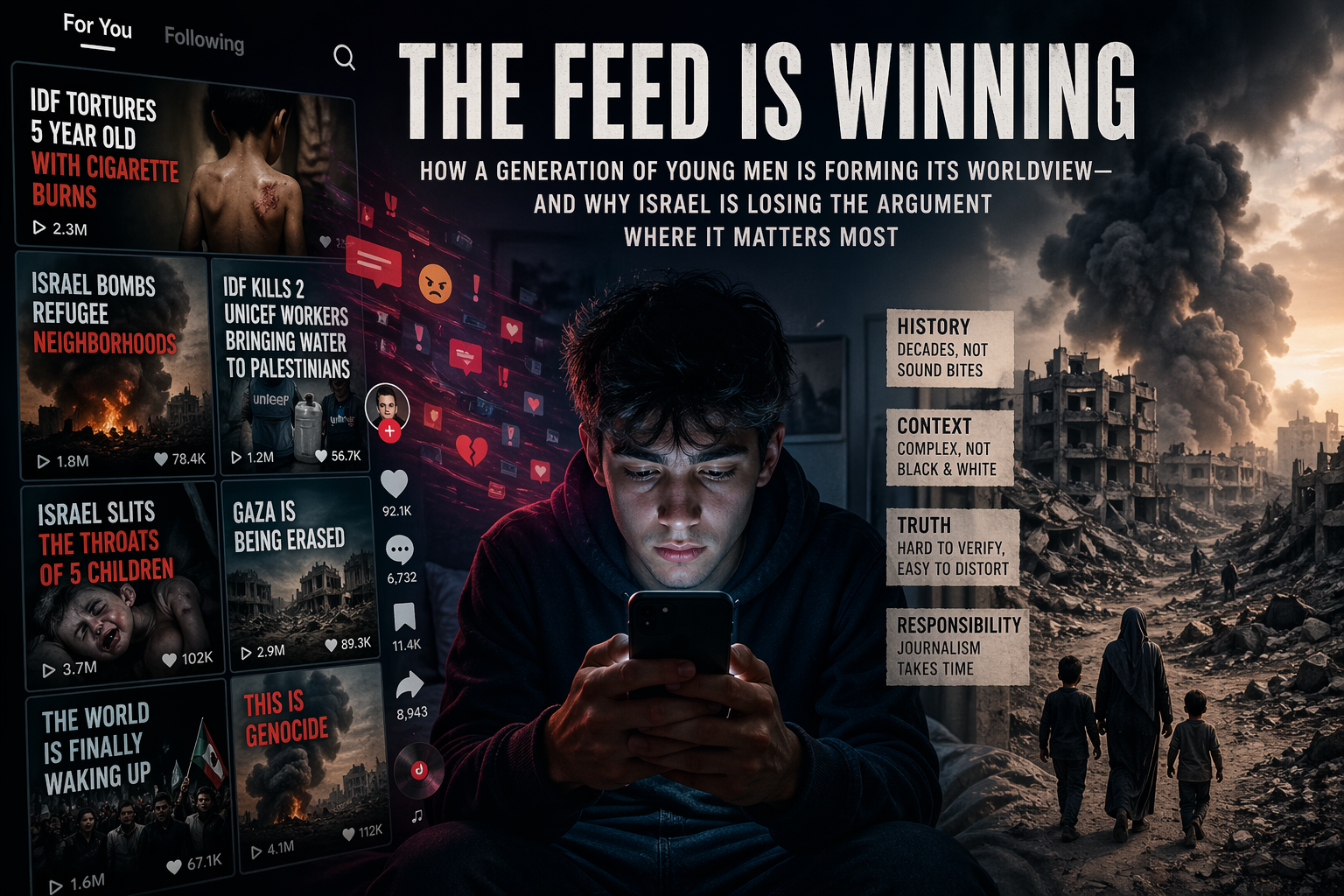
Over the past week, I stepped outside my usual media habits and into a different information ecosystem, one that a growing share of younger Americans, especially young men, experience every day.
What I found wasn’t just a different set of opinions. It was a different way of constructing reality. So, I have constructed a two part series.
Part I is about the experience: what the feed looks like, how it feels, and what it does to your perception in real time.
Part II is about what it means: who it’s shaping, how it intersects with broader cultural currents, and why it matters for Israel and the Jewish community.
Part I
My media diet, at least on paper, is exactly what you’d prescribe if you were trying to stay informed without losing your mind. I read widely on Substack. I subscribe to writers I respect, disagree with, learn from. I listen to long-form podcasts that go deep instead of wide and conversations that actually take the time to wrestle with complexity instead of flattening it.
And yes, every evening, I turn on MSNBC and CNN and get exactly what I expect: a panel of very serious people explaining the world to me, interrupted every six minutes by ads for medications I didn’t know I needed but apparently qualify for simply by continuing to breathe past 60. It’s less a commercial break and more a gentle reminder of the target demographic.
I’ll usually time it for Ari Melber. He’s thoughtful, measured, and, in a media environment that increasingly rewards heat over light, still trying to do something resembling journalism.
In other words, I’m not exactly wandering the information desert. And yet, the more I’ve thought about it, the more I’ve had to admit something slightly unsettling: I’m a mainstream media dinosaur and I am clearly not living in the same media universe as a 22-year-old man trying to make sense of the world right now. Not even close.
Because while I’m reading essays and listening to hour-long conversations, he’s scrolling. On TikTok. On YouTube. On Twitch. Through a constant stream of voices that don’t just report events, they interpret them, instantly, emotionally, and with absolute confidence.
And if I’m being honest, I don’t really know what he’s seeing. I can tell you how the war in Gaza is being framed in the outlets I trust. I can walk you through the arguments, the history, the competing narratives. But if you ask me what shows up in his feed when Israel, Iran, or Gaza starts trending, I’m guessing. And that feels like a problem.
So I tried something simple.
I set up a brand new account on TikTok as a 22 year old male. A clean and blank slate for the algorithm. Then, I searched “Israel Gaza,” and started watching.
OMG.
The first clip I opened didn’t ease me in. It was a video claiming that the IDF had tortured a five-year-old with cigarette burns. No sourcing. No attribution. No context. Just a conclusion, delivered with absolute certainty.
Swipe.
The next few clips were already dialed to eleven. Bombs falling, buildings collapsing, entire blocks reduced to dust. No introduction. No context. Just devastation, presented as self-explanatory.
Swipe.
Another clip. A voiceover, calm but certain, accusing Israel of atrocities that would be difficult to process even in a full investigative report—let alone in 30 seconds.
Swipe.
Then the talking heads start to appear. A face on screen, speaking directly to the camera, walking through what supposedly just happened—an airstrike, a convoy, aid workers caught in the middle. The details sound specific. The tone is authoritative. But the sourcing is invisible. You’re not shown where the information comes from, only what it means.
Swipe.
More destruction. More certainty. More explanations that arrive fully formed. You don’t have time to question them. The next video is already loading.
Swipe.
At some point, you stop trying to verify anything. You’re not given the space to. What you’re given instead is a rhythm, a steady, uninterrupted flow of images and assertions that all point in the same direction. And then, almost unexpectedly, something different.
A clip of Anderson Cooper interviewing Rachel Goldberg-Polin. It’s emotional. Grounded. Human in a way that feels familiar if you’re used to traditional media. For a moment, the tone shifts. And then it’s gone.
Swipe.
Back to the feed. Back to certainty. Back to devastation. Back to a narrative that doesn’t ask you to think so much as to absorb. It didn’t feel like I was being presented with a range of perspectives. It felt like I was being pulled, quickly and efficiently, toward a conclusion. And the most striking part wasn’t any single claim. It was how consistent the direction was.
If I had stopped there, I wouldn’t have walked away with questions. I would have walked away with a conclusion: that Israel is not a country navigating a complex war, but a force defined almost entirely by the harm it inflicts, and doing so with apparent intent.
And I didn’t arrive at that conclusion through analysis. I arrived at it through repetition. I didn’t have to go looking for the most extreme content. The algorithm brought it to me, quickly, consistently, and without asking if I was ready for it.
I used to think TikTok and the like were mostly harmless—cat videos, recipes, the occasional time-wasting scroll. After twenty minutes in that feed, that view feels almost naive. It’s not just delivering content. It’s rewiring attention. Rewarding speed over depth, emotion over analysis, certainty over doubt. And that doesn’t just shape opinions about Israel. It shapes how a generation processes reality itself.
The algorithm doesn’t just decide what you see. It quietly teaches you how to see. And this is where the shift really happens. For older generations, credibility was institutional: newspapers, networks, experts, science, and intellectuals.
For younger audiences, credibility is personal. Does this person feel real? Do they sound like they believe what they’re saying? Do they speak with confidence, even if it’s misplaced?
Authenticity has become the new authority. Or at least, the performance of it. A creator speaking into a webcam, reacting in real time, occasionally stumbling over their words, that reads as honest. But a polished segment with a teleprompter and a producer, that reads as managed. Even when the underlying information is stronger.
So the hierarchy flips:
Unfiltered beats edited
Confident beats careful
Relatable beats credentialed
Which means someone can be wrong in substance and still win in trust because they feel authentic in delivery.
There’s a natural instinct to ask whether all of this is cause or effect. Whether platforms like TikTok are shaping these views or simply reflecting them. The answer is probably both. The feed doesn’t create sentiment out of nothing. It surfaces what already resonates, what people respond to, what they’re willing to watch all the way through.
But once it finds that signal, it doesn’t just reflect it. It amplifies it. Repeats it. Refines it. Until what may have started as one perspective among many begins to feel like the only perspective that exists.
At that point, it’s no longer a mirror. It’s an engine. And engines don’t just reflect direction. They accelerate it.
At some point, the question shifts. It’s no longer just what people are seeing. It’s what that experience is doing to them. Because once you understand how the feed works, how it shapes attention, how it rewards certainty, how it turns repetition into belief, you start to see something else.
This isn’t just about information. It’s about orientation. And the people most immersed in this system aren’t just forming opinions. They’re forming identities. They’re forming ways of understanding who they are, what they stand for, and where they fit in the world.
That’s where this really starts to matter.
And that’s where we’ll pick up next time.