
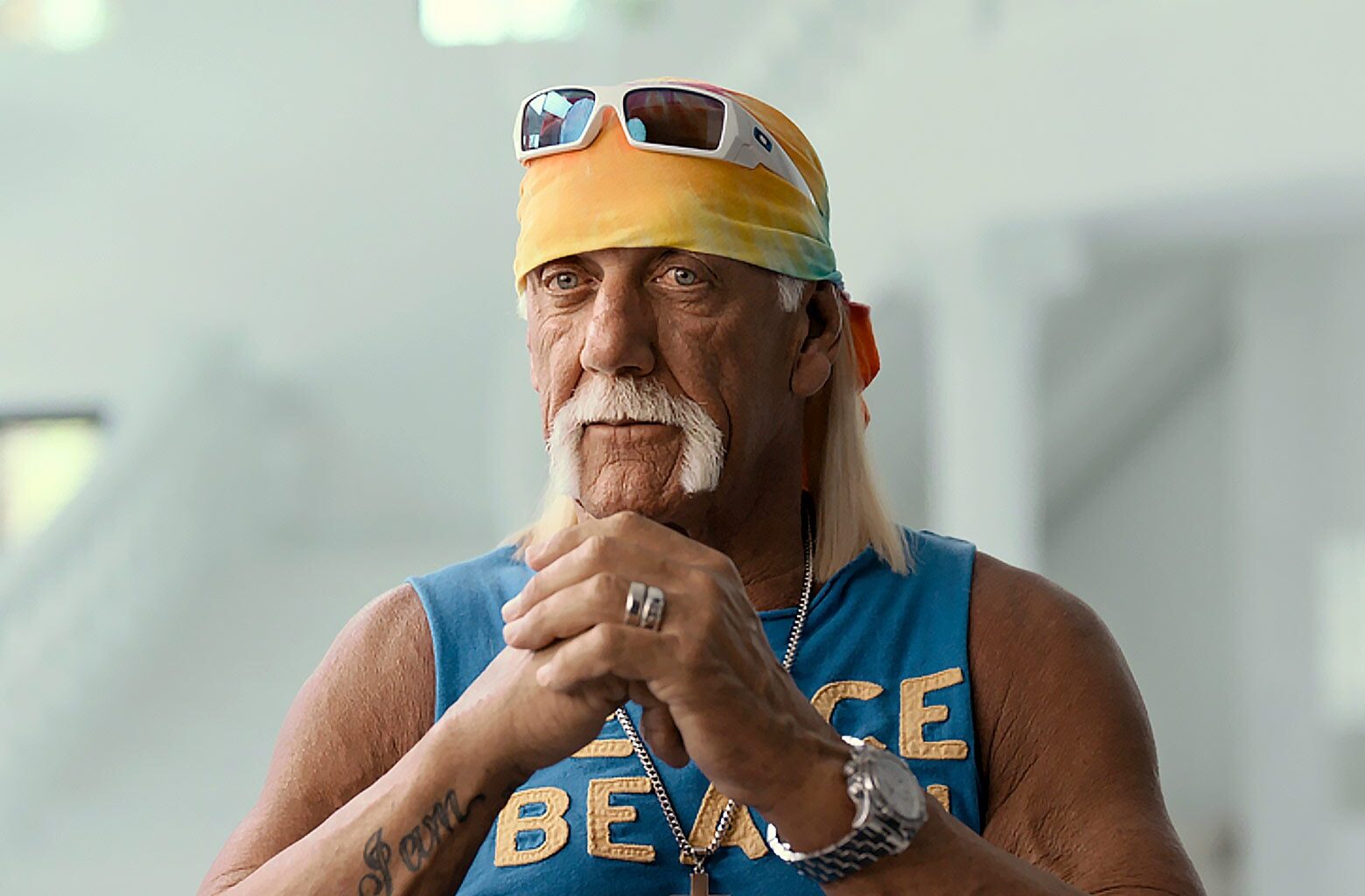
The fourth and final episode of Netflix’s documentary miniseries Hulk Hogan: Real American opens with Werner Herzog, an avowed WWE fan, opining about the spandexed simulacrum that is pro wrestling. The series chronicles the life and times of Hogan with a cast of jowly wrestling legends—their bodies depleted after too many suplexes—reminiscing about the good old days. Herzog, then, is a bit of an outlier. He’s here to provide a narrative rudder for a story rife with contradictions, applying the barest scaffolding to a messy biography. “All of us in a way have a performative life,” he says, in his unmistakable Bavarian accent. “It’s part of human nature, of the human experience.”
That monologue is delivered over footage of a weary Hulk Hogan, standing in front of an iPhone camera, recording what appears to be promotional videos for his Florida restaurant, Hulk’s Hangout. The Hulkster puffs up as best he can—achieving some small fraction of his 1980s figure—proclaiming his excitement for the week’s social calendar, headlined by something called “Main Event Karaoke.” Afterward, Hogan slowly deflates back into a sullen old man, who, minutes earlier, we watched hobble around his gym, hips teetering side to side, his broken knees supported by a tall, Moses-ish walking staff. The intimation here is obvious. Real American wishes to peel the shtick off Hogan, diving deep into the psychology of an icon who has blended his corporeal existence with the unreality of pro wrestling to the point that no distance remains between the two. It’s a noble ambition, but given the slipperiness of the man born Terry Bollea, to say nothing of the usual meddling that comes with any authorized documentary, Real American was doomed from the start.
Who is Hulk Hogan? Like every other pro wrestler on the planet, he is, at his core, a fabulist. You can’t really blame him. That’s the job. During the heights of Hulkamania, in the mid-1980s, Hogan lived the life of a superhero. He tore off of his red tank top with his bare hands, exposing a godlike physique, setting packed stadiums ablaze. He struck action-figure poses, smothered in baby oil and with sweat dripping from his horseshoe mustache, fending off an endless procession of villains. Hogan won every fight, the living embodiment of American exceptionalism. He became encoded into the essential grammar of pop culture, and effectively synonymous with his own sport. Few have lived a life as rare as his.
Hogan sat for his interview for Real American in early 2025, months before he died of a heart attack at the age of 71. By then, Hogan had been telling his story for long enough that all of its artifice and self-aggrandizing overreaches—the subtle ways that Hogan has shaded the narrative—had ossified into canon. Any documentary setting out to crack the concrete of Hogan’s mythos would need to probe the paradox inherent in the man’s self-image. But Real American was co-produced by the WWE, and Netflix is only a year removed from inking a massive deal to bring the company’s flagship television product, WWE Raw, to the streamer’s catalog. With those conflicting interests in hand, I wasn’t surprised to learn that the series was either too compromised, or too reticent, to really tug on those threads. Hogan, as he always managed to do, took full advantage.
Real American is positioned as a coda, and as such, it relies heavily on Hogan’s personal bravado. The first three episodes largely focus on the man’s career in the ring, where disbelief is permanently suspended. As a longtime consumer of Hogan’s many embellishments, I immediately identified a few classics. He gestures toward the specious idea that during WrestleMania III’s main event between him and Andre the Giant—perhaps the most iconic wrestling match of all time—he feared that Andre would go off-script, beating him up for real, thus claiming the title for himself. (Hogan has spun this yarn on numerous occasions. It comes off as an attempt to inject belated drama into the soap opera of pro wrestling, now that the cat is out of the bag.) Hogan says something similar about his famous showdown with the Iron Sheik: He claims that, feeling a swell of patriotism, he swarmed the opposing performer as soon as the bell rang—beating him down with rights and lefts, shattering the pantomime, as if Hogan himself transcended the choreographed contrivances of the art form. Nowhere does Real American cross-check these assertions, or even posit the idea that Hogan, immersed in the long tradition of kayfabe, has a penchant for stretching the truth. Instead, we’re all witness to Hogan’s legacy as he remembers—or perhaps imagines—it.
This is pretty much unavoidable whenever anyone interfaces with the Hulkster. He has his story, and he’s sticking to it. The man is never going to change—he never did change—and honestly, I do find it vaguely charming that Hogan held onto his carny bona fides to the bitter end. (Hogan’s instinctive fabrications are so chronic that they’ve become a meme in wrestling fandom. His most famous whoppers include his insistence that he almost joined Metallica, that Elvis Presley—who died in 1977, the same year as Hogan’s first match—was a fan of his, and, of course, that he had a 10-inch penis.) What is less charming, however, is the attention Real American pays to Hogan’s foibles outside of the squared circle, which are cordoned off to the final episode and carry significantly higher stakes.
It is here where you feel the influence of the WWE’s maneuvering most acutely. The Gawker trial gets a brief segment, starring an interview with Hogan’s trial attorney. The basic facts are quickly summarized: Gawker published a sex tape featuring Hogan and a friend’s wife, and the resulting defamation lawsuit earned him a $140 million verdict. Hogan is offered lots of sympathy: The documentary luxuriates in his agony that young Hulkamaniacs might have seen their hero in a compromising position with one Google search. Left unmentioned, however, is tech billionaire Peter Thiel, who bankrolled Hogan’s litigation in an attempt to exact revenge on a media company he held a personal vendetta against. Thiel would later emerge as one of the nation’s top right-wing political donors. That certainly feels relevant to the saga, especially considering how, minutes later, we’re served footage of Hogan’s address at the 2024 Republican National Convention, and an interview with Donald Trump. How, and why, did Hulk Hogan get conscripted into the culture war toward the end of his life? The documentary doesn’t seem to care.
Luke Winkie
Everyone Hated Hulk Hogan When He Died. He Had One Person to Blame.
Read More
This isn’t sour grapes. I don’t relish recounting Hogan’s sins. The problem, instead, is that, despite being positioned as a career-spanning capstone, Real American simply fails to flesh out the many things that make its subject fascinating. You might remember that another scandal surfaced in conjunction with Hogan’s sex tape. After coitus, he repeatedly uttered a racial slur about the Black man that his daughter, Brooke, who is noticeably absent from Real American, was dating at the time. (Without beating around the bush: Hogan used the N-word multiple times, and reckoned that if Brooke was going to date a Black man, he’d rather have her marry an “8-foot-tall [redacted] worth a hundred million dollars. Like a basketball player.”) The documentary doesn’t quote those remarks, nor even make much of a gesture toward their content. Hogan offers a stiff, noticeably defensive apology (“I got very mad about a personal situation, I used a word”), and the documentary quickly moves on without seeking the perspective of any Black wrestlers in and around the WWE, including those who made their apprehension about Hogan’s cultural rehabilitation abundantly clear, and who could offer some valuable introspection on the duality of Hollywood Hogan. If Real American’s stated mission is to explore the nether space that exists between the man’s in-ring persona and his inner life, then beyond any questions of social justice, that’s a straight-up dereliction of narrative duty.
I could go on. Hogan infamously helped Vince McMahon squash a burgeoning unionization effort in the WWE, a chapter that is given no airtime in the documentary whatsoever. (This omission is especially flagrant when considering that Jesse Ventura—the chief organizer behind the effort—is liberally quoted throughout the series.) There are endless tales of behind-the-scenes politicking, in which Hogan has been accused of leveraging his position in the locker room to protect his top spot, that are glossed over. (Google “Nick Patrick” if you’re curious.) But even within Real American’s accommodating laxness, Hogan’s interiority—a paranoid, vengeful, headstrong man—manages to occasionally shine through. He eagerly buries any wrestler he perceives to be less resonant than him, particularly the technical wiz Bret Hart, whom Hogan once snookered out of a well-deserved title reign. (During one choice segment in the documentary’s four-hour run time, Hart calls Hogan a “backstabbing, knife-wielding piece of shit.”) The documentary spends some time on Hogan’s gimmicky presidential campaign in 2000, with Hogan telling the cameras, with total earnestness, that he only dropped out because he was afraid he might have won. Relatedly, Hogan recalls his latter-day MAGA turn with satisfied, score-settling aplomb, a chance to claw his way back into the arena on the back of canceled-guy grievance. It might be the single most revealing moment in the documentary.
He Made One of 2024’s Breakout Hits. His New HBO Series Is Another Magnum Opus.
The Real Problem With the Michael Jackson Movie
Nearly a year has passed since Hogan’s death. The wrestler’s brand is living on in all the usual ways. His Real American Beer, launched in conjunction with his reactionary comeback, crowds the aisles of grocery stores far and wide. His restaurant serves up chili fries, mahi-mahi bites, and grouper tacos. The WWE shop stocks 191 different Hulk Hogan items, including a horrifically garish red-and-yellow tie-dye shirt inscribed with the words “Hulkamania Is Still Running Wild.” But if there was ever a chance to witness an honest accounting of the Hulk Hogan story—to excavate, in Herzog’s words, the toll a performative life takes on the body and soul—that opportunity has come and gone. We are left with the eternal facsimile: a frenzied man, bulging with muscles, wagging his finger in the face of Ric Flair, Sgt. Slaughter, and “Rowdy” Roddy Piper. Any deeper comprehension has turned to dust—Hulk Hogan is the gimmick, and the gimmick alone. I hate to say it, but I think that’s what he always wanted.
Get the best of movies, TV, books, music, and more.