
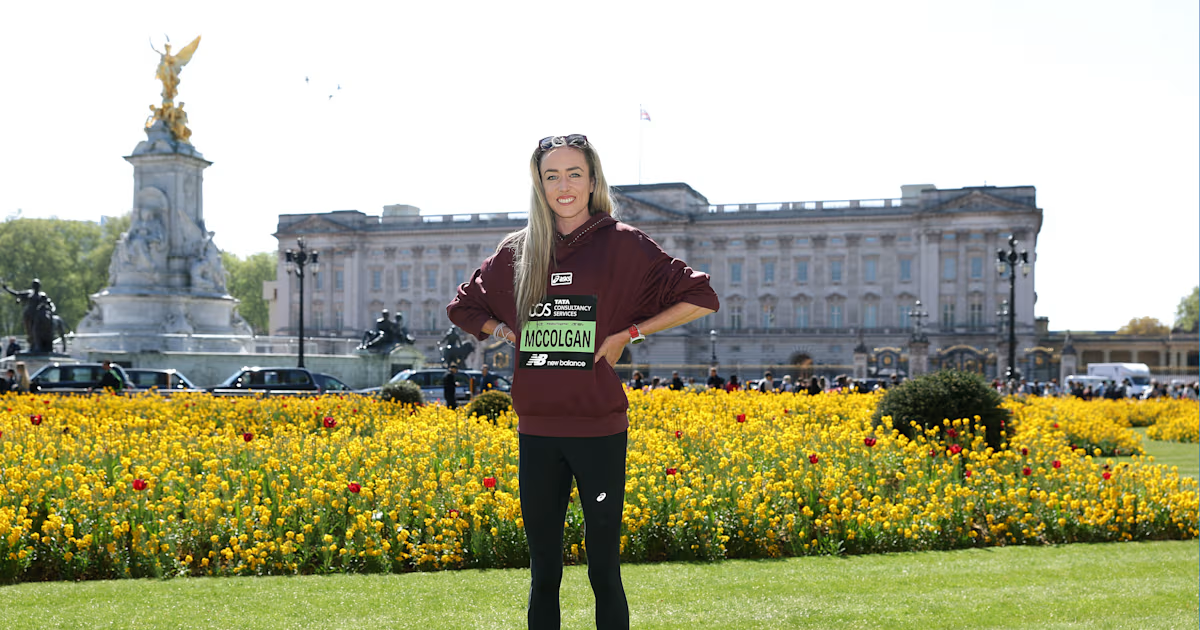
Why London still feels different
McColgan spoke warmly about the London Marathon, but in precise terms rather than broad praise. What stayed with her from last year was how close the crowd felt throughout the course.
“It really just blew all my expectations of any race I’ve ever done before out of the water,” she said. “From start to finish, there’s people cheering you every second of the way.
“It’s so much more intimate. People are cheering at you specifically. When you’re on the track, there’s a big noise and there’s a crowd, but in London, you hear people specifically calling out your name. It’s those small interactions from start to finish, that’s what makes London Marathon the London Marathon.”
That experience also shaped the way she approached this training block. McColgan explained that the build-up hasn’t solely been about handling marathon volume, but also regaining the speed she felt had faded during the injury-hit period around her knee surgeries.
In a round-table session, she said she needed to move back towards “30 minutes or so” for 10km and close to 67 minutes for the half marathon if she wanted to keep progressing over the full distance. The signs are already there. This season, she has run 30:08 for 10km and 1:07:08 for the half-marathon.
So how does she define success in London this time?
“To be honest, success for me… of course I’d like to try and break into maybe the top five of those elites,” she said. “But ultimately running a PB, like I can’t ask for anything more than running a PB. If you run the best you’ve ever run before, that’s a huge positive and a step forward for me.”
She also acknowledged that 2:20 remains a meaningful long-term benchmark. At the same time, she made clear that one race doesn’t have to answer every question. She’d still like to test herself in a fast autumn marathon, ideally in a mixed field, because, as she put it, “it’s not easy running a marathon solo”.