
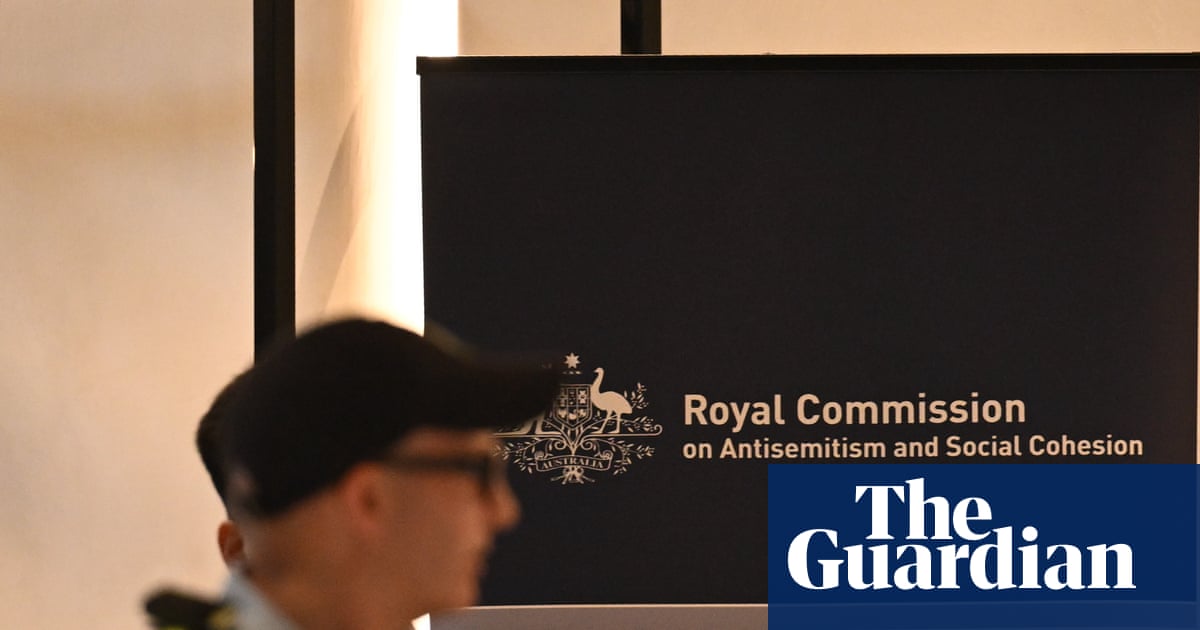
The royal commission on antisemitism and social cohesion will hold a second block of public hearings – this time to examine the lead-up to December’s Bondi massacre and focus on information known before the attack about the two gunmen, and what action taken by security agencies with it.
On the evening of Sunday 14 December 2025, two antisemitic gunmen, allegedly inspired by Islamic State, opened fire on a Jewish celebration of Hanukah at a park behind Bondi beach.
Fifteen people were killed, and 40 more were injured. One of the gunmen, Sajid Akram, was shot dead by police. His son, Naveed Akram, 24, has been charged with 59 offences, including 15 of murder.
Sign up for the Breaking News Australia email
In a statement issued on Friday, the royal commission said the second block of public hearings would interrogate the circumstances surrounding the atrocity.
The hearings will examine information known about the alleged shooters and what was done with intelligence about the pair; the security arrangements for the Hanukah by the Sea event; and how decisions were made on applications for firearms licences. It will probe, too, how intelligence on particular individuals is shared between security agencies.
The hearings will also focus on the broader terrorism threat level and security environment in the lead-up to the attack, and government resourcing for counter-terrorism work.
The commission’s interim report, issued last month, found Sydney’s Jewish community had warned police a terrorist attack was “likely” but that NSW police appeared not to have completed a comprehensive written risk assessment.
“A terrorist attack against the NSW Jewish Community is likely and there is a high level of antisemitic vilification,” Jewish security organisation Community Security Group (CSG ) wrote in an email to police in November, the report detailed.
“No written risk assessment for Hanukah by the Sea 2025 has been provided by NSW Police,” the report found.
The NSW police commissioner, Mal Lanyon, acknowledged the finding but said there was a “policing presence on that night”.
“NSW [police] had worked with CSG in the lead up to it … as we continue to do,” he said.
“As the commissioner, I’ve been very clear that we will learn from this incident. If there are lessons to take away, as an organisation, I am committed to implementing that.”
The commission’s interim report also recommended that federal and state governments prioritise nationally uniform gun laws, and a gun buy-back scheme similar to that seen in the wake of the Port Arthur atrocity.
The report said efforts towards reforming gun laws had been “unduly leisurely”, given the vital imperative of community safety.
The commission, before former high court justice Virginia Bell, has just completed its first week of public hearings, focused on defining antisemitism, its historical and contemporary manifestations and its impact on the lives of Jewish Australians.
The commission heard evidence from Jewish Australians detailing antisemitic abuse and attacks in public places, schools, universities and workplaces. They told the commission Jewish identity was conflated with the actions of the state of Israel and the Israel Defense Forces.
An anonymous witness, pseudonymised before the commission as ABJ, gave evidence on Friday that she had been compelled to quit volunteering at a national crisis counselling hotline, assisting people in acute distress, because of consistent, vitriolic antisemitic calls.
She said she was devastated to leave after 13 years of voluntary service.
“I was really upset … I loved working there,” she said. “It was a big part of my life.”
Before the 7 October Hamas attacks on Israel, ABJ said she had only taken a handful of calls from people expressing antisemitic views.
But after the Hamas attack and Israel’s military offensive in Gaza, she said she was inundated by antisemitic hatred.
“It was instant,” ABJ said. Every shift would involve at least one antisemitic call, with those phoning telling her that Jews control the government and media, own all the businesses, and “have their tentacles everywhere”.
“I was so anxious … that I called in one day and I said, ‘Look, I’m not coming back, and I never heard from them again’,” she said.
ABJ told the commission she felt antisemitism had become endemic in parts of Australian society.
“A section of our society is ruining it, and I’m not sure how the genie goes back in [the bottle],” she said.
But ABJ said those views were not held by all: after neighbours learned her nephew was among those murdered in the Bondi terror attack, they sent flowers and offered to install security cameras to make her feel safe.
ABJ told the commission she only asked of her neighbours, when they saw instances of antisemitism: “don’t be quiet any more, talk up, talk when you see something.”