
By David Albright, Sarah Burkhard, Spencer Faragasso, and the Good ISIS Team
May 7, 2026
Introduction
The war against Iran has gone through two phases, the first in June 2025 and the second running from February 28 to a ceasefire on April 7/8, 2026. This report evaluates the damage and destruction caused to nuclear sites during the second phase. The Institute could identify at least six nuclear sites that were attacked. Three other sites that were attacked could be nuclear-related, but there is not enough information to be certain. In total, six to nine sites were attacked that were nuclear related.
The Institute damage assessment of the first phase is contained in reports on the Institute’s website and shows that Iran’s centrifuge program was destroyed, including the ending of uranium enrichment, severe damage to sites associated with producing the nuclear weapon itself, and a loss of key nuclear weapons development and production know-how.[1]
During the second phase of the Iran war, Iran’s nuclear facilities continued to be targeted and destroyed by Israeli and American airstrikes. There was no significant additional damage to the facilities directly associated with uranium enrichment, they have remained destroyed and no reconstruction efforts have been detected. There has been no indication that Iran resumed any enrichment. The Israeli priority in the second phase appears to have been more on further degrading Iran’s ability to make the nuclear weapon itself, a process called nuclear weaponization. Some of these weaponization sites targeted were revealed publicly for the first time, shedding new light onto the extent of Iran’s nuclear weapons related work.
With regards to weaponization, the IDF identified at least four more nuclear weaponization-related sites that were attacked in the second phase. In addition, we identified three more sites that are likely nuclear weaponization sites, for a total of four to seven sites. A total of five nuclear weaponization-related sites were attacked in June 2025, for a grand total of nine to twelve sites involved in developing and building nuclear weapons. Many of these sites contained elements added only in recent months or years. At least one site held a post-June reconstituted capability that Israel somehow discovered.
Two fuel cycle facilities were also attacked. The Ardakan Yellowcake Production Plant (YPP) was targeted by Israel, destroying the key infrastructure needed to produce yellowcake from uranium ore. The Arak heavy water production plant was hit again, this time more thoroughly than in the first phase. The latter has economic consequences since the Atomic Energy Organization of Iran sold heavy water commercially. The attack has strategic consequences since heavy water would be needed in an Arak-type heavy water moderated reactor. The destruction of the Ardakan facility eliminates an important source of natural uranium oxide, needed in a variety of nuclear programs from enrichment to heavy water reactors.
Israel and the United States targeted many industrial and military sites, mostly involved in missile, drone, and conventional arms research, development, and production, deployments, and use of military hardware. It is possible that some of these sites were actually nuclear-related but not announced as such and not identified by the Institute. In addition, a few ex-Amad sites that were repurposed and attacked are also included at the end of the report.
Additional nuclear scientists were killed, although the exact number is not publicly known. Israel did announce that it killed members of the Defense Council, which included the head of SPND and its previous head. Unlike the June war, Israel has not released a list of names and expertise of the scientists it killed, other than announcing that it had killed more. The effort appears to be aimed at eliminating the know-how of those in the nuclear weapons program. Know-how should not be confused with knowledge, which cannot be destroyed. Know-how is much more difficult and time-consuming to replace, particularly in a highly secretive nuclear weapons program.
Other important sites, like the Esfahan underground complex, composed of a tunnel complex with three entrances, and the Natanz Pickaxe Mountain area, composed of two separate tunnel complexes, were not targeted. These sites are believed to hold most of Iran’s ten tonnes of enriched uranium, including 440 kilograms of highly enriched uranium. But the tunnel complexes believed to hold enriched uranium were sealed by Iran before the war and have yet to be opened. In addition, the vehicle and personnel entrances to the Natanz underground enrichment site were attacked. Overall, much of the enriched uranium looks bottled up in sites where any movement can be easily detected, making the enriched uranium more difficult to access and use.
Attacks in phase two have further set back Iran’s ability to make nuclear weapons. Recent media reports of the U.S. intelligence community finding that the second phase of the war did not set back timelines for Iran to build nuclear weapons do not accord with the visible damage of nuclear weaponization facilities and require both more explanation and scrutiny.
To further lengthen the time needed to break out to weapon-grade uranium, negotiations should ensure the stocks of enriched uranium are removed or down blended to natural uranium. This will build confidence that enrichment to weapon-grade uranium in a secret program will be more time consuming than building the nuclear weapon itself and increase confidence against cheating under a negotiated, permanent end, or long-term halt to Iran’s centrifuge program.
The attacks in both phases of the war deserve credit for significantly increasing both the time needed to finish a nuclear weapon and the chance of failure if tried. While the new Iranian regime is widely perceived as more motivated to decide to make nuclear weapons, its means to do so are severely degraded as is its confidence in trying. While before the June 2025 war Iran could have broken out and built a non-missile deliverable nuclear weapon with almost 100 percent certainty in less than six months, it will face a much more difficult struggle towards success if it tries in the coming months, and the probability of succeeding, whether it be in nine months, one year, or two years, is now much less technically certain, and significantly less than 100 percent. That real risk of failing to successfully build a nuclear weapon may be a deterrent against deciding to try.
Nuclear Weaponization Related Targets
Min-Zadayi Site
Min-Zadayi is a previously unknown site suspected to play a key role in Iran’s attempt to reconstitute nuclear weapons capabilities post-June 2025. On March 3, 2026, the Israeli Defense Forces announced that the Min-Zadayi (also sometimes spelled Minzadehei) complex located east of Tehran was targeted in airstrikes, describing the site as a secret nuclear compound, or “nuclear headquarters,” partially located underground, where a “group of nuclear scientists operated covertly to develop a key component in the nuclear weapons system.”[2] A caption on an IDF video about the attack states, “The complex is designed to enable the restoration of the required technology and the advancement of capabilities for the development of nuclear weapons.” The meaning of “component” is ambiguous as to whether it refers to a specific component of a nuclear weapon or a group or division of the nuclear weaponization effort.
Subsequent reporting by Le Monde indicated that the complex was involved in the “metallization” of making a nuclear weapon. This likely refers to the metallurgy required to make the weapon-grade uranium core of a nuclear weapon, and can involve converting uranium tetrafluoride to uranium metal, melting the metal in a specialized furnace, casting it, and finishing the core. According to the IDF, the site was a restoration of a capability, presumably one lost or damaged during the June strikes. If so, this new activity at this site may be linked to the Meysami (aka Meithami) site, which was attacked twice in the June 2025 war, with many buildings destroyed, including a newly constructed one. In a report to the UN Security Council, Israel stated, “The site contained a large amount of metallurgical equipment that served the Advanced Materials Centre, under the Shahid Meithami group, the chemistry group of SPND. This equipment can be used, with modifications, for the metallurgy process for fissile core fabrication.”[3] Post-June, sorting and clearing of rubble was seen at the site.
The Min-Zadayi complex was a pre-existing military, likely SPND site, situated near a civilian recreational park giving it the appearance of a resort, which helped mask its purpose when viewed with satellite imagery, although typical signs of physical protection of a sensitive military installation can be seen upon closer observation. This includes a high-wall security perimeter, checkpoints, and guard towers (see Figure 1). The complex contains two clusters of above-ground buildings as well as long, winding roads with a series of buildings revetted into the hillside. One hillside building highlighted by the IDF in an infographic is connected to the above ground complex by a walled walkway as well as by trenching. It is unclear how far this facility extends under the hillside, but the highlighted building was not attacked as of April 1, 2026.
Airbus high resolution satellite imagery from March 4, 2026, showed that the airstrikes destroyed three large above-ground buildings. A large crater can be seen on a nearby hillside above bunkered entrances, as well as five to six smaller craters that penetrated a concrete surface at the top of the hillside (see Figure 2-5). The targeted concrete surface has the appearance of a courtyard/parking area at first glance, but it may in fact be a roof for a partially raised, partially below-grade facility, connected to both above ground buildings and the targeted facility underneath the hillside (see Figure 6 and 7).
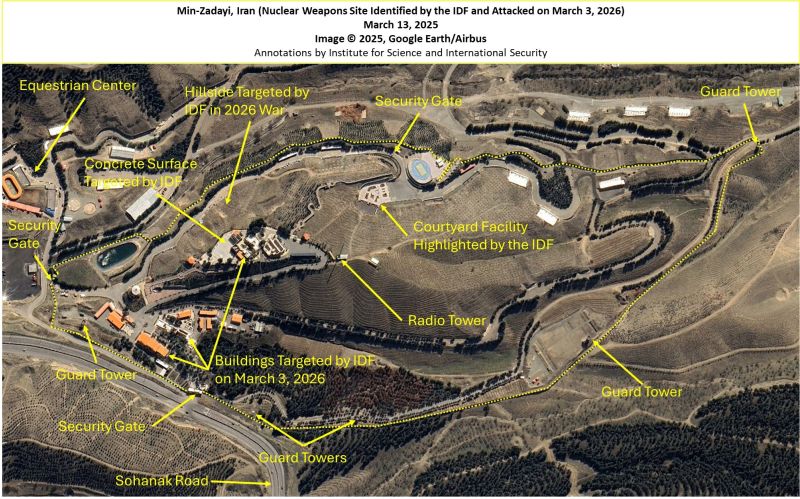
Figure 1. An overview of the Min-Zadayi complex, highlighting the security perimeter and its proximity to civilian recreational facilities.
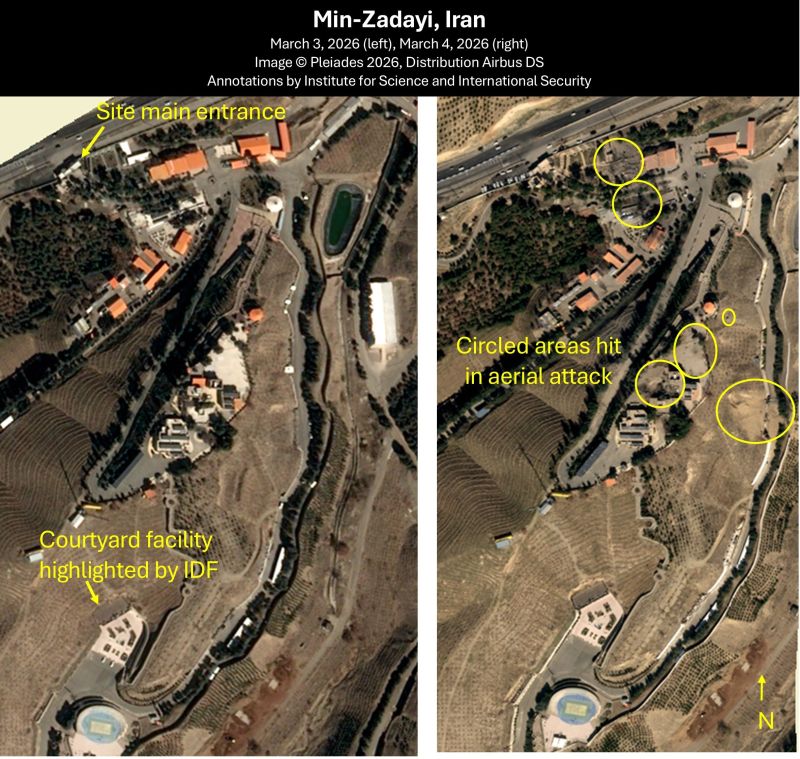
Figure 2. A before and after image of the compound, highlighting the attacked areas in the two clusters of above ground buildings as well as craters on and near the hillside.
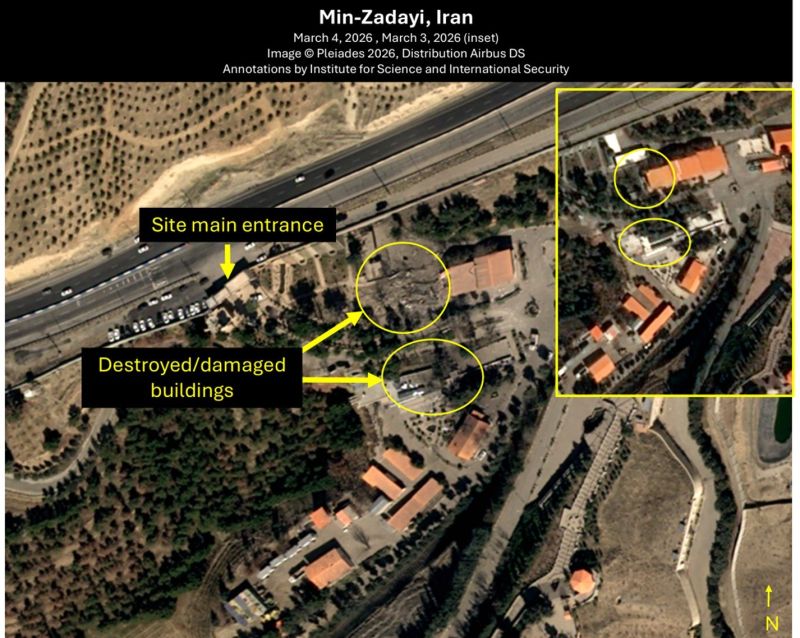
Figure 3. A close up of the targeted cluster of buildings closest to the entrance to the site.
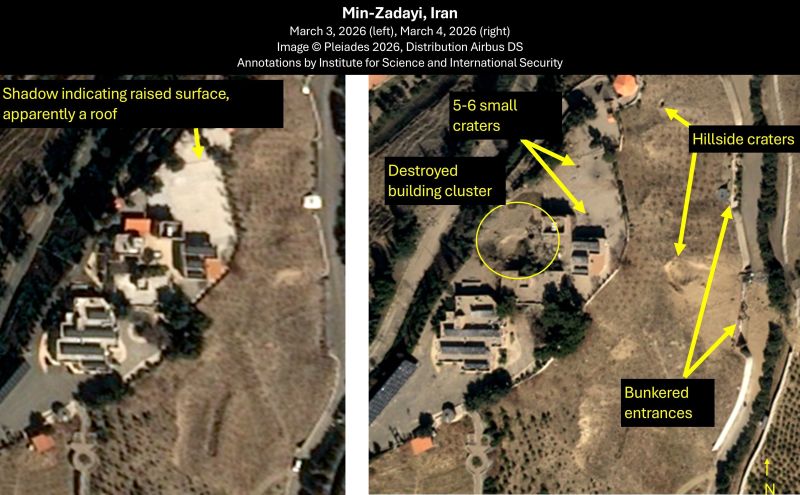
Figure 4. A close up of the hillside crater and smaller craters on a nearby concrete surface, apparently a roof for a partially buried area.
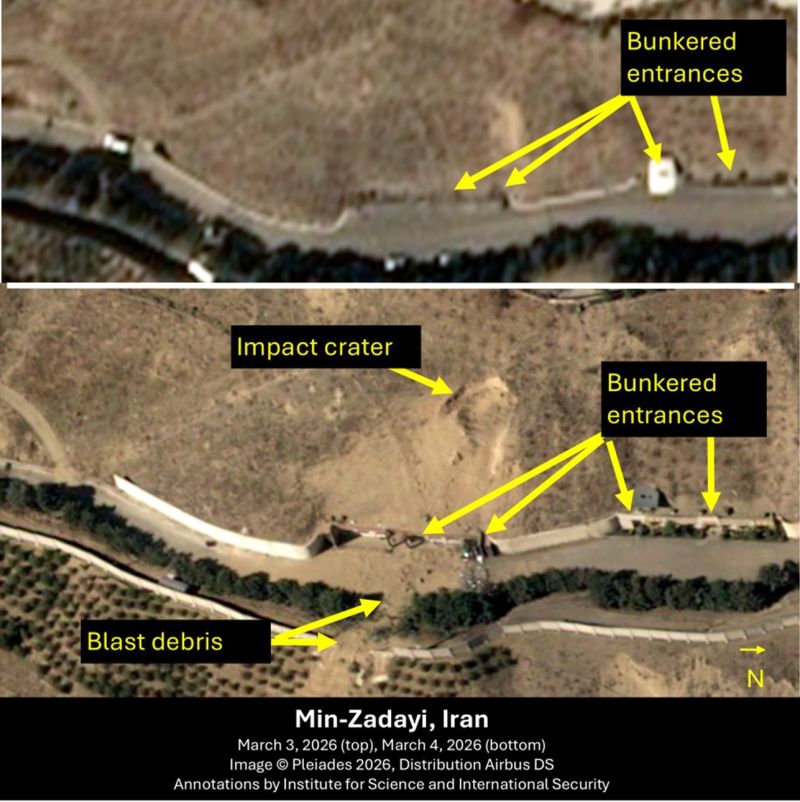
Figure 5. A close up of the bunkered entrance and the impact crater close by.
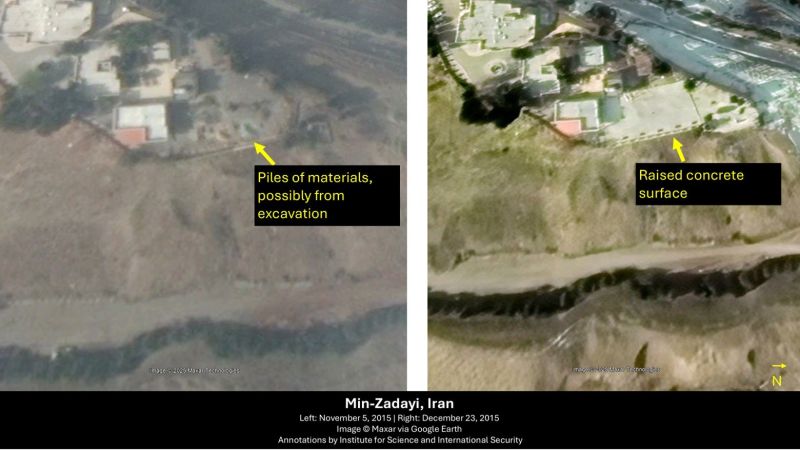
Figure 6. The targeted concrete surface was constructed from 2014 to 2015, with excavation at the top of the hillside visible in early 2015 (not shown) indicating a connection to the bunkered entrance facility targeted by the hillside strike.
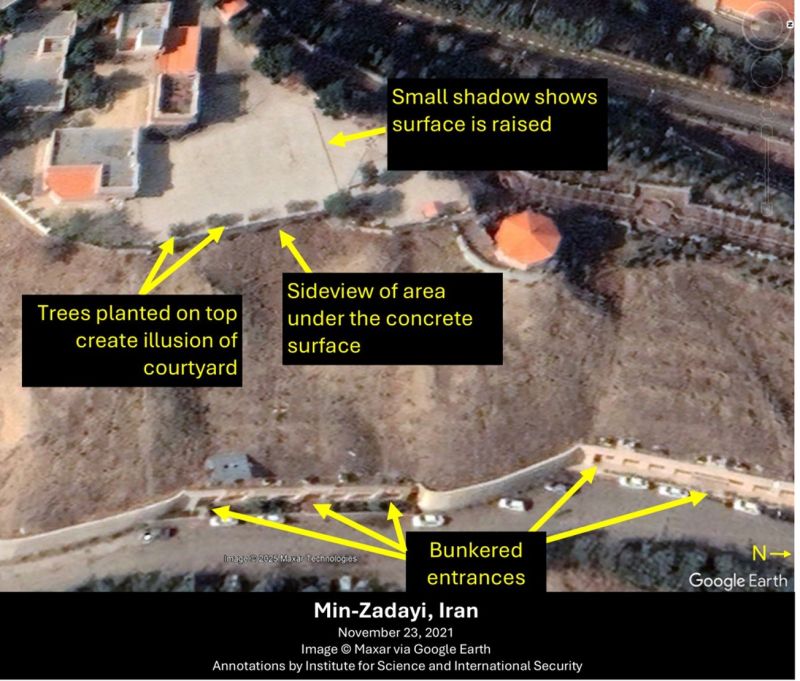
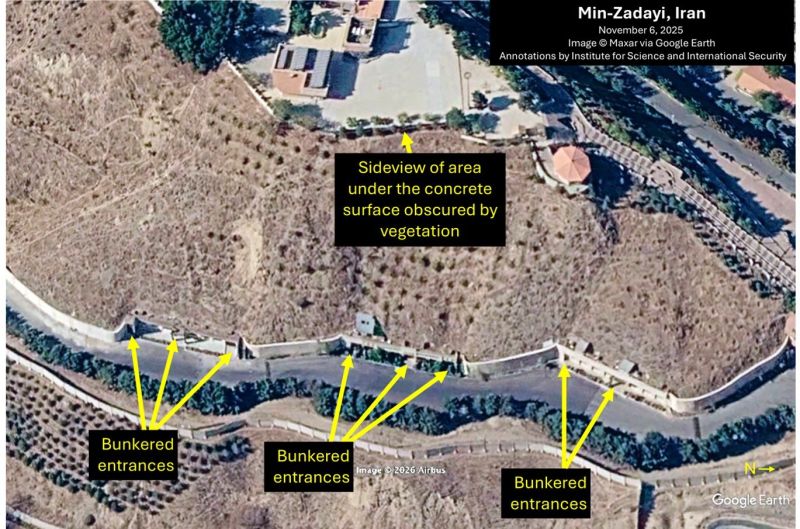
Figure 7. A November 2021 and a November 2025 image show the targeted concrete surface is raised.
Taleghan 2
The IDF destroyed a newly built, highly fortified facility at a site known as Taleghan 2, located within the Parchin military complex, and tied the strike directly to Iran’s nuclear weapons capabilities. It described the attack on the site as “an additional layer in the ongoing effort to deny the regime the core components required to achieve nuclear weapons.”[4]
The Taleghan 2 location is well known among those studying Iran’s nuclear weapons program. It was a building used for nuclear weapons development purposes under Iran’s Amad Plan in the early 2000s. During the Amad Plan, Taleghan 2 originally contained a specially built, cylindrical high explosive test chamber operated with a flash x-ray able to peer deeply into high explosive experiments, providing a capability to study in detail the initiation of the spherical compression of a dense mass. Iran conducted an important nuclear weapons test in Taleghan 2 in 2003 involving a scaled-down version of the multipoint initiation system that Iran called the shock wave generator. It was designed to fit in the outer volume of the nuclear weapon and uniformly set off the main high explosive charge.
The IAEA never visited the building. Available evidence supports that the high explosive chamber and associated flash x-ray were removed from the building during a multi-year Iranian sanitization of the site, which also included the co-located Taleghan 1 building.
The original building at Taleghan 2 was destroyed by an Israeli airstrike in October 2024. Based on Axios reporting and the Institute’s understanding, it appears likely that just prior to the October 2024 bombing, Taleghan 2 contained equipment used to make high purity PETN plastic explosives. These explosives, which are moldable, are an essential component of the shock wave generator. Translated portions of the IDF March 2026 post in Hebrew described the site as one “used by the Iranian regime to advance nuclear weapons capabilities,” and “used in recent years to develop advanced explosives.”
The site was rebuilt beginning in May 2025, before the June war. Satellite imagery of the early stages of construction showed what was possibly one or multiple high explosive containment vessels installed inside the new structure. The facility under construction was not attacked in June 2025. Iran subsequently went to great lengths to harden and protect the new facility, constructing it with a reinforced steel frame, covered in hardened concrete, and buried under dirt. Additional passive defensive measures were installed, such as an anti-drone fence above the facility and hardened concrete walls in front of its entrance.
Vantor satellite imagery from March 11, 2026, revealed the destruction of Taleghan 2 (see Figure 8).[5] Three large craters caused by earth penetrating weapons can be seen evenly spaced across the top of the facility. The weapons penetrated directly into the main internal building holding the probable high explosive containment vessels beneath and destroying the facility (see Figure 9). The blast concussion created by the earth penetrating weapons caused a nearby support building and the outer defensive concrete wall to collapse. Nearby, a fire control and instruments building used at the Taleghan 1 facility was destroyed.
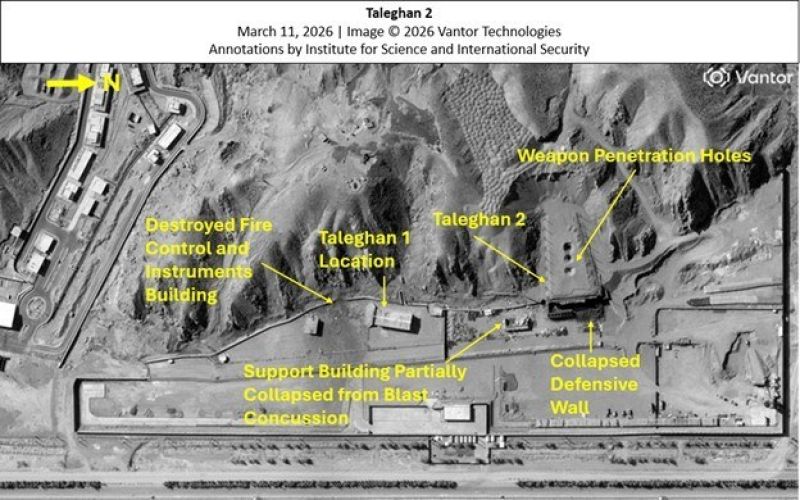
Figure 8. A Vantor satellite image provided to the Institute showed the attack on the Taleghan 2 facility and surrounding buildings.
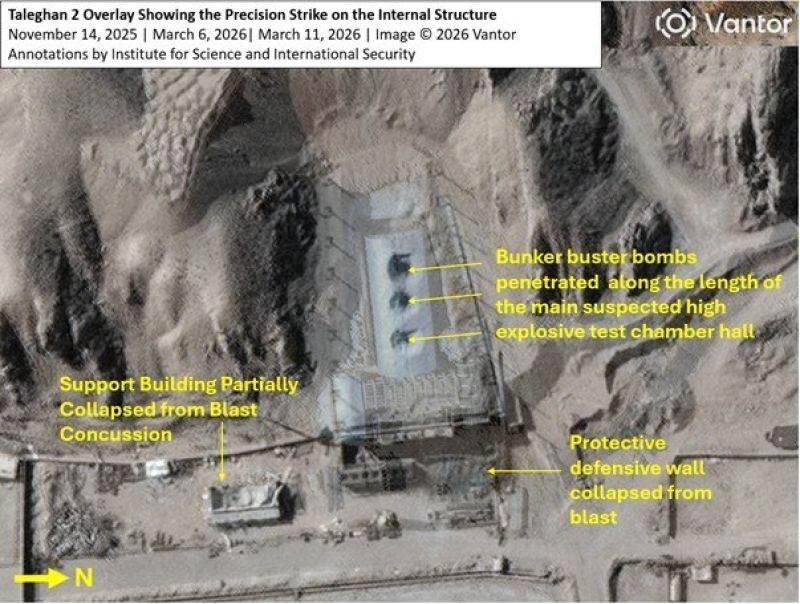
Figure 9. An overlay of the Vantor satellite image showing the precision of the strikes and how they entered directly into the main internal building.
Malek Ashtar University and the Building Adjacent to the Mojdeh Site (Lavisan 2)
Two buildings near the previously destroyed Mojdeh site were targeted in March 2026. One was a newly built, large engineering laboratory-type building, the other was part of Malek Ashtar University. The latter was directly tied to nuclear weaponization work by the IDF. Figure 10 shows the buildings before they were struck.
The large, suspected engineering laboratory-type building was targeted in early March. As Figure 10 shows, the new building was located adjacent to the Mojdeh site (aka Lavisan 2), connected to the site by ground paths, and connected to Malek Ashtar University via a pedestrian walking bridge. The Mojdeh site was destroyed in the June 2025 war and subsequently sanitized.[6]
Satellite imagery from March 3, 2026, confirmed that the suspected engineering laboratory-type building was completely destroyed, spreading debris across a wide area and onto the highway next to it (see Figure 11).
The purpose of the building was not clarified by the IDF. Its proximity to the Mojdeh Site suggests a connection to SPND and nuclear weapons development. It also appears to share a common security perimeter with the Mojdeh site.
In a report to the UN following Operation Rising Lion, Israel described the Mojdeh site as “used for radiation R&D and high explosives.” It explained, “The site contained SPND laboratories, including unique components and R&D projects both for the nuclear and conventional projects weapons [sic] in the fields of neutronics, explosives, and diagnostics.”
The newly destroyed building was finished only in early 2025. With construction starting in 2016, it likely was built to supplement SPND activities at Mojdeh and/or at Malek Ashtar University.
Later in March, the IDF announced the attack on a large building on the campus of Malek Ashtar University; as shown in Figure 10, the building is close to the building discussed above and connected by a foot bridge. Malek Ashtar University of Technology has been connected to Iran’s nuclear weapons program for years. Post-Amad planning meeting minutes from 2003 found in the nuclear archive describe plans for continuing nuclear weapons research and development at Malek Ashtar University.
In their statement, the IDF described the purpose of the attacked building as, “a strategic research and development site used by the Iranian terror regime to develop components for nuclear weapons production.”[7] Airbus satellite imagery from March 18, 2026, confirmed that the building had been heavily damaged by the airstrike, destroying an entire section of the structure (see Figures 12).
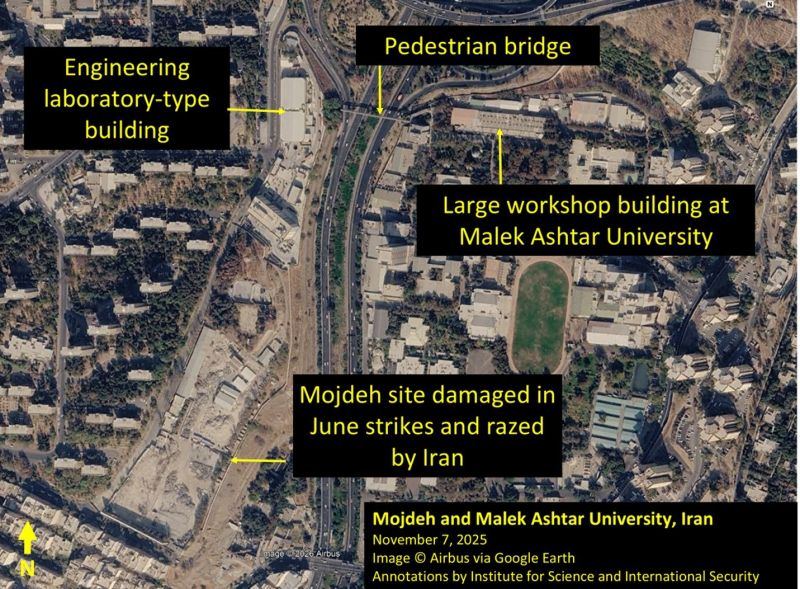
Figure 10. The newly targeted buildings are close to the previously targeted Mojdeh site and connected by footpaths.
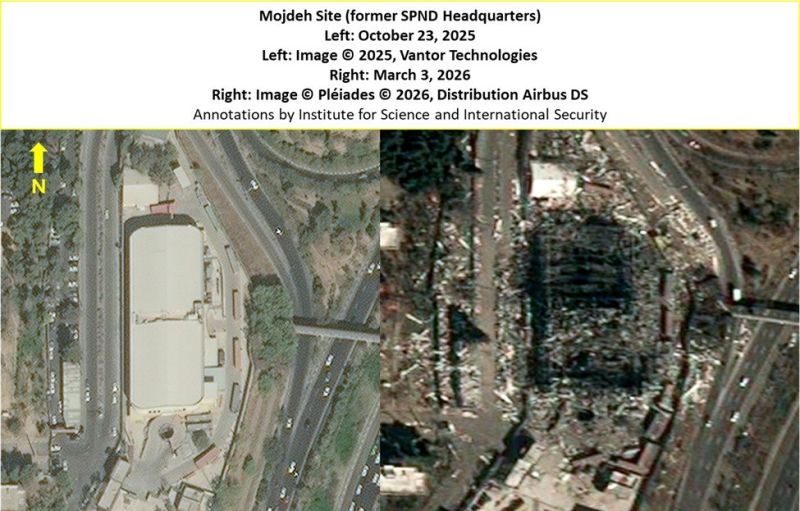
Figure 11. A before and after view of the destroyed engineering-laboratory building connected to Malek Ashtar University and the Mojdeh Site.
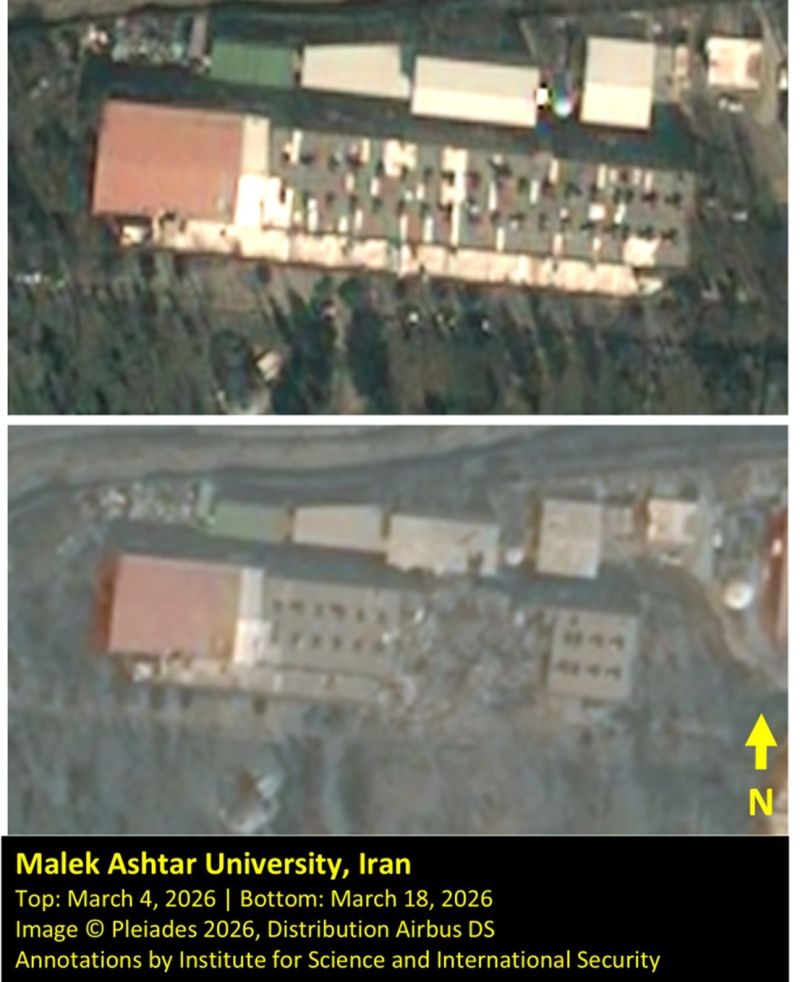
Figure 12. Before and after view of the large workshop building at Malek Ashtar University that was destroyed by an Israeli airstrike.
Shahid Chamran
A large site east of Tehran was identified by the Institute as attacked and destroyed by Israel or the United States. This site had earlier been identified by NCRI as the location of the alleged headquarters of the SPND subordinate entity, Shahid Chamran Group.[8] The complex was initially struck between March 6 and March 19. The site was then struck again sometime between April 5 and April 11, 2026. While there is currently no confirmation by the IDF that the site was related to SPND or the Chamran Group, the destruction is significant, and the connection between the Chamran Group and nuclear weapons development is well documented. In a sanction listing dated to May 2025, the United States’ State Department stated the Shahid Chamran Group “conducted nuclear-related research.” At the time, the head of the group was sanctioned for supporting “SPND’s nuclear and explosives research and development efforts, including those with potential military applications.”
The attacked complex is located near Sorkheh Hesar, off of Damavand Highway, along the main road to Khojir, the Aerospace Industries Organization’s (AIO’s) main missile development and production site and near former Amad Plan sites. Construction of the site started in 2012 at about the same time as the new SPND headquarters moved to the Noor site. Major expansion of the site began in mid-2023 and was nearly complete when it was attacked.
The complex was not attacked in June 2025, as far as could be determined from satellite imagery. As of early 2025, several buildings had just been completed or were still under construction. Post-June 2025, imagery shows high levels of activity remaining across the site, as indicated by large volumes of cars in the parking lots and the paving of roads. Limited activity is visible with respect to progress on the construction of four buildings in the northern portion of the complex. Figure 13 shows the complex as of April 2025.
Imagery from March 24 and April 14, 2026, shows that the multiple destroyed buildings include both the administrative headquarters and laboratory office building complex, as well as a possible ejector-diffuser test facility, and several other engineering halls and support buildings. One destroyed building piqued our interest due to a central high-bay section, with a large radius loop road, a large drive-in door on the west end and a large, paved area all around the building. See Figures 14 and 15.
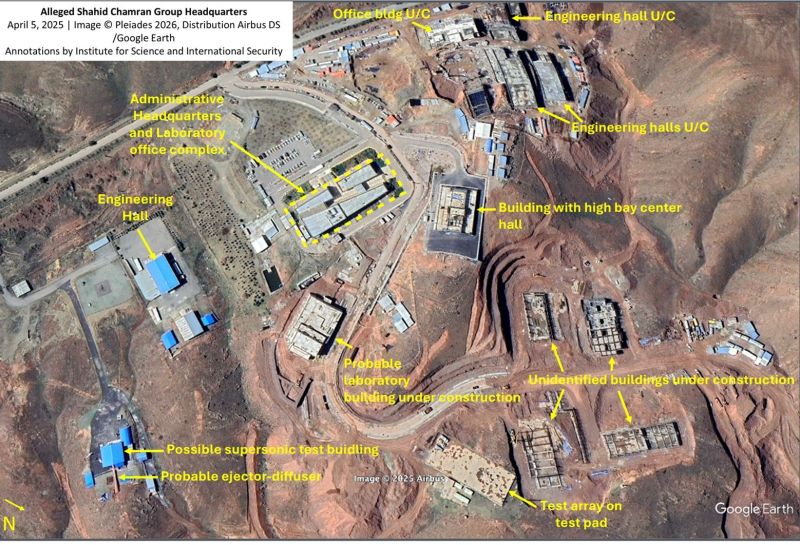
Figure 13. The alleged Shahid Chamran Group headquarters complex in April 2025.
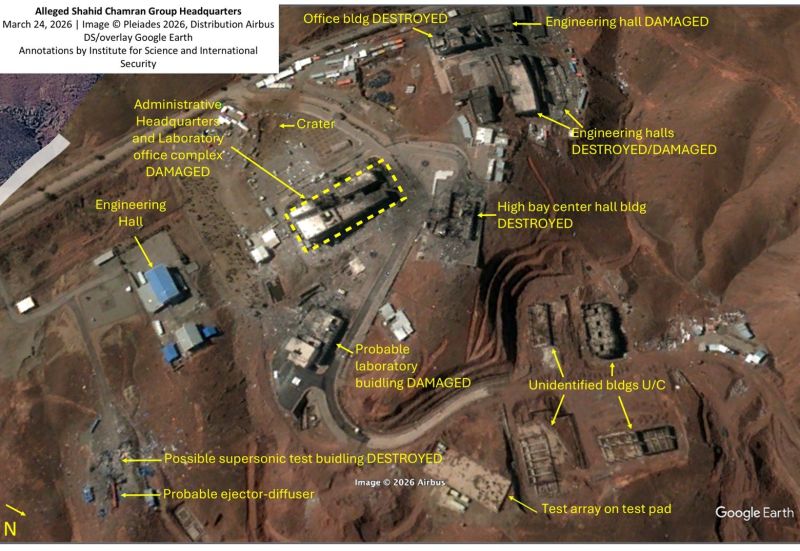
Figure 14. A view of the complex after it was initially targeted with airstrikes sometime between March 6 and March 19. Several buildings are heavily damaged or destroyed.
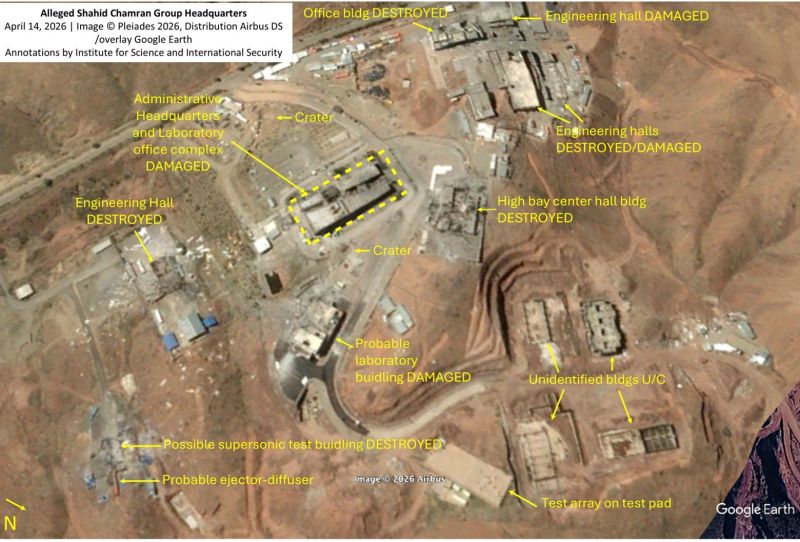
Figure 15. A view of the Shahid Chamran Group complex after it was targeted in a second airstrike. One additional blue roofed high-bay engineering hall was destroyed in that attack.
SPND Officials and Nuclear Scientists
On the first day of the war, the IDF announced that several members of the Iranian Defense Council were killed.[9] This strike eliminated two key personnel involved in SPND, including Houssein Jabal Amelian (Chairman of SPND) and Reza Mozafari Nia (former Chairman of SPND). Ali Shamkhani was also killed. Shamkhani was on the late 1990s, early 2000s interagency Supreme Council for Advanced Technologies that was responsible for overseeing the decision to launch a crash nuclear weapons program, codenamed the Amad Plan.
On two separate occasions, Israel claimed that it had just killed nuclear scientists but did not release their names and affiliations, as it had done in the June war. From open sources, only one or two individuals can be identified.[10]
The media has named two scientists. The first is Hossein Zaki Dizaji. He was from Imam Hossein University and allegedly a former Amad program member.[11] He has co-authored with Fereydoun Abbasi-Davani, leader and founder of the nuclear weapons program and former head of the AEOI. They co-authored a paper in May 2025 about shielding radiation using the software MCNP. He has done considerable work on fast neutron detection using MCNP and SRIM codes. The other one is Mohammad Reza Kia from Amirkabir University. Little is known about his possible involvement with the nuclear weaponization program. His available published work was also related to radiation therapy and dosimetry, and he used Monte Carlo simulations.[12]
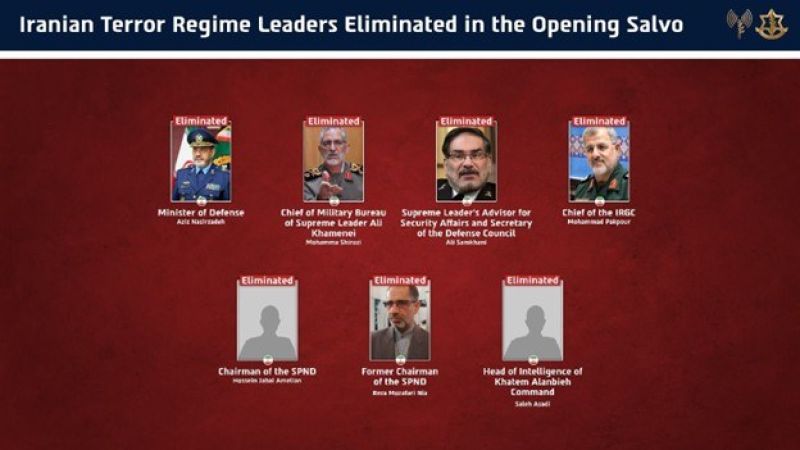
Figure 16. A statement by the IDF identifying the defense personnel killed. SPND and nuclear related officials are among the dead.
Imam Hussein University
Imam Hussein University is a key IRGC university and information about strikes on the site largely focused on the role of serving the IRGC during the war. At least one building was tied to the nuclear program.
On March 10, 2026, the IDF announced airstrikes on an underground complex at Imam Hussein University. According to the IDF Telegram post, the target was a “weapons research and development complex used by the Islamic Revolutionary Guard Corps (IRGC)” with an “underground route […] where IRGC armed forces conducted experiments and tests related to the development and production of ballistic missiles.” The post continued stating, “The complex was located within the IRGC’s central military university (“Imam Hussein”), which served as an emergency asset and a gathering site for operational activity.” On March 11, the IDF announced its attack on “a compound established in the heart of the central military university of the IRGC (‘Imam Hussein’), used by the regime’s operatives to oversee the campaign and conduct meetings.”
On March 30, the IDF announced striking Imam Hussein University grounds again, to “inflict significant damage to the regime’s weapons production and development capabilities.” It described the destroyed military infrastructure as including:
“* Wind tunnels constructed beneath the university, used by the regime for testing and development of ballistic missiles
* The chemistry center of Imam Hossein University, used by the regime for research and development of chemical weapons
* The technology and engineering center of the mechanics and development group, a central complex used by the regime for the development of ballistic missiles and additional weapons.”
In an attached infographic, the IDF also clearly labels one building as a “Physics Center” used for “development and research of the Iranian Nuclear Program.” Figure 17 shows the infographic. Figure 18 shows an overview of Imam Hussein University and highlights the post-strike damage visible at the sites labeled in the IDF infographic. Figure 19 shows a close-up of the “Physics Center” before and after the strike; the strikes leveled the building, which was a two-story building resembling an office building, but also leveled or destroyed nearby buildings, including a laboratory-type building and a workshop.
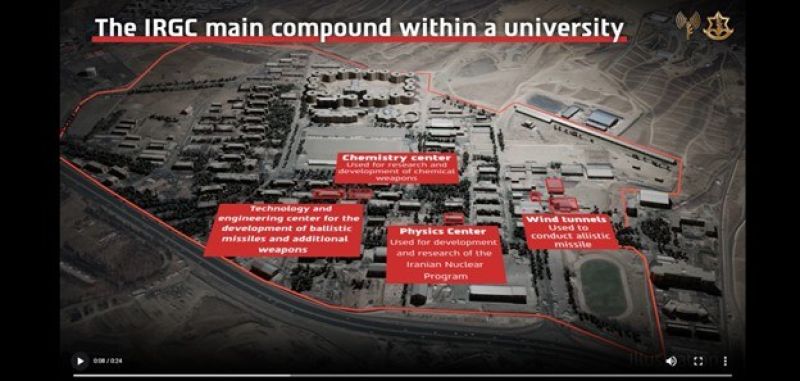
Figure 17. An IDF visual of Imam Hussein University labels a building as a Physics Center used by the Iranian Nuclear Program.
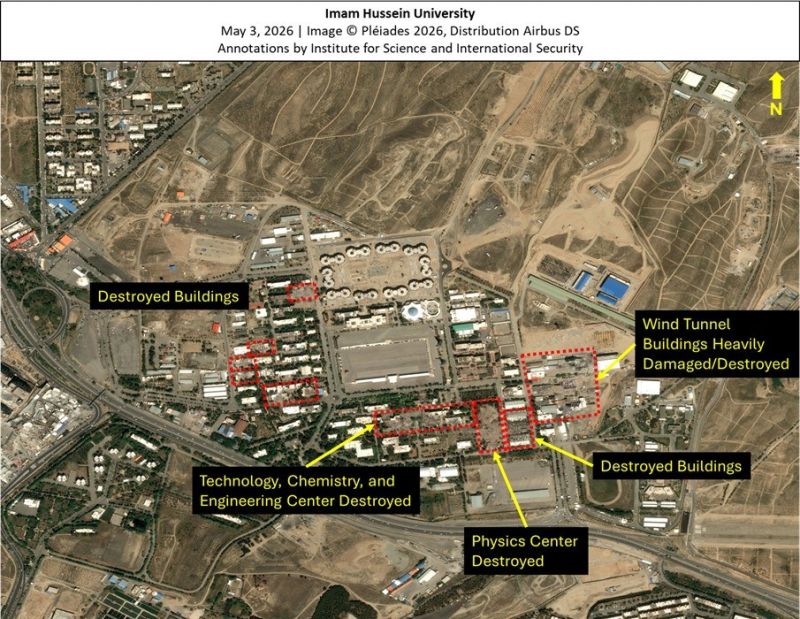
Figure 18. Overview of visible damage at the Imam Hussein University, which was attacked multiple times because of its ties to the IRGC.
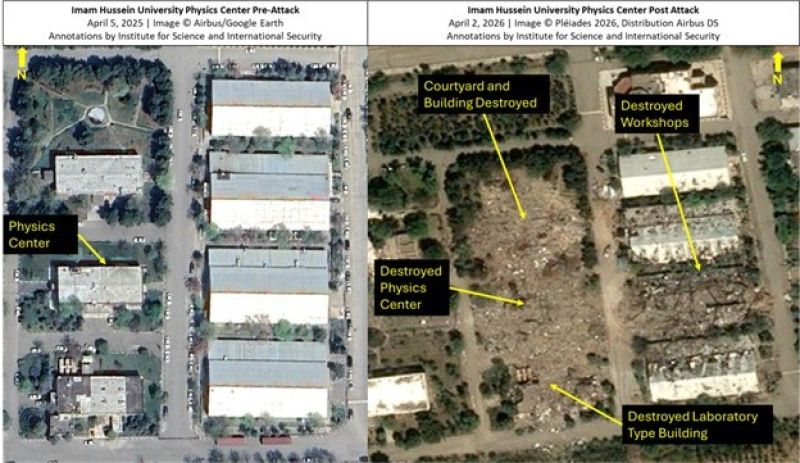
Figure 19. Pre- and post-attack satellite imagery taken in early April 2025 and 2026 that shows the leveling of the “Physics Center” highlighted by the IDF.
Other Universities with Nuclear Weaponization Relevance
There are additional universities that were attacked that may have held nuclear weaponization relevant equipment, activities, or resources. While the IDF has not announced a nuclear related reason for targeting additional universities, the Amad follow-on organization SADAT was affiliated with several universities, in particular Malek Ashtar University of Technology and Imam Hussein University, which are already discussed above, but also Shahid Beheshti University. Further, a secret Iranian document on further developing a neutron initiator for a nuclear weapon included plans to “protect our capacity” at Shahid Beheshti University.
Satellite imagery of Shahid Beheshti University dated to April 14, 2026, shows only little visible damage around the site, which is dense with multi-story buildings (see Figure 20). One multi-story building in the northern area of the university grounds was destroyed.
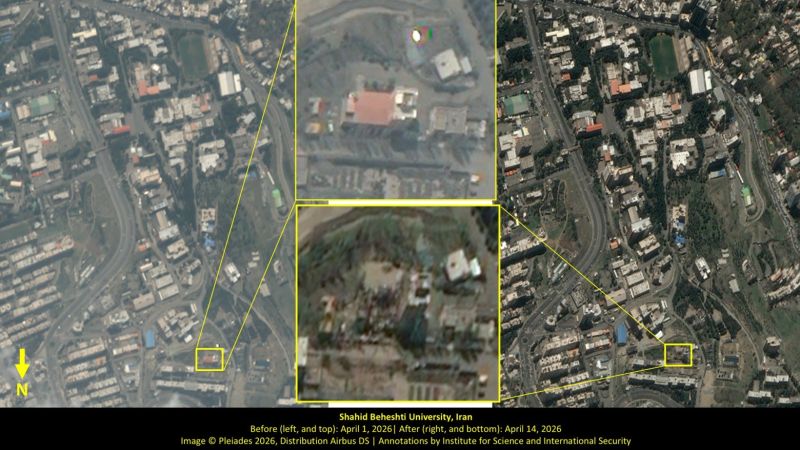
Figure 20. Before and after strike damage at Shahid Beheshti University, with before and after close-ups of a destroyed multi-story building in the northern area of the university grounds.
The IAEA was reported to have at least tried to inspect multiple universities in Iran,[13] likely for purposes of trying to verify if Iran’s declaration was complete and later possibly to monitor Section T of the JCPOA, where Section T constituted a ban on certain nuclear weaponization activities. In September 2017, the then-IAEA Director General Amano described difficulties in verifying Iran’s Section T compliance, citing a lack of requirements to submit declarations or ensure access.[14] Reporting in 2018 indicated that the IAEA was only able to visit two universities, Iran University of Science and Technology and Sharif University of Technology.
Natanz Nuclear Complex
The Natanz Nuclear Complex was targeted multiple times during the 2026 war. On March 1, 2026, the personnel and vehicle access points to the underground enrichment halls were targeted and destroyed by airstrikes (see Figure 21). On the first day of the war, satellite imagery identified vehicle activity outside the vehicle access building, suggesting that Iran was entering the underground facility. Destroying the access points effectively denied entrance into the underground complex and increased the visibility of future efforts to restore access. Later, March 27th imagery showed that two onsite aboveground security checkpoints and the main entrance to the complex were destroyed (see Figure 22 and 23). This was done to limit freedom of movement at the site and prevent ground access.
The enrichment facilities at Natanz have not operated since before the June 2025 war, as a result of the destruction caused to the onsite primary and backup utilities (electrical and HVAC systems), the physical destruction caused to the enrichment halls themselves and the above ground PFEP, and the displacement of HVAC chiller around the complex. In the months leading up to the 2026 war, Iran constructed a makeshift paneled roof over the bombed-out Pilot Fuel Enrichment Plant, likely as an effort to hide their activities while they conducted salvaging and recovery operations of any equipment or materials that may have survived the June 2025 bombing.
Pickaxe Mountain. The Pickaxe Mountain site, composed of two independent tunnel complexes just south of the Natanz enrichment plant, was not attacked in either phase of the war, except for what may have been part of a mobile air defense capability placed on a spoil pile near the western tunnel entrances of the larger tunnel complex. The debris remains there and has not been removed.
Iran did take steps to make access to the tunnel complexes more difficult. Soon before the start of phase 2 of the war, Iran buried and hardened with concrete the older tunnel portals to the smaller tunnel complex that was built around 2007. During the war, as early as April 22, the two eastern tunnel portals of the larger, newer complex were partially blocked by grey earthen material, sufficiently to prevent vehicle access to both portals. On April 1, 2026, these portal entrances were clear and unobstructed. Unlike the situation at both the Fordow and Esfahan tunnel entrances, this material does not provide complete tunnel entrance obscuration at either portal. Nonetheless, this material would appear to be sufficient to significantly hinder rapid ingress/egress by vehicles and would require the use of heavy earth moving equipment to gain such access and clear an unobstructed path inside. At present, we do not yet see evidence of such blockage having been undertaken at the two western tunnel portals of the larger complex. Figures 24 and 25 show this recent activity at the larger Pickaxe complex.
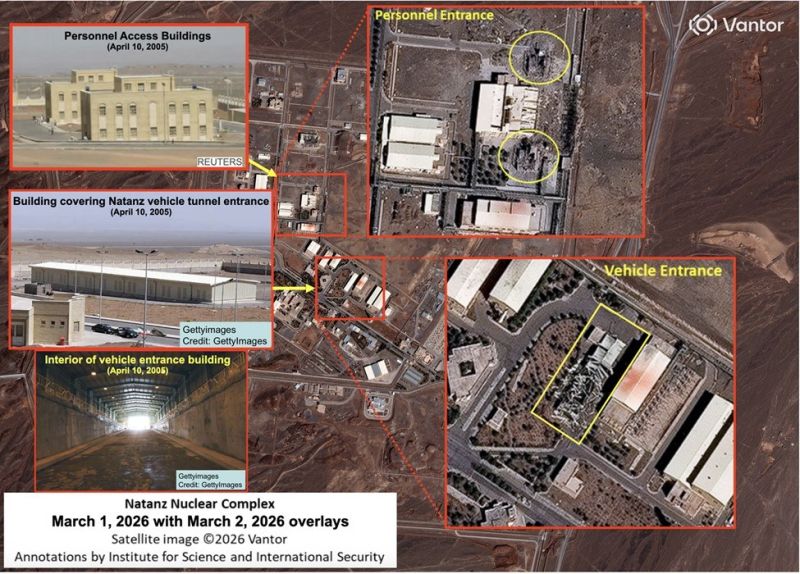
Figure 21. A Vantor satellite image that showed the destroyed personnel and vehicle entrances to the underground complex at Natanz.
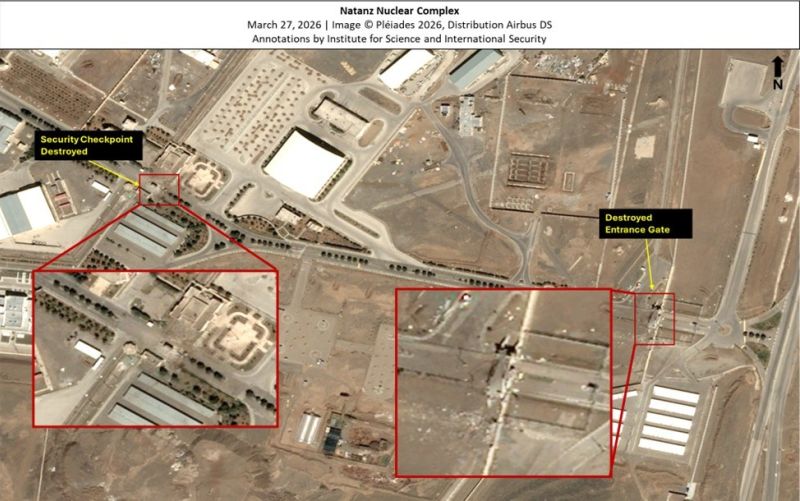
Figure 22. A view of the airstrikes on the main gate entrance and an internal security checkpoint.
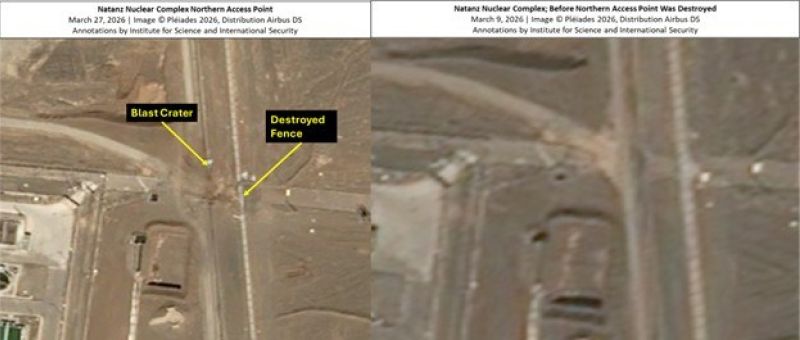
Figure 23. A view of the northern security checkpoint that was targeted in the attack.
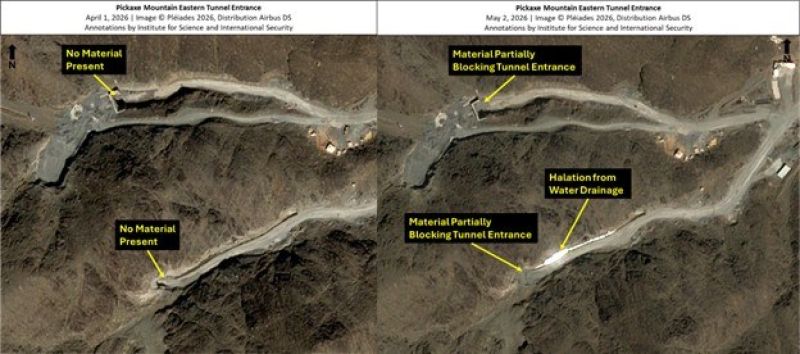
Figure 24. A before and after view of the eastern tunnel portals show how they were partially blocked by earthen material.
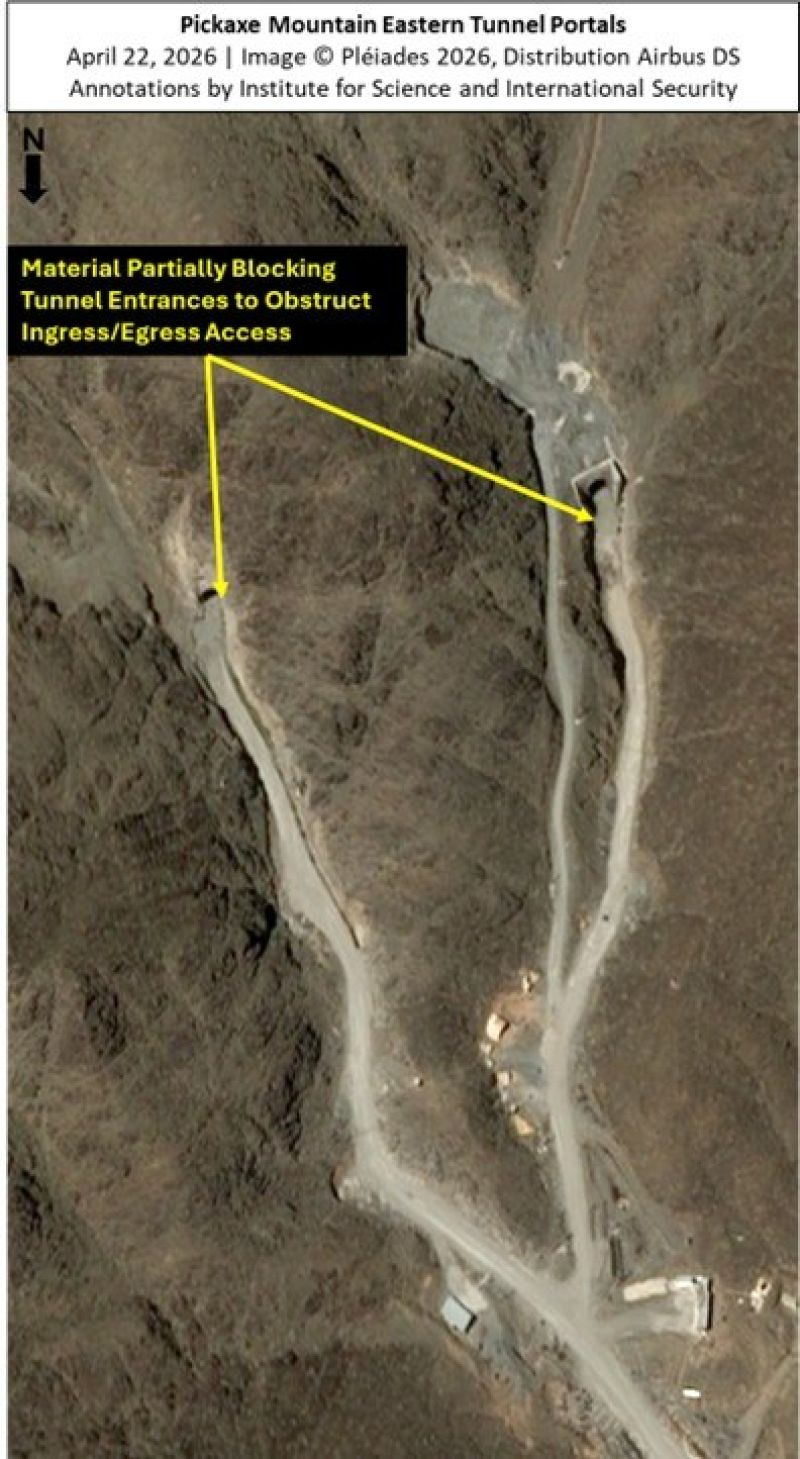
Figure 25. An alternate angle of the eastern tunnel portals at Pickaxe Mountain. This angle shows how the portals are partially blocked.
Arak Heavy Water Production Plant
On March 27, 2026, the IDF announced on X that the Arak heavy water production plant was again targeted in airstrikes.[15] Satellite imagery from March 29, 2026, confirmed that the heavy water production plant adjacent to the Arak IR-40 Heavy Water Reactor was destroyed (see Figure 26). In this attack, all three stages of heavy water production were targeted as well as several support facilities, rather than just one stage as had occurred in the June war. The attack has rendered the heavy water production plant completely inoperable. The nearby IR-40 Heavy Water Reactor remained destroyed and was not targeted again during this phase of the war.
The IDF further stated in their announcement that the plant was “a significant economic asset for the terrorist regime and served as a revenue source for the Atomic Energy Organization of Iran. Its operations generated tens of millions of dollars in revenue for the regime each year.”
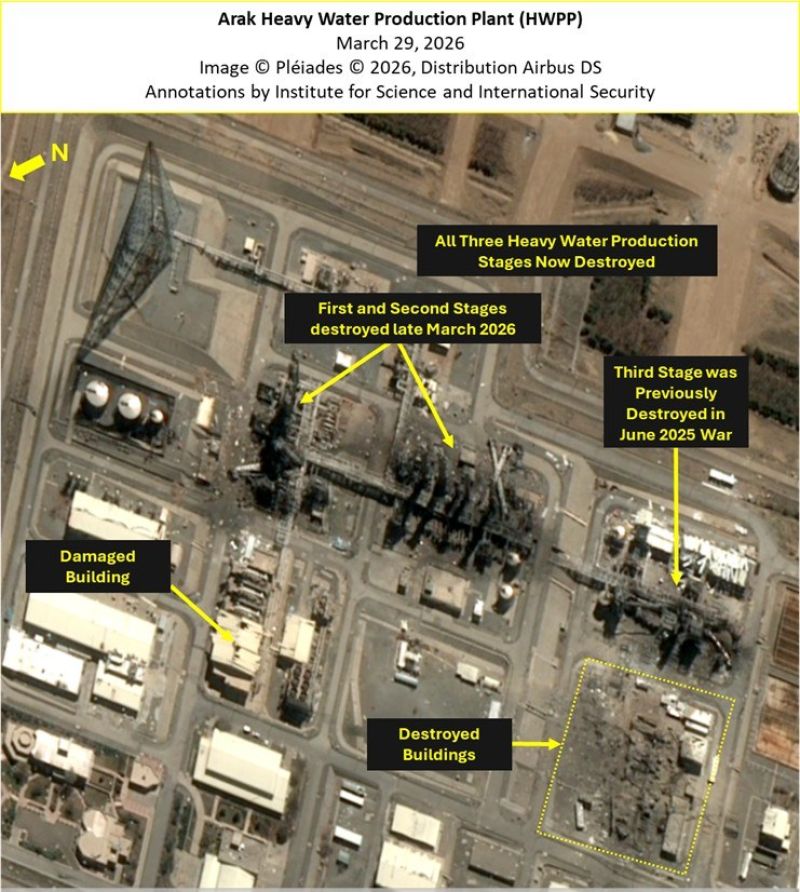
Figure 26. A view of the destroyed Arak heavy water production plant.
Ardakan Yellowcake Production Plant
Satellite imagery from March 28, 2026, showed that the Ardakan Yellowcake Production Plant (YPP) was targeted by the IDF. The IDF announced the strike on March 27, and reported, “The strikes were aimed at the central infrastructure used for the unique production processes at the site.”[16] The airstrikes destroyed the main and auxiliary processing buildings and caused collateral damage to the surrounding buildings (see Figure 27 and 28). Debris could be seen strewn across the complex. The strikes rendered the production plant inoperable. Ardakan was receiving uranium ore from the Saghand uranium mine but could have also processed ore from other mines Iran was planning and building, such as the Narigan Mine.[17] Producing yellowcake, or U3O8, is the first step to convert the uranium into a form usable for enrichment or nuclear fuel.
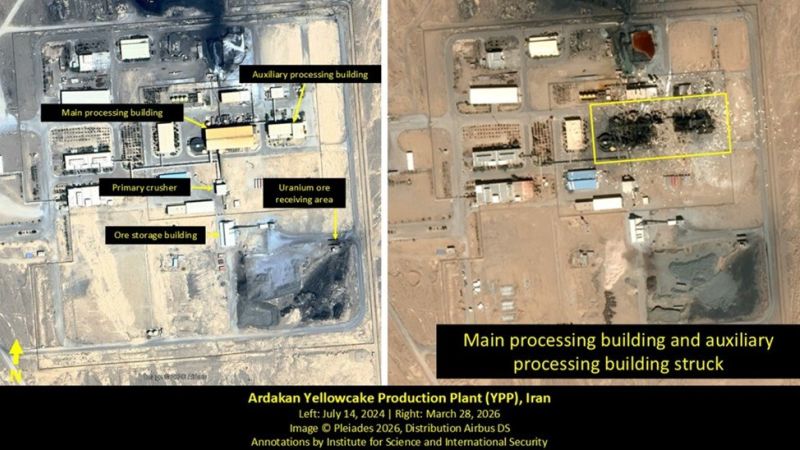
Figure 27. A before and after view of the Ardakan Yellowcake Production Plant. The main and auxiliary processing buildings were completely destroyed, rendering the production plant inoperable.
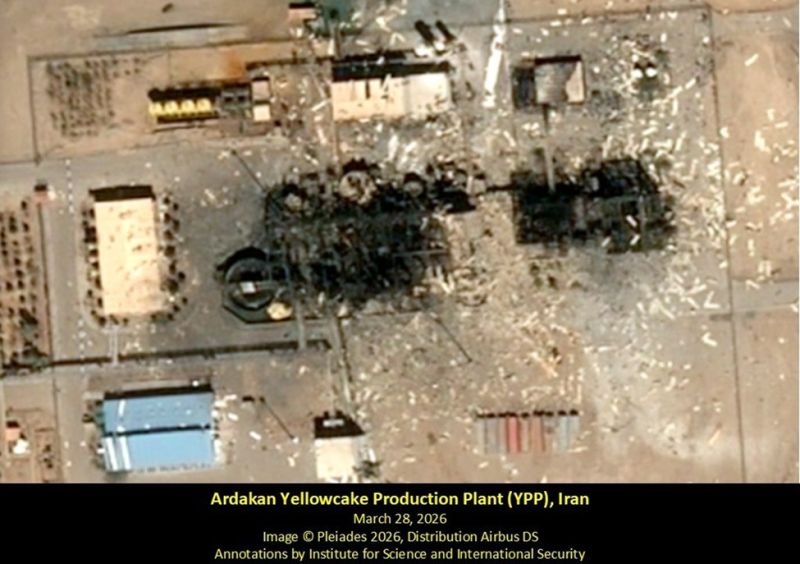
Figure 28. A close-up view of the destruction caused to the main and auxiliary production buildings at Ardakan.
Esfahan Nuclear Site
Tunnel Complex. There were no new attacks on the tunnel complex at Esfahan holding over half of Iran’s stock of 60 percent HEU, but possibly also near 20 percent enriched uranium and the beginning stages of a new enrichment plant. As previously reported by the Institute, the tunnels may have been more damaged in June than is widely believed. One indicator of such damage would be the very limited activity at the tunnel entrances post June 2025. Of the three entrances, only the northern one appears to have been repaired. The middle one was dug out but not visibly opened. No visible efforts were made to repair or dig out the southern tunnel entrances post June, which experienced severe damage to ventilation equipment outside the entrance. This is the entrance where blue barrels, likely carrying HEU in overpack containers, were seen a few days before the June strikes.[18] Evidently, no portion of the tunnel was ready for sustaining regular operation: Even before new bombings began, Iran sealed all three tunnel entrances again with dirt.
On or after March 18, 2026, Iran installed additional roadblocks at all three tunnel entrances, the northern, middle, and southern ones, as well as the entrance to a probable utilities alcove adjacent to the middle entrance. Figure 29 shows an overview. The addition of the makeshift roadblocks complicates efforts to access the tunnel entrances but also makes access more detectable.
Adjacent Air Defense Site Destroyed. Following IAEA information in early March that an attack took place near the Esfahan nuclear complex that damaged two buildings, we identified that a defense complex in the southwest corner of the area was destroyed.[19]
Satellite imagery shows that damage at this site near the Esfahan nuclear complex occurred between February 28 and March 6 and additionally between March 6 and March 18. Because of the difficulty of finding the site, here are the coordinates, 32°34’3.07″N, 51°48’59.77″E. The site is likely involved in the defense of the Esfahan nuclear complex, and the main attacked building could have been the command and control center for physical protection of the above ground nuclear complex roughly 1.2 km away (2.1 km away from the underground complex). Wikimapia identified the site as Army Defense Unit Esfahan. This site includes a small tunnel complex built around 2007 (see Figure 30).
Figure 31 shows the strikes hit both tunnel entrances, one of which could have served mainly as utilities support in recent years and featured what may have been a cooling unit protected by a concrete defensive barrier. Both features appear to have been destroyed in the strike. A probable command and control bunkered facility was also struck in a second attack between the 6th and 18th of March 2026, and a connected underground portion appears to have collapsed.
The residential area next to it is labeled in Wikimapia as Thamari Town (AEOI Housing) and it appears not to have been attacked.
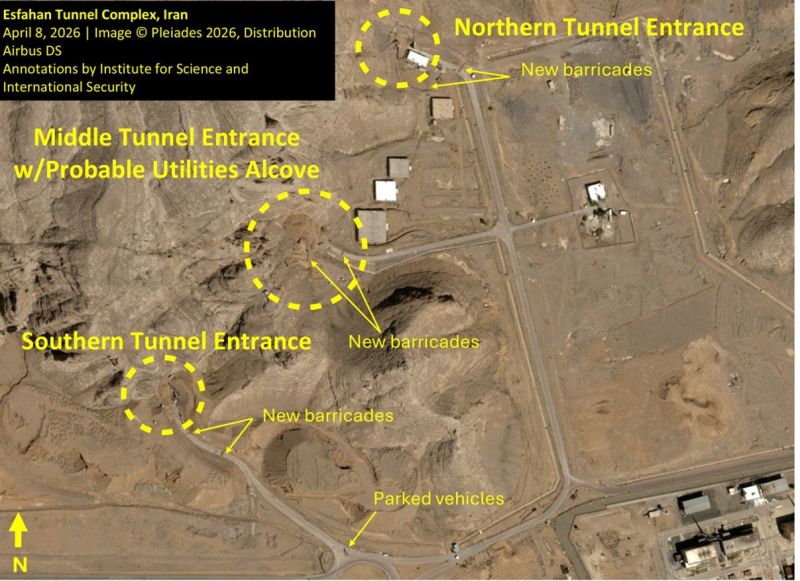
Figure 29. Overview of the tunnel complex as of April 8, 2026, with the new roadblocks identified.
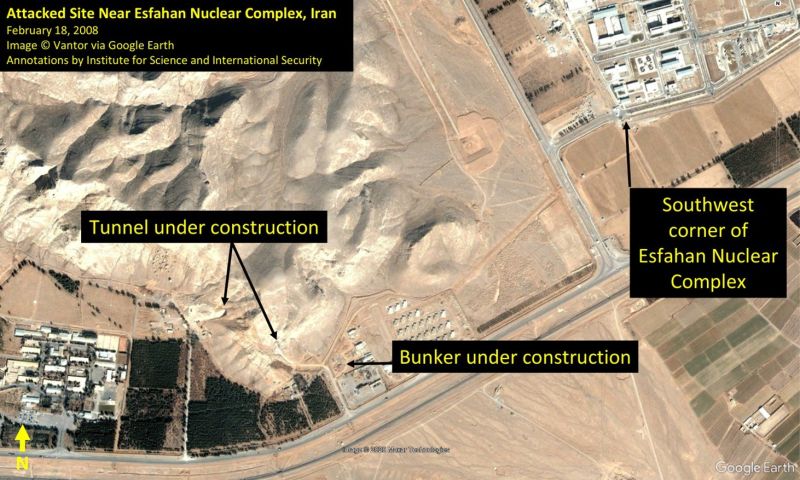
Figure 30. Overview of the attacked defense post near the Esfahan nuclear complex, with a tunnel and bunker under construction in 2007-2008.
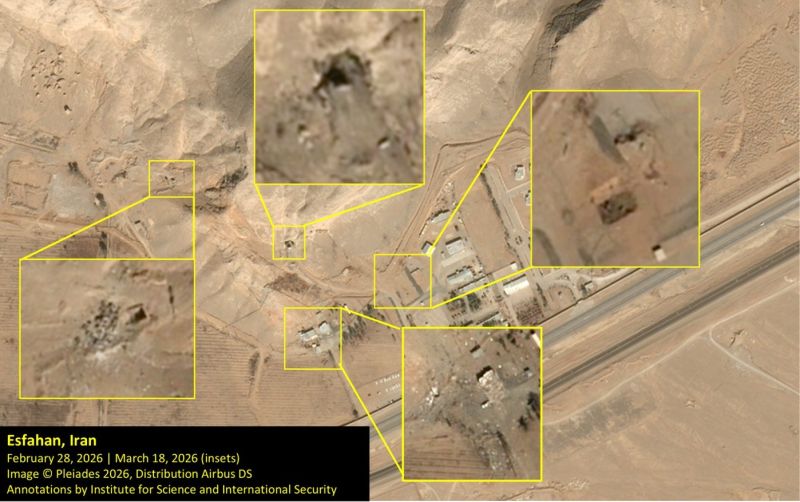
Figure 31. The damage inflicted on the defense post in two separate bombing campaigns.
Additional Ex-Amad Sites Hit
The Institute looked at several additional sites with relevance to the Amad Plan.
One that was attacked was the former Amad Plan mountain tunnel site called Shahid Boroujerdi, situated in the Parchin military complex, and built under the Amad Plan to be a production-scale plant for making weapon-grade uranium metal cores for nuclear weapons.[20] The IDF did not release accompanying information. The Institute later received confirmation from Israel that the site was not struck because of a current relation to the nuclear program, but instead it was repurposed after Amad to be part of Iran’s defense industrial base. It is not included in our count of nuclear facilities.
Another attacked site is the Lashkar Ab’ad complex, where Iran conducted secret laser uranium enrichment activities under the Amad Plan and succeeded in enriching small amounts of unsafeguarded Chinese-supplied uranium metal feed in 2002/2003, achieving enrichment levels of 0.8 percent in Russian-supplied equipment.[21] IAEA experts assessed that the facility could have made highly enriched uranium, albeit in very small quantities, if all the foreign-supplied equipment had been delivered.
Iran decommissioned the enrichment equipment but continued to develop lasers at the site. From 2003 to 2006, the IAEA had sufficient access to the site to verify that Iran did not reconstitute enrichment activities at this site. The site received new attention in 2010, following a statement by then President Mahmoud Ahmadinejad: “Today, we are capable of enriching uranium with lasers. It is now possible to do this using the same devices which are on display here in this exhibition,” He continued, “using the laser technology for enriching uranium would lead to carrying out the enrichment process with a higher quality, accuracy and speed.”[22] The IAEA visited the site again in February 2014 and did not report seeing any uranium enrichment activities. No uranium enrichment project emerged, as far as can be discerned from open sources.
The recent bombing campaign struck the original building involved in uranium enrichment and others built later. Figures 32 and 33 show the Lashkar Ab’ad site pre and post bombing, in January 2026 and on April 25, 2026. It was not included in our count of nuclear sites.
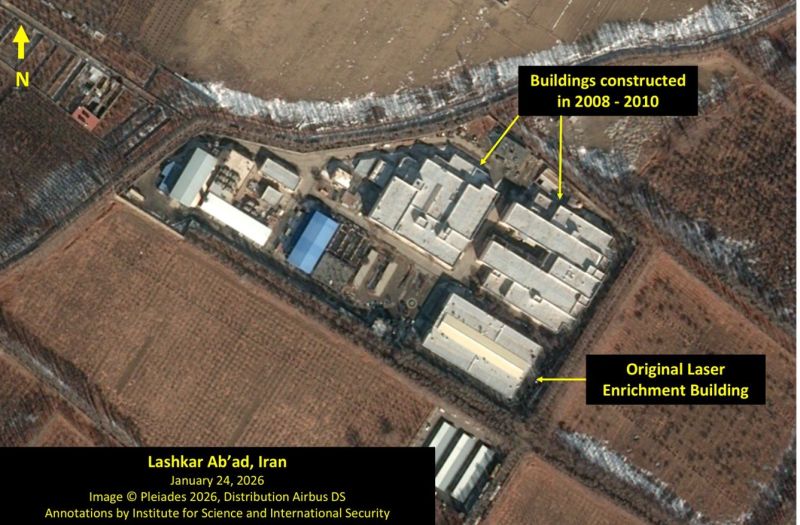
Figure 32. The Lashkar Ab’ad laser site before it was struck.
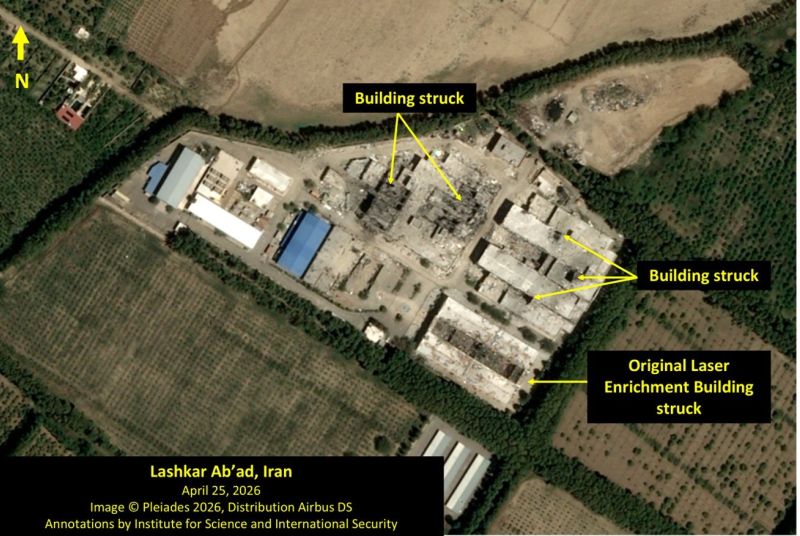
Figure 33. The Lashkar Ab’ad laser site after it was struck.
Sources
[3] Note Verbale dated 9 September 2025 from The Permanent Mission of Israel to the United Nations Office and other International Organizations in Geneva addressed to the Secretariat of the Conference on Disarmament, transmitting Israel’s working paper on operation “Rising Lion” And The Iranian Nuclear Program And Ballistic Missiles Threat*
[14] Francois Murphy,” IAEA chief calls for clarity on disputed section of Iran nuclear deal,” Reuters, September 26, 2017, https://www.reuters.com/article/us-iran-nuclear-iaea/iaea-chief-calls-for-clarity-on-disputed-section-of-iran-nuclear-deal-idUSKCN1C12AN/
[15] https://x.com/IDFFarsi/status/2037572204439777286?s=20